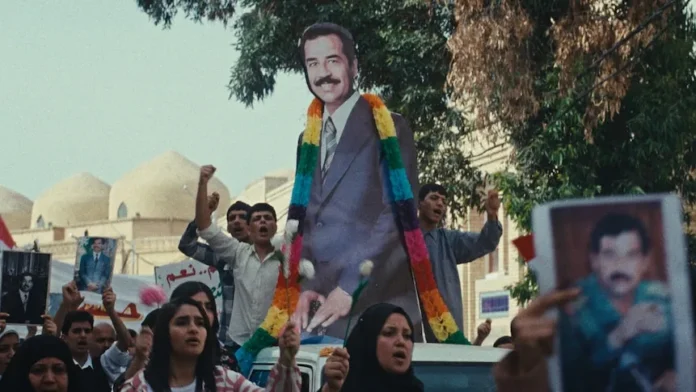
Iraqi filmmaker Hasan Hadi remembers fetching flowers in primary school to celebrate then-President Saddam Hussein’s birthday. He still keeps a photo of himself holding the bouquet during that era, when United Nations Security Council sanctions crippled Iraq following the 1990 invasion of Kuwait.
Childhood Hardships Under Sanctions
Severe shortages of food, medications, and clothing plagued the country. “If you wanted a new pen or pencils for school, you couldn’t get them,” Hadi recalls from his New York City apartment. “Nothing was being imported.” Corruption thrived amid water shortages, yet students drew names from a bowl to decide who brought gifts for Hussein. Hadi’s task proved easier than baking a cake, which required scarce eggs, sugar, and baking soda. Failure risked harsh punishment. “As a child, you sense why this happens but don’t grasp the political depth,” Hadi explains. “You definitely understand severe poverty.”
The President’s Cake: A Bittersweet Debut
These memories inspire Hadi’s poignant debut feature, The President’s Cake. First-time actors Baneen Ahmad Nayyef and Sajad Mohamad Qasem shine as schoolmates Lamia and Saeed. “What they brought to the screen was phenomenal,” Hadi says, achieved without rehearsals through shared stories, games, dancing, and singing.
Lamia, an orphan living with her grandmother Bibi (Waheed Thabet Khreibat) and rooster Hindi in a reed hut by Iraq’s Mesopotamian marshes, must bake a cake. Bibi reluctantly sends her to a potential guardian in Baghdad, but Lamia escapes and enlists Saeed for ingredients. Their adventure encounters kind and cruel adults. “All these characters draw from real incidents involving me or my friends,” Hadi notes. “The film reveals how sanctions alter human nature and society.”
Laughter as Survival in Tough Times
Some antagonists simply struggle to survive. “You need to eat and provide for your family, crossing many lines,” Hadi observes. “The first bribe brings guilt; the second prompts thoughts of purchases. Rebuilding those boundaries takes generations.” Regional conflicts, including tensions with Iran, hinder societal recovery. Comic moments, like a blinded soldier dismissing his bride’s looks, prove essential. “Life becomes intolerable without laughter,” Hadi states. “It’s the key to survival.”
Challenges and Magic of Production
Despite budget constraints, a suspicious government, and shooting on water and in city streets, the film captures stunning locations. “I aimed to transport audiences to Iraq through soundscapes, visuals, and production design,” Hadi says, evoking smells and textures.
Hadi critiques the complex aftermath of Hussein’s fall under false weapons of mass destruction claims. “It feels like someone killed your abusive father—not your brother, but American soldiers and policies contributing to Iraqi deaths.” He envisions a brighter future, including Iraq’s film industry revival after cinemas closed during his youth. Exposed to Godzilla and RoboCop on TV, Hadi later appreciated Tarkovsky, Bergman, and Antonioni. “Films offered my only window to other cultures in isolation,” he reflects. After studying at New York University, he returned home to shoot despite limited support. “The local community backed us amid struggles—that felt magical.”
Award-Winning Defiance
Middle East conflicts delay the film’s Iraqi release, but Hadi anticipates diaspora screenings in Australia. He earned the Cannes Film Festival Best First Feature award, sharing the spotlight as Jafar Panahi won the Palme d’Or for It Was Just an Accident. “It’s a dream,” Hadi says. “Panahi noted the pressure for the next film, but you must defy it and tell your story.”
The President’s Cake arrives in cinemas April 2.