
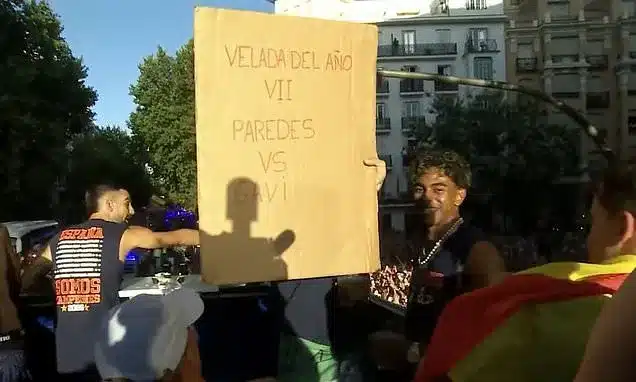
Spain’s young football sensation Lamine Yamal playfully referenced the controversial actions of Argentina’s Leandro Paredes during the recent World Cup final celebrations in Madrid. Following Spain’s 1-0 victory over Argentina in the championship match, a massive crowd of approximately two million fans gathered in the capital to honor their victorious team. However, the match’s conclusion was overshadowed by an incident involving Paredes, who was seen engaging physically with two Spanish players.
Post-Match Incidents Mar World Cup Final
The immediate aftermath of the World Cup final saw Leandro Paredes involved in a heated exchange. He was observed grabbing Eric Garcia by the throat and subsequently pushing Gavi, a substitute. These actions escalated into a large-scale altercation on the field. Lamine Yamal’s gesture during the subsequent victory parade appeared to be a direct, albeit lighthearted, response to Paredes’ confrontation with Gavi.
Yamal’s Playful Jab at the Parade
During the celebratory parade through Madrid, Yamal was seen holding a sign that read: ‘Velada del ano VII: Paredes vs Gavi’. This is a clear reference to ‘Velada del Ano’, a popular celebrity boxing event in Spain, drawing a parallel between the on-field incident and a staged combat. The sign humorously framed the confrontation as a boxing match, highlighting the perceived aggression from Paredes.
Argentina’s Reaction and International Scrutiny
Argentina’s conduct following their World Cup final loss drew widespread criticism. Despite the condemnation, some members of the Argentine squad maintained a defiant stance. Midfielder Enzo Fernandez, who was sent off during the match, suggested that the team had represented their nation admirably, irrespective of the result.
Fernandez stated, “As time passes, you realize there is something much bigger than a result. For years, this group has represented our country in the best possible way. It teaches that competing isn’t just about winning, but about giving everything for the shirt and never giving up. Being part of this group, which has always stood up, competed to the very end, and defended these colors with pride, humility, and commitment, is something I’ll always cherish. I want to thank all the Argentine fans. Thank you for always being there, for supporting us in every match, for your affection, for your unconditional support, and for making us feel at home no matter where we are in the world. Wearing my country’s shirt is the greatest honor of my career, and I will continue to give everything I have every time I’m called upon to defend it.”
Pundits Criticize Argentine Behavior
Several prominent football figures and pundits voiced their disapproval of Argentina’s post-match behavior. Micah Richards described the antics as “embarrassing,” noting that such reactions were not befitting of a team of their caliber. He added, “Paredes is better than that. We all know what it’s like to lose a game but this is not good enough.”
Joe Hart characterized the behavior as “disgusting,” singling out Lionel Messi as the only player on the pitch who displayed class. Wayne Rooney echoed these sentiments, stating, “It doesn’t surprise me. We’ve seen this from Argentina before. It’s just sad, very poor from them. If you lose a game of football, be graceful. It’s a reaction to them being outplayed. Enzo Fernandez has got what he deserves.”
The narrative of Argentina’s aggressive play extended beyond the final whistle. Their performance throughout the World Cup final was described as thuggish, with particular mention of Fernandez’s foul on Pau Cubarsi, which resulted in the defender being sent flying. Paredes also faced scrutiny for a challenge near the penalty box that led to a crucial free-kick for Spain just before extra time.
Statistics from the match indicated a high number of fouls committed by both sides, with Argentina committing 24 and Spain 21. Argentina registered only two shots during the entire game, with their first shot on target occurring in the 117th minute. Alan Shearer commented on the situation, “There’s a way to lose. Too many times we’ve seen that reaction from them. They were trying to win free-kicks and their reaction after full time was terrible. The best team won. It’s a result for football because of the way Spain have played.”
Messi’s Role in On-Field Confrontations
Even Lionel Messi was not exempt from criticism regarding his conduct during the match. Wayne Rooney pointed out an incident where Messi attempted to influence the referee to issue a red card to Spain’s Marc Cucurella late in the game. This occurred during a melee that ensued after Fernandez received his second yellow card.
Cucurella was seen making a gesture with his fingers over his mouth after a verbal exchange with Messi. Messi immediately reacted by signaling for the referee’s attention, seemingly interpreting Cucurella’s action as provocative. FIFA regulations have previously led to dismissals for similar gestures, but in this instance, the referee and VAR did not intervene.
BBC pundits expressed disappointment with Messi’s actions. Joe Hart remarked, “Oh wow! Wow! Yeah, I didn’t enjoy that at all from Lionel Messi. You realise how on top Spain are if even Lionel Messi is reverting to that.” Micah Richards added, “We don’t want to see people getting sent off in a World Cup final for that.”
Wayne Rooney also shared his frustration, stating, “It is desperation. Argentina play like that, we know that’s what they do. But the one thing you want is good sportsmanship and that was sad to see Lionel Messi doing that.” The incident highlighted the intense emotions and pressures present during a World Cup final, with even the most respected players caught up in the heat of the moment.
Conclusion: A Moment of Levity Amidst Controversy
Lamine Yamal’s lighthearted sign at the victory parade offered a moment of levity, playfully addressing the contentious moments of the World Cup final. While the match itself concluded with Spain’s triumph, the post-match events and subsequent reactions from both players and pundits underscored the intense emotions and competitive spirit that defined the tournament.