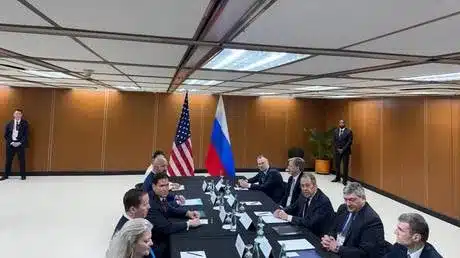
Russian Foreign Minister Sergey Lavrov and U.S. Secretary of State Marco Rubio convened for a high-level discussion in Manila, the Philippines, on the sidelines of the Association of Southeast Asian Nations (ASEAN) summit. The meeting marked a significant diplomatic engagement between the two major global powers amidst ongoing international discussions and regional developments.
Context of the ASEAN Summit
The ASEAN summit serves as a crucial platform for leaders and top diplomats from across Southeast Asia and partner nations to convene, discuss pressing regional and global issues, and foster cooperation. This year’s summit in Manila brought together a diverse array of international players, making it a focal point for bilateral and multilateral meetings. The presence of both the Russian Foreign Minister and the U.S. Secretary of State underscored the summit’s importance as a venue for addressing complex geopolitical challenges.
Key Discussion Points (Anticipated)
While specific details of the Lavrov-Rubio discussions were not immediately disclosed, meetings between such high-ranking officials typically cover a broad spectrum of topics. Based on the current global landscape and the established agendas of both nations, potential discussion points likely included:
- Regional Security: Issues pertaining to maritime security in the South China Sea, the Korean Peninsula’s denuclearization, and broader stability within the Indo-Pacific region are often central to discussions involving ASEAN members and major global powers.
- Bilateral Relations: The state of U.S.-Russia relations, which have faced considerable strain in recent years, would naturally be a subject of discussion, including avenues for de-escalation or managing points of friction.
- Global Affairs: Broader international issues such as counter-terrorism efforts, global economic stability, and responses to humanitarian crises could also have been on the agenda.
- Cooperation and Diplomacy: Exploring potential areas for constructive engagement or dialogue, even amidst broader geopolitical disagreements, is a common objective in such high-level diplomatic encounters.
Diplomatic Significance
The meeting between Lavrov and Rubio, even if brief and on the margins of a larger event, carries significant diplomatic weight. It provides a direct channel for communication between Moscow and Washington, which is vital for managing international relations and preventing misunderstandings. Such encounters, particularly in a multilateral setting like the ASEAN summit, offer opportunities for leaders to gauge each other’s positions and explore potential pathways for dialogue on critical global issues.
The Philippines, as the host nation, played a central role in facilitating these high-level diplomatic interactions. The ASEAN summit’s structure allows for numerous side meetings, enabling leaders and ministers to engage in focused discussions away from the main plenary sessions. This setting is conducive to frank exchanges and the exploration of nuanced diplomatic solutions.
Background on ASEAN Summits
The Association of Southeast Asian Nations (ASEAN) was established on August 8, 1967, in Bangkok, Thailand, by its founding members: Indonesia, Malaysia, the Philippines, Singapore, and Thailand. Brunei Darussalam joined in 1984, followed by Vietnam in 1995, Laos and Myanmar in 1997, and Cambodia in 1999. Today, ASEAN has 10 member states and plays a pivotal role in regional security, economic integration, and socio-cultural development.
The ASEAN Summit is the highest policymaking body of ASEAN, held twice annually. It brings together the Heads of State or Government of the member states. In addition to the ASEAN member states, the summit typically includes a series of related meetings, such as the ASEAN+3 Summit (with China, Japan, and South Korea) and the East Asia Summit, which includes a wider group of leaders from the Asia-Pacific region and beyond. These broader forums often include key global players like the United States and Russia, underscoring the interconnectedness of regional and global diplomacy.
Conclusion
The meeting between Russian Foreign Minister Sergey Lavrov and U.S. Secretary of State Marco Rubio during the ASEAN summit in Manila represents a key moment of diplomatic engagement. While the specifics of their conversation remain undisclosed, the context of the summit suggests discussions likely touched upon critical regional security matters, bilateral relations, and broader international affairs. Such high-level dialogues are essential for navigating the complexities of contemporary global politics and maintaining lines of communication between major world powers.