An ambitious new exhibition at the Australian Centre for Contemporary Art (ACCA) in Melbourne aims to demystify and explore the complex emotion of loneliness through a diverse range of artistic expressions. Titled Are you lonely tonight? I’m so lonesome I could cry, the show, curated by ACCA’s Artistic Director and CEO Myles Russell-Cook and Sophie Prince, draws inspiration from the iconic Elvis Presley song and positions art as a powerful tool for understanding and connecting with feelings that are often difficult to articulate.
Art as a Lens for Understanding Loneliness
The exhibition’s genesis lies in the growing recognition of loneliness as a significant societal issue, a sentiment echoed by Russell-Cook. “We’ve got a loneliness epidemic, but there’s been a strange resistance on the part of even psychiatrists to define loneliness,” he observes. This societal reticence, he suggests, can contribute to a lingering stigma around admitting feelings of isolation. Russell-Cook points to the observation that “loneliness has more often been commented on by songwriters than social scientists,” highlighting the unique capacity of art to make invisible feelings visible.
“Artists make visible feelings that are not visible, that resist definition,” Russell-Cook explains. To this end, ACCA commissioned 11 artists, ranging from emerging local talents to established figures like actor and painter Lucy Liu, to interpret and represent their personal understanding of loneliness. The result is a collection that Russell-Cook believes offers profound insights: “The way I see it, we can understand loneliness far better through art than probably just about anything else.”
A Kaleidoscope of Isolation and Connection
The exhibition presents a wide spectrum of artistic approaches, demonstrating that loneliness is not a monolithic experience but rather a multifaceted emotion, akin to a “kaleidoscope.” Visitors are immediately greeted by Pao Pao, a goldfish belonging to Russell-Cook, who swims in a tank as part of Kelly Yu’s short film Endling, a poignant narrative about the last of a species. Another striking piece is Seth Brown’s Frank, an installation featuring a hot dog endlessly scrolling through images of bread on a phone, searching for a perfect match, a humorous yet relatable metaphor for seeking connection.
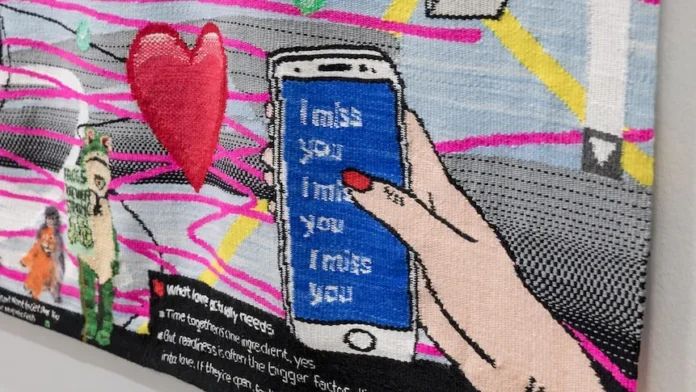
The works span global perspectives and diverse themes. LA-based artist Kayla Mattes contributes Lonely Planet, a nearly seven-meter tapestry woven from memes, internet icons, and online ephemera. This piece delves into the paradox of digital connectivity, where vast networks of communication can paradoxically amplify feelings of isolation. “The loneliness of the screen” is a central theme for Mattes, who sees her work as an archive of fleeting digital moments, transforming them into a tangible, preserved form. The artwork also evolved into a deeply personal exploration of heartbreak, both romantic and existential, reflecting on the current state of the world.
Aotearoa/New Zealand artist Natasha Matila-Smith’s installation, If I die, please delete my Soundcloud, offers a stark portrayal of modern isolation. The audience is invited to lie under a single bed, don the provided headphones, and watch a video of the artist engrossed in her laptop, accompanied by on-screen phrases that capture anxieties of the digital age. This piece, like others in the exhibition, grapples with the internet’s dual role as both a source of distress and a vital platform for connection.
Solitude in Creation and Public Life
The exhibition also frequently touches upon the inherent solitude experienced by artists in their creative process. Lucy Liu, an actor and visual artist, offers a triptych from her Shunga series, which explores the tension between private artistic endeavors and a highly public career. Russell-Cook notes that Liu’s experience exemplifies the “loneliness of walking into a room with a thousand people who think they know you, but they actually know about you.” The deep introspection required for artistic creation often necessitates periods of seclusion, a reality familiar to many artists.
Patrick Pound, an artist and collector based in Melbourne, whose work often involves meticulously arranging found objects, discusses the solitary nature of his practice. “Art itself, it’s often a very solitary pursuit. If it is a game and a puzzle, it’s a game of solitaire,” he states. His installation, The museum of loneliness, features a curated oval of objects, each imbued with untold stories. Pound sought items that could “hold an idea that is normally kept private and is not spoken about much,” likening the process to finding objects that are “saturated” with meaning, much like a peach holding the sun.
Pound emphasizes the “material intelligence” of everyday objects, suggesting they offer lessons and information beyond the scope of artificial intelligence. “Objects are always relatable no matter how daft they are, we take something from them; we’ve all had them or seen them or ignored them before,” he remarks.
Finding Community Through Art
Despite its focus on loneliness, the exhibition ultimately fosters a sense of warmth and shared experience. Russell-Cook highlights contemporary art’s capacity to build community and connection. “When an artist makes a work and they put it into a gallery, they’re inviting a conversation with a stranger.” This exhibition is the first in ACCA’s Art as Emotion series, with future installments planned to explore other emotions, beginning with rage, featuring Yoko Ono. The series aims to channel powerful emotions into constructive dialogue and hopeful outcomes.
“The vulnerability that is in so many of these works, that’s an offering from the artists; they’re inviting you to sit with the work and to feel something, and to connect with them,” Russell-Cook concludes. “If that doesn’t make you feel a little less lonely, then I would be surprised.”
Are you lonely tonight? I’m so lonesome I could cry is on display at the Australian Centre for Contemporary Art until August 30.