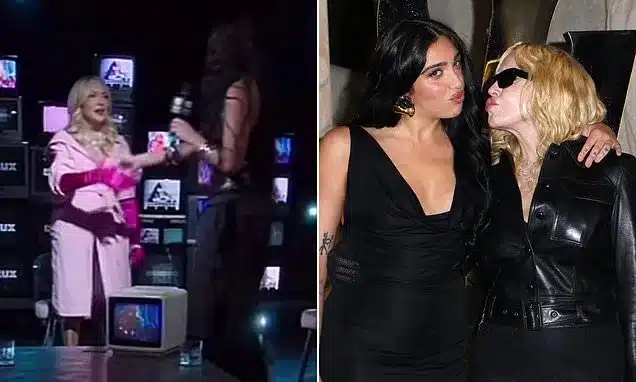
Pop icon Madonna and her daughter, Lourdes Leon, have publicly addressed their complex and often challenging relationship, detailing a dynamic that has been described as both “tense and emotional.” The mother-daughter duo recently collaborated on a new song titled “The Test,” a duet that explores the intricacies of their bond, and spoke about their experiences at a listening party for Madonna’s upcoming album, “Confessions II,” in London.
Exploring a Mother-Daughter Dynamic Through Art
During a conversation at the London event, Lourdes, 29, explained that the idea to collaborate on “The Test” stemmed from a desire to articulate the unspoken aspects of their relationship. “I think that between a mother and a daughter and a relationship it’s kind of – there’s a lot of things that are unspoken,” Lourdes shared. “There’s a lot of love that’s unspoken but also a lot of tension and emotions that are kind of difficult to put into words because it can be so emotional.” She felt that channeling these feelings into art would provide a more accessible avenue for communication, noting that art has always been a significant point of connection for her and her mother.
Madonna, 67, echoed her daughter’s sentiments, describing the creative process as deeply moving. “It was very emotional and there were moments when I felt like crying, hugging her,” Madonna recalled. She acknowledged that while they don’t always see eye-to-eye, their shared passion for creativity and art has consistently served as a unifying force. “It was a very magical moment and we both had to be vulnerable,” she added.
When asked to summarize the experience of working on “The Test” in a single word, Lourdes offered “healing.” This suggests that the collaborative effort provided a cathartic and restorative experience for both of them.
Lyrical Reflections on Fame and Individuality
The lyrics of “The Test” offer a candid glimpse into their individual perspectives. Madonna sings about her attempts to place her daughter on a pedestal, acknowledging that Lourdes “didn’t ask for all the flashing lights.” The Material Girl reflects on her own actions, admitting, “I didn’t think of how it could disturb or how it hurt,” and expressing a wish to have understood the pain she may have caused, particularly concerning the constant public scrutiny Lourdes faced growing up.
Lourdes, in turn, addresses her upbringing in the shadow of her globally famous mother. She describes her mother as a significant influence, shaping her identity and aspirations. However, her lyrics also convey a journey of self-discovery and the establishment of her own identity, seeking to “trace the line of what you have sewn” while simultaneously “[keeping] my own design, make it a landscape, make it alive.” This highlights her effort to honor her mother’s influence while forging her own path.
Past Tensions and the Path to Reconciliation
This public discussion of their relationship follows previous instances where both Madonna and Lourdes have spoken about past difficulties. Madonna had previously mentioned on “The Graham Norton Show” that Lourdes could be “very standoffish” when they began working on the song, suggesting that Lourdes had harbored “a lot of resentment” over the years.
Madonna explained that Lourdes initially approached the collaboration with a degree of reluctance, not wanting to be perceived as leveraging her mother’s fame. “She doesn’t want to be perceived as my daughter, taking advantage of her privilege,” Madonna stated. She described Lourdes as working at her own pace and being respectful of her process, acknowledging her daughter as a talented songwriter with a strong voice.
The breakthrough, according to Madonna, came when Lourdes expressed a realization about her own feelings. “You know what, I realise I’ve been holding onto something,” Lourdes reportedly told her mother, identifying the feeling as potentially “anger” or “resentment.” Madonna elaborated that Lourdes had struggled with these feelings throughout her adolescence, stemming from the unique challenges of growing up as the child of a superstar. Lourdes’s suggestion to write a song together was presented as a potential “healing experience,” allowing each to express their truths.
Independence and Artistic Drive
In earlier interviews, Lourdes has spoken candidly about her desire for independence from her mother’s powerful influence. In a 2021 interview with “Interview” magazine, she described her upbringing as one of “extreme privilege” but emphasized that her family did not offer “handouts.” She explained that her mother, whom she characterized as a “control freak,” aimed to prevent her children from becoming complacent. To establish her autonomy, Lourdes shared that she paid for her own college tuition and first apartment after graduating high school, seeking to escape her mother’s pervasive control.
Madonna, in a 2019 interview with “Vogue,” acknowledged Lourdes’s considerable talent but suggested she might have lacked the same intense drive that propelled Madonna to global stardom. Since embarking on her own career, Lourdes has established herself as a model, socialite, and indie musician, pursuing her own artistic endeavors.
Album Reception and Event Atmosphere
The release of “Confessions II” has been met with positive reviews, with some critics noting it as Madonna’s best-reviewed album since “Confessions on a Dance Floor” in 2005. The listening party itself was designed to immerse guests in Madonna’s world, featuring a dramatic entrance through a sculpture of her legs and creatively themed cocktails named after her hit songs, such as “Spicy Danceteria” and “Into? The Groove Grindr Mule.” Merchandise was also available, with one fan reportedly purchasing a T-shirt emblazoned with the phrase “don’t be a vibe kill.” Following the interview segment, Madonna performed tracks from her new album, accompanied by DJ Stuart Price.
The collaboration on “The Test” and the subsequent public discussion signify a moment of open dialogue and emotional processing for Madonna and Lourdes, highlighting the enduring power of art to bridge generational divides and heal complex family dynamics.