
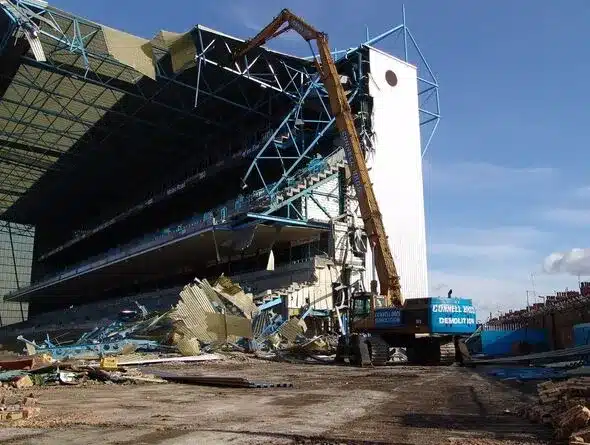
Iconic Manchester Stadium Makes Way for Homes
A storied football ground, which served as the home for Manchester City for eight decades, has been demolished and replaced by hundreds of new residential properties. The stadium, known as Maine Road, first opened its doors in 1923 and its demolition took place between 2003 and 2004. Located in the Moss Side area of Manchester, the venue was a significant landmark in English football history.
The Genesis of a Footballing Hub
Plans for the new stadium were first revealed in 1922. The club had made the decision to leave their previous ground, Hyde Road, as they believed it could no longer be expanded. Compounding this, a fire had significantly damaged the main stand at Hyde Road just two years prior. A site was subsequently chosen in Moss Side, and the construction of Maine Road was completed in approximately 300 days.
A Legacy of Memorable Matches and Records
The inaugural match at Maine Road was held on August 25, 1923. Manchester City secured a 2-1 victory against Sheffield United in front of a crowd exceeding 58,000 spectators. Throughout the subsequent decades, Maine Road evolved into one of English football’s most renowned venues. It played host to significant events, including FA Cup semi-finals, international matches for the England national team, the Charity Shield, and a League Cup final.
The stadium also holds a remarkable attendance record that remains unbroken. In 1934, a staggering 84,569 fans witnessed Manchester City’s FA Cup tie against Stoke City. This figure stands as the highest attendance ever recorded at an English club ground.
Temporary Home for Rivals and Modernization
During a period of necessity, even Manchester United utilized Maine Road from 1945 to 1949. This was due to damage sustained by their own stadium, Old Trafford, during the Manchester Blitz in World War II.
Over the years, Maine Road underwent several transformations. New stands were erected, and older terraces were replaced as football stadiums transitioned towards an all-seater policy, a change prompted by the Taylor Report. By the time of its closure, Maine Road had a seating capacity of just over 35,000.
The Transition to a New Era
The club’s decision to relocate was driven by the construction of the City of Manchester Stadium, now known as the Etihad Stadium, which was built for the 2002 Commonwealth Games. Following Manchester City’s departure from Maine Road, demolition commenced later that year and concluded approximately 10 months later.
While there were discussions about potential alternative uses for the stadium by other sports teams, these plans did not materialize. In 2005, approval was granted for a substantial housing development on the site. A total of 474 homes were constructed on the land where the iconic stadium once stood. The development, named Maine Place, features a public art installation that commemorates the former stadium’s location. Additionally, a green space has been established to mark the original centre spot of the pitch.