
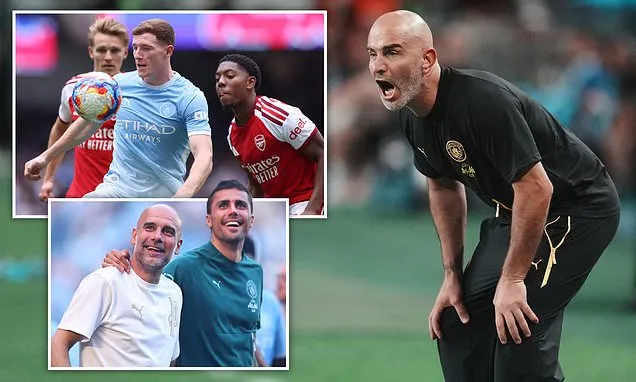
Manchester City’s commanding presence in English football appears significantly altered following the departure of Pep Guardiola, with many suggesting the team has lost its distinctive ‘fear factor’ and ‘aura’. The appointment of Enzo Maresca as his successor presents a monumental challenge, as the club navigates a period of transition without the architect of its modern success.
The Guardiola Era: A Legacy of Dominance
For nearly a decade, Pep Guardiola stood as the undisputed genius at the helm of Manchester City. His arrival in the summer of 2016 marked the culmination of the Abu Dhabi ownership’s ambitious project, which began with their acquisition of the club in 2008. Under Guardiola’s guidance, City not only achieved unprecedented domestic success, including four consecutive Premier League titles – an English top-flight record – but also cultivated a distinct playing style and an aura of near-invincibility.
Guardiola’s influence extended far beyond tactics and team selection. He instilled a relentless hunger for success, a formidable footballing intellect, and a presence that seemed to elevate every aspect of the club. His ability to consistently innovate and find solutions, even in the face of adversity, made Manchester City a formidable opponent, often perceived as having an almost unfair advantage due to his strategic brilliance. This was the ‘end game’ the ownership envisioned, transforming the club into a dominant force.
The club’s structure was meticulously built around Guardiola, with key figures like CEO Ferran Soriano and Director of Football Txiki Begiristain, often described as his lieutenants, reinforcing his vision. Everything at City, from player recruitment to on-field strategy, was deeply intertwined with Guardiola’s philosophy. His departure leaves a void not just in management, but in the very identity of the team.
The Community Shield: A Glimpse of a Diminished City
Recent performances, particularly the Community Shield match against Arsenal, have offered a stark illustration of this perceived decline. While acknowledging the match’s status as a glorified friendly and the fact that some players were still returning from the World Cup, observers noted a tangible shift in Manchester City’s demeanor. The team appeared less cohesive, less dominant, and, crucially, less intimidating.
The characteristic swagger and unwavering confidence that defined Guardiola’s City seemed to be absent. Instead, the team looked ‘reduced,’ struggling to impose their will on an Arsenal side that played with renewed vigor and confidence. This was not just about a bad day at the office; it suggested a deeper loss of identity, a ‘raison d’être’ that was intrinsically linked to Guardiola’s presence. The players, accustomed to his ‘religion’ and his near-omniscient guidance, seemed adrift without their ‘god’ on the touchline.
The departure of key player Rodri, coinciding with this period, further amplified concerns. Rodri, who had been instrumental in City’s success and even shone at the World Cup, was reportedly heading to Barcelona. Losing such a pivotal figure at this juncture was seen as a particularly ill-timed blow.
Enzo Maresca: The Inheritor of an Unenviable Task
The weight of following such a monumental figure falls upon Enzo Maresca. The adage ‘never be the man who follows the man’ seems particularly apt for his situation at the Etihad Stadium. Maresca inherits a team built in Guardiola’s image, now tasked with maintaining its elite status without the man who defined it.
Maresca, described as lacking the commanding presence of his predecessor, faces the challenge of not only implementing his own tactical ideas but also of re-establishing the team’s psychological edge. The perception is that with Maresca on the touchline, City appears ‘smaller,’ and he himself is viewed as a ‘bit-part player’ in a larger narrative of the club’s existential crisis. His role is to manage the transition, but the team’s diminished aura suggests this will be an arduous undertaking.
Arsenal’s Liberation and Renewed Optimism
In stark contrast to City’s apparent struggles, Arsenal showcased a liberated and rejuvenated spirit. After a season that saw them narrowly miss out on the Premier League title, they appeared to have shed their previous mental blocks. The team played with a newfound ‘joie de vivre’ and confidence, a stark improvement from their sometimes-labored performances at the end of the previous campaign.
Manager Mikel Arteta, a former Guardiola assistant, also seemed to exude a lighter demeanor. Key players, like Martin Odegaard, who had perhaps shown signs of pressure late last season, looked revitalized after strong World Cup performances. This suggests a positive trajectory for Arsenal, who, having proven to themselves they can compete for major honors, now appear poised to be formidable contenders throughout the upcoming season.
A New Landscape in English Football?
The shift in Manchester City’s perceived strength, coupled with Arsenal’s apparent resurgence, could signal a significant change in the competitive landscape of English football. While City’s underlying quality and resources remain substantial, the intangible elements of aura, fear factor, and the guiding genius of Pep Guardiola were clearly potent forces. Their absence is being felt, and Enzo Maresca’s tenure will be closely watched as he attempts to navigate this new era.
The realization of what Manchester City possessed in Guardiola may only now be dawning, not just for their rivals, but perhaps for the club itself. The challenge for Maresca is immense: to build upon a legendary foundation while forging a new identity for a team that has, for now, lost its most defining characteristic.