Michael Owen Reflects on England’s ‘Golden Generation’ and Missed Opportunities
Football icon Michael Owen has opened up about the perceived shortcomings of England’s ‘Golden Generation,’ suggesting that the team’s failure to secure major silverware stemmed from tactical issues on the pitch rather than player disharmony or seating arrangements at team meals.
Owen, who will serve as an exclusive World Cup columnist this summer, expressed surprise at recent claims from Rio Ferdinand suggesting a rift with Steven Gerrard. “I can’t wait to see Rio or Stevie and ask, ‘Is this real?'” Owen remarked. “I question my own bloody mind. It’s like, ‘Oh my God, did I have my head up my a***?” While acknowledging the existence of distinct club loyalties, such as a ‘Manchester United table,’ Owen firmly stated that he “absolutely” did not dislike any of his teammates and emphasized the need for honest reflection on why the team didn’t achieve more.
Looking ahead to the current England squad’s pursuit of a second star on their jersey, Owen believes the team of his era, considered by many to be the finest since 1966, has valuable lessons to impart. His own World Cup experiences between 1998 and 2006, all ending at the quarter-final stage, have left him with a significant regret: the dismissal of Glenn Hoddle as manager in 1999.
Hoddle’s Untapped Potential and Eriksson’s Struggles
Owen lauded Hoddle as possessing “the most underused, under-appreciated football brain this country has possibly ever had.” He is convinced that Hoddle at the helm of the ‘Golden Generation’ would have been “a marriage made in heaven,” describing the former manager as “incredible.” In stark contrast, Owen recalled England’s performances under Sven-Goran Eriksson, particularly the 2002 quarter-final defeat to Brazil. “Against the very, very best, we hardly got a kick,” he stated, noting that even against 10 men for the final half hour, the team failed to create opportunities. “It was the most flat effort I’ve ever seen, considering it was a World Cup quarter-final. We just weren’t smart enough.”
Owen refuted the notion that formations were irrelevant, emphasizing the tactical challenges faced. He described situations where “you just think, ‘Oh my word, how do we beat them? They’re set up so well you can’t even see a pass.'” He pointed to his own goals, like the one against Brazil, as benefiting from hopeful long balls and opponent mistakes, rather than intricate build-up play. The rigid 4-4-2 formation and being outnumbered in midfield meant England often resorted to “launch[ing] it to Heskey,” despite the presence of talented midfielders like Gerrard and Lampard.
Comparing the team’s strengths and weaknesses to Brazil’s dominant 2002 side, Owen highlighted the disparity in attacking and defensive talent. “Brazil’s wing-backs were Cafu and Roberto Carlos – ours were Danny Mills and Ashley Cole. Their front three was Ronaldinho, Rivaldo, and Ronaldo – we had Owen and Heskey!” he mused, admitting a sense of overconfidence within the squad. “We were so blasé to think we deserved to win, but I do believe we would have had a better chance with Hoddle.”
Tactical Solutions and Camp Life
Owen suggested that implementing Hoddle’s 1998 3-5-2 formation could have provided a solution. With a wealth of defensive talent available, including John Terry, Sol Campbell, Rio Ferdinand, and Gareth Southgate, Owen envisioned a midfield bolstered by David Beckham, supported by Gary Neville and Ashley Cole as wing-backs, allowing for greater ball retention and game control. “It sounds easy now, yet we made bloody hard work of it.”
However, Owen also acknowledged that Hoddle’s strict approach to camp life was detrimental. He contrasted the “miserable” environment of the 1998 World Cup in France, where players were isolated from families, denied access to mobile phones and golf, and subjected to a monotonous diet under the banner “Chew to Win,” with the more relaxed atmosphere he believes is necessary for modern teams.
Owen welcomed the current manager’s more lenient stance on family visits and player downtime, citing the need for an “odd night out to let your hair down” to avoid burnout. He recalled the extreme opposite experience at the 2006 World Cup in Baden-Baden, where the “WAG circus” overshadowed the team’s preparations. He confessed to instructing his wife to “avoid the wild crowd” and not be pictured dancing on tables, fearing it would impact his game.
Career Defining Moments and World Cup Pressure
That 2006 tournament marked Owen’s last, ending prematurely due to an ACL rupture in the opening minutes of the final group game. “To have it taken away from you in an instant, that is hard to take. Just bang. No warning. Your life turned upside down.”
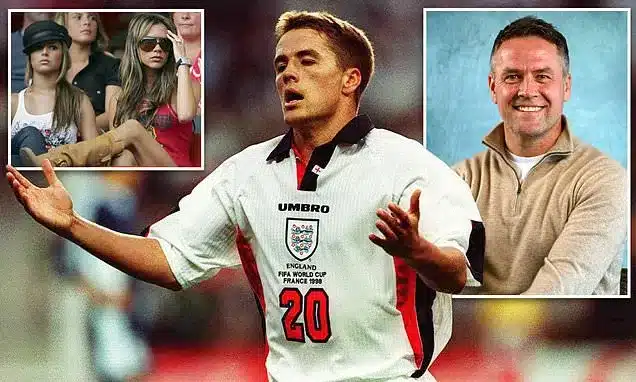
Reflecting on his career, Owen revealed he has never willingly watched his own matches, including his iconic goal against Argentina in the 1998 World Cup. “To quote Roy Keane: it was just my job!” he stated, though he acknowledged the profound impact of that goal, which propelled him from a national to an international star. “Wherever I travel in the world, people say, ‘I remember exactly where I was when you scored that goal.’ It was a moment that transcended the globe.”
Owen also spoke about the immense pressure of playing for England, particularly in penalty shootouts. He described experiencing a level of anxiety before taking a penalty for his country that was far beyond anything he felt at club level. “I had just scored a great goal, I was on top of the world. And I’m still thinking, ‘Oh s***, if I miss this, I’m going to be in a pizza advertisement with a paper bag over my head.’ That’s not normally me. Playing for England just does something different to you.”
Despite the pressure, Owen urged current and future England players to embrace the opportunity. “What an opportunity these players have now. Embrace it. I wish it was me again. Go and show the world what you can do.” He concluded by emphasizing that a World Cup rewards “players brave enough, and managers smart enough, to seize their moment.”