In a nation grappling with pervasive conflict, Myanmar’s traditional martial art, Lethwei, has emerged as a powerful symbol of resilience and a stark contrast to the pervasive violence. Known as the “Art of Nine Limbs,” this bareknuckle combat sport, which permits headbutts and emphasizes knock-out blows, offers participants a unique avenue for self-expression, discipline, and even survival in a country deeply scarred by a protracted civil war.
The ‘Art of Nine Limbs’: Lethwei’s Unique Rules
Lethwei, often referred to as Burmese boxing, distinguishes itself from other martial arts through its permissive ruleset. Unlike many combat sports, Lethwei fighters engage bareknuckle, with only thin gauze wraps protecting their fists. The “Art of Nine Limbs” moniker stems from the recognition of all eight of the body’s striking points – two fists, two elbows, two knees, and two feet – along with the head, as legitimate weapons. This comprehensive approach to striking allows for a dynamic and often brutal display of combat prowess, aiming for decisive knock-out victories.
For many, Lethwei transcends mere sport; it is viewed as a vital form of self-defense. “It’s not only a sport, it’s our art of self-defence,” explained Saw Kyaw Thein Tuu, a 73-year-old veteran fighter and coach. He highlighted the practical application of the art in a conflict-ridden environment: “Guns are of no use if they run out of bullets on the battlefield. This art will help them defend and fight enemies anytime.” This perspective underscores the sport’s deep roots in a culture where self-reliance and the ability to defend oneself are paramount.
A Paradoxical Pursuit of Peace and Discipline
Amidst the turmoil, the discipline and focus required in Lethwei offer practitioners a profound sense of inner peace and self-improvement. Nineteen-year-old Su Luck, who fights under the evocative pseudonym “Peace Prize,” finds solace and purpose in the sport. “I can’t live without fighting. I have never once considered giving up this passion,” she stated. Her dedication is matched by a philosophical outlook on the challenges within the ring. “Even when I take hits to the face, I accept it as my own weakness, as a sign that I still have more to learn,” Su Luck shared. Despite the sport’s inherent aggression, she harbors aspirations beyond the ring, dreaming of becoming a schoolteacher. Her journey highlights the duality of Lethwei, where intense physical combat can coexist with personal growth and a desire for a peaceful future.
Su Luck is considered a rising star in a discipline traditionally dominated by men. Her perspective on perfection is one of continuous learning: “I never think I’ve become perfect.” This mindset is crucial for navigating the demanding nature of Lethwei and its potential for serious injury.
Lethwei’s Heartland and Aspirations
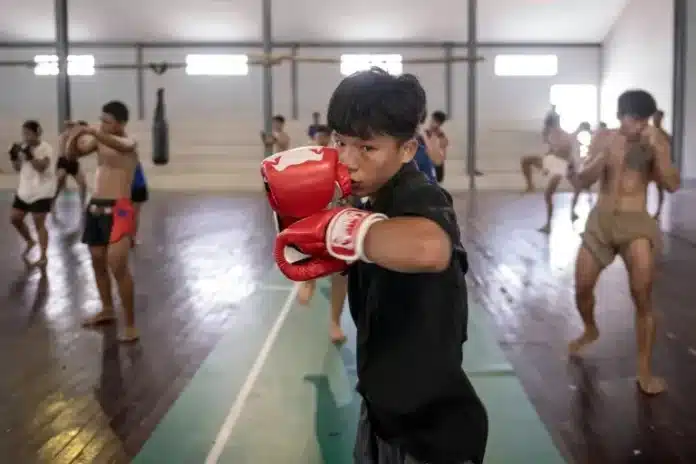
The state of Karen, particularly its capital Hpa-an, is recognized as the heartland of Myanmar’s Lethwei tradition. Here, the sport is not just a pastime but a way of life, deeply ingrained in the local culture. Even as many young people are drawn into the nation’s ongoing civil war, a significant number remain devoted to Lethwei. At the dawn of the monsoon season, over a hundred teenagers and young adults participated in a rigorous training regimen, starting with a dawn run beneath the striking limestone karsts characteristic of the region, before moving to a sports hall for intense sparring sessions.
Coaches from the Karen State Traditional Lethwei Organisation push their trainees to hone their skills, emphasizing powerful jabs and high kicks. The demanding workouts leave the young athletes drenched in sweat, a testament to their commitment. The international success of Burmese-American fighter Joshua Van, the reigning flyweight champion in the Ultimate Fighting Championship (UFC), serves as a significant inspiration. However, Van achieved his UFC title without employing Lethwei’s signature, high-risk moves, which are often prohibited in international mixed martial arts competitions due to their perceived danger.
Navigating Pain, Conflict, and the Future of Lethwei
For fighters like 22-year-old Moe Hein, refining Lethwei’s potent techniques comes with a heavy emotional toll. While dedicated to the sport, he admits to struggling with the infliction of pain on opponents. “In some matches when the other person gets battered, bruised or cut because of me, I don’t feel happy inside,” he confessed. “But since it’s a sport, I’ll try to hit him and he’ll try to hit me too. That’s just how it is.” This sentiment reflects the complex ethical considerations faced by athletes in such a physically demanding discipline.
Myanmar’s civil war, which has raged for years following the 2021 military coup, has resulted in immense loss of life and widespread displacement. According to ACLED, an organization that monitors violent incidents, the conflict has claimed over 100,000 lives. The ongoing instability has also impacted Lethwei, with veteran coach Saw Kyaw Thein Tuu recounting witnessing fatalities within the sport itself. “I have been to 200 matches in my life and there were six people killed,” he stated, adding that these incidents required police intervention. He reflected on the sport’s intensity, suggesting, “Our Myanmar traditional lethwei should not be considered a sport. It should be thought of as another type of game.”
The United Nations reports that over 260,000 people are displaced in Karen state alone, a region contested by various armed factions vying for control of vital trade routes and illicit operations. The journey from Yangon to Hpa-an is marked by numerous checkpoints, underscoring the pervasive insecurity. Despite these harsh realities, Lethwei continues to offer a sense of order and honor for many. “Compared to fighting outside, it’s more honourable to fight in the ring,” Su Luck asserted. “On the stage, when two fighters challenge each other and compete it has more dignity and respect.” This sentiment highlights Lethwei’s role not just as a sport, but as a cultural anchor providing a framework of rules, respect, and honor in a society struggling with widespread chaos.
Conclusion: Lethwei as a Symbol of Enduring Spirit
Lethwei embodies a complex duality within Myanmar: a brutal martial art that demands immense physical and mental fortitude, yet also serves as a source of discipline, self-respect, and a unique form of cultural expression. In a nation besieged by conflict, the “Art of Nine Limbs” offers its practitioners a structured outlet for aggression, a path to personal growth, and a powerful symbol of enduring human spirit. While the sport’s inherent dangers are undeniable, and its practice occurs against a backdrop of national turmoil, Lethwei continues to thrive, offering a sense of honor and dignity to those who step into its unforgiving ring.