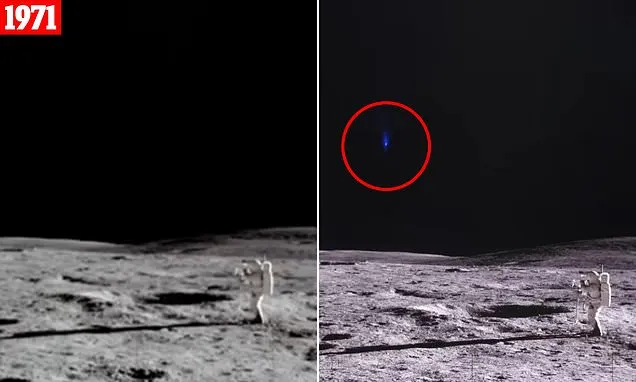
Allegations have surfaced suggesting that NASA may have intentionally altered photographs from the Apollo missions to conceal evidence of an extraterrestrial presence on or around the Moon. These claims, put forth by individuals identifying as whistleblowers and researchers, center on discrepancies between original photographic data and publicly released images, as well as purported astronaut testimonies of encounters and warnings from non-human intelligence.
Alleged Photo Alterations and Anomalies
Physicist Maaneli Derakhshani, who specializes in lunar and Martian surface anomalies, detailed specific instances of alleged image manipulation during an appearance on the “American Alchemy” podcast. Derakhshani presented a case involving an Apollo 14 photograph featuring astronaut Ed Mitchell. According to Derakhshani, one version of the image, sourced from the Lunar and Planetary Institute archive managed by NASA since the 1970s, shows a completely black lunar sky. However, a different version of the same photograph, labeled “March to the Moon” and managed by the Johnson Space Center and Arizona State University, reportedly displays a distinct blue orb in the sky above Mitchell.
Derakhshani further pointed to images from the Apollo 17 mission, the final lunar landing. He described one photograph capturing three solid blue lights in the sky above a lunar hill. When this area of the image is brightened, the lights appear to be connected, suggesting they might be part of a larger object. NASA’s own documentation from the initial release of declassified UFO files in May reportedly noted that a “special investigation” was opened regarding this image, as experts believed the lights could represent a significant physical object in space.
Another Apollo 17 photograph, according to Derakhshani, shows blue, metallic-looking streaks in space. When enhanced, these streaks allegedly resemble insectoid forms with faint trails, indicative of propulsion. While skeptics, such as astrophysicist Neil deGrasse Tyson, have suggested such anomalies could be attributed to cosmic rays or lens flares, Derakhshani argued that the solid, round nature of the lights makes these explanations statistically improbable.
Astronaut Testimonies and Alleged Cover-ups
Beyond photographic evidence, the claims involve alleged testimonies from astronauts themselves. Derakhshani and podcast host Jesse Michels discussed accounts suggesting that astronauts, including Neil Armstrong, the first person to walk on the Moon, received telepathic warnings from extraterrestrials. These messages reportedly advised against returning to the Moon.
Ken Johnston Sr., a former NASA engineer and astronaut trainer who was a backup for the Apollo missions, is cited as a key whistleblower. Derakhshani recounted that Johnston claimed he was instructed to destroy original Apollo negatives containing anomalies. However, Johnston allegedly saved some of these negatives, later sharing copies online. These purported anomalies are presented as evidence of an effort to suppress information about alien encounters.
Michels also referenced alleged statements from Eugene Cernan, the commander of Apollo 17. Cernan reportedly confided in Josen Takano, a Japanese NASA museum curator, that he received a telepathic message during his mission stating, “We don’t really want you here.” Similarly, apocryphal stories suggest Neil Armstrong also conveyed warnings about returning to the Moon, reportedly shared at gatherings with high-level political figures.
Context and NASA’s Response
These allegations emerge as NASA prepares for its Artemis program, which aims to return humans to the lunar surface. Artemis III is tentatively scheduled for 2027, with Artemis IV planned for a lunar landing the following year, marking the first crewed landing since the Apollo era. The long gap since the Apollo missions has fueled various unverified conspiracy theories, including those related to extraterrestrial activity.
Despite the release of extensive photographic and audio data from the Apollo missions, and initiatives like the Trump Administration’s UFO disclosure campaign, NASA and the Pentagon have consistently denied finding definitive proof of alien life. Derakhshani acknowledged that the altered pictures and reported sightings do not constitute conclusive proof of alien visitation but emphasized that the patterns observed are difficult to explain through natural geological processes, camera malfunctions, or common space debris.
Skepticism and Future Implications
The scientific community remains largely skeptical of these claims. Explanations for perceived anomalies often involve natural phenomena, photographic artifacts, or misinterpretations of complex imagery. The rigorous scientific standards required for such extraordinary claims necessitate verifiable, repeatable evidence, which has yet to be presented publicly and accepted by mainstream science.
Nevertheless, the persistent nature of these allegations, coupled with the upcoming return to the Moon, continues to fuel public interest and debate surrounding the possibility of extraterrestrial life and the potential for a historical cover-up. The detailed accounts, if substantiated, would represent a significant re-evaluation of humanity’s understanding of its place in the cosmos and the history of space exploration.
The ongoing exploration through the Artemis program, along with continued analysis of archival data, may eventually shed further light on these enduring mysteries of the Moon and the cosmos.