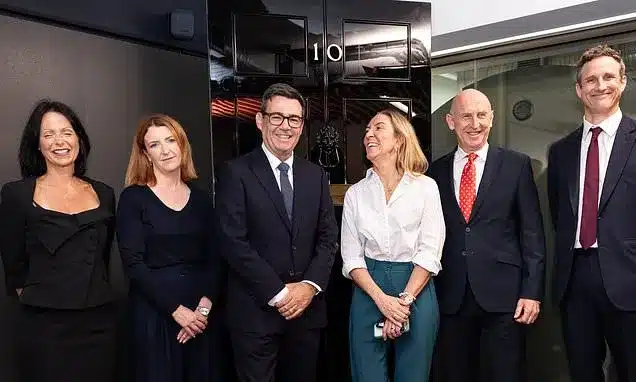
A new temporary office for the Prime Minister, dubbed ‘No10 North’, has officially opened in Manchester, marking a significant step in a plan to decentralize government functions. The initiative, championed by Greater Manchester Mayor Andy Burnham, aims to bring decision-making closer to communities outside of London. However, the launch has been met with scrutiny regarding the associated costs for taxpayers, particularly concerning security and transport arrangements.
Opening of ‘No10 North’ in Manchester
Andy Burnham expressed profound satisfaction at the opening of the temporary ‘No10 North’ office in Manchester, describing it as a momentous occasion. The Prime Minister attended the launch, arriving via a government jet for a short flight from Scotland. He addressed concerns about the financial implications for the public, questioning the necessity of constant travel to London for meetings. The event featured a symbolic replica of the iconic Downing Street door, with notable figures including Cabinet Office minister Louise Haigh, Cabinet Secretary Dame Antonia Romeo, and Chancellor John Healey present.
Burnham, who has previously served as mayor of Manchester and maintains his family home in the city, intends for this move to symbolize a broader effort to devolve power away from Westminster. This ‘King of the North’ initiative is part of a larger vision for regional empowerment.
Temporary Location and Future Plans
Currently, ‘No10 North’ is operating from Heron House, a government building in central Manchester that also houses GCHQ and a register office. The choice of venue has drawn some attention, with a bridal party observed entering the building on the same day as the official opening. This temporary arrangement contrasts with the long-term vision for a permanent Prime Minister’s base in the city.
The permanent site, a five-acre disused retail park acquired by the council in 2017, is slated to become the future ‘No10 North’. The Treasury approved the initial plans for this ‘digital campus’ in March of the current year. However, construction is not yet underway, and the site is not expected to be operational until 2032. This timeline extends beyond the potential date of the next general election.
Security and Financial Scrutiny
The opening of the Manchester office has necessitated a significant increase in security measures. Armed police were visible on duty during Burnham’s arrival, and surrounding areas, including Albert Square, have undergone enhancements. While Downing Street has stated that the operational costs of ‘No10 North’ will be absorbed by existing Cabinet Office budgets and will not incur additional taxpayer expense, independent experts have raised concerns.
These experts warn that the outlay for fortifying the office and maintaining round-the-clock security could be substantial. This contrasts with the typical security arrangements at Downing Street and other government buildings in Whitehall, which are often closed to the public. The use of a government jet for the Prime Minister’s travel to Manchester has also contributed to the debate surrounding the event’s cost.
Burnham’s Vision for Devolution
During his address to staff at the Manchester office, Andy Burnham articulated his deep personal connection to the city and his long-held commitment to regional development. He recalled leaving Manchester as a young graduate in search of employment, highlighting the economic challenges the city faced in the past. Burnham emphasized that the ‘No10 North’ initiative is a tangible example of his commitment to ‘putting power in every postcode’ and enabling local communities to drive their own progress through devolution.
He stated, “I cannot tell you what a proud moment this is. I think this might be the best day of my life.” Burnham elaborated on his personal journey, noting that nearly 35 years prior, he left Manchester as a recent graduate unable to find work in a city that was then struggling economically. He contrasted this with the city’s current revitalization and the broader devolution agenda across England.
Burnham further explained that the project embodies the principle of empowering people to enact change, drawing parallels with Manchester’s own transformation and the ongoing efforts in other English cities through devolved powers. The presence of a replica Downing Street door, designed by artist Jason Bruges in support of the GREAT Britain Campaign, underscored the national significance attached to the initiative, particularly during a National Economic Council meeting held at the new office.
Conclusion
The establishment of ‘No10 North’ in Manchester represents a significant policy move aimed at rebalancing the UK’s governance structure. While the long-term benefits of decentralization are yet to be fully realized, the immediate focus remains on the practicalities of implementation, including the substantial security and logistical considerations. The project’s success will likely be measured not only by its impact on regional development but also by its financial accountability to the public purse.