
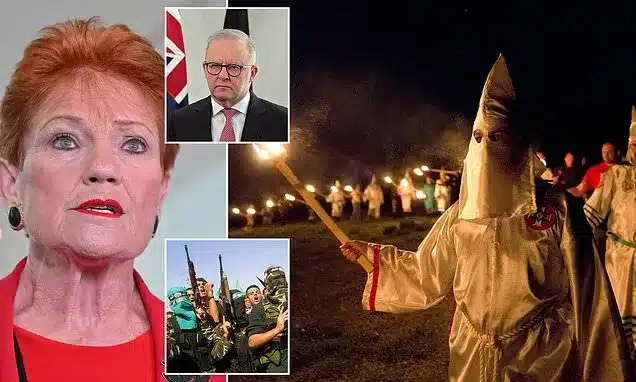
In the complex landscape of political discourse, the endorsement of a politician by an extremist group raises significant questions about accountability and the nature of political association. Recently, comments made by a leader of the Ku Klux Klan (KKK) praising Australian politician Pauline Hanson have sparked debate. This situation, however, mirrors a broader challenge: how to assess political actions and statements when they draw attention from unsavory figures, without unfairly implicating the politicians themselves.
The Pauline Hanson and KKK Connection
A report highlighted that Thomas Robb, identified as a KKK leader in America, expressed approval of Pauline Hanson. In response, Hanson has unequivocally rejected both the organization and its ideology. The core issue at hand is whether such an unsolicited endorsement, particularly from a figure associated with hate groups, should be considered evidence against Hanson or indicative of her own beliefs and affiliations. Critics might attempt to leverage this endorsement to discredit Hanson, but establishing a genuine link requires more than just the extremist’s positive remarks.
For an endorsement to carry genuine weight as criticism, it would necessitate evidence of Hanson actively seeking or welcoming the support, or proof of cooperation, coordination, or a shared organizational agenda. Without such demonstrable links, the approval from an extremist figure remains an external, albeit disturbing, commentary. Attributing the extremist’s views or motives to Hanson based solely on their positive statement risks creating a dangerous precedent.
The Peril of Guilt by Association
The danger in automatically linking a politician to the views of an extremist who praises them lies in the power it grants to fringe elements. Any extremist could potentially “contaminate” a politician’s reputation simply by offering a complimentary statement. This dynamic benefits the extremist, who gains publicity, and potentially sensationalist headlines for news outlets, while forcing the politician into a defensive position of having to disprove an association they have not cultivated.
It is crucial to distinguish between an extremist’s opinion and a politician’s actions or stated beliefs. Pauline Hanson, like any political figure, is subject to scrutiny regarding her policies, public statements, the candidates she supports, and her capacity to implement her agenda. Legitimate criticism should focus on these tangible aspects of her political career. When her statements are objectionable, they should be quoted directly. When her proposals are flawed, the reasons should be clearly demonstrated.
Importing the moral reprehensibility of a white supremacist’s endorsement into an assessment of an Australian politician’s platform requires concrete evidence. The mere fact that an extremist approves of a politician is insufficient grounds for condemnation. This principle applies broadly: agreement on one specific issue does not automatically imply agreement on all other matters.
Broader Implications: Albo and Hamas
This analytical challenge extends beyond the Hanson case. Consider the recent Australian government decision to formally recognize Palestinian statehood. This move was reportedly welcomed by Hamas. By the same logic used to criticize Hanson, one might attempt to link Prime Minister Anthony Albanese (referred to as “Albo”) to Hamas due to their positive reaction to this policy decision. However, such an association would be fallacious.
Hamas praising a decision made by the Australian government does not automatically render the Prime Minister a sympathizer of Hamas. Just as an unsolicited endorsement from a white supremacist does not establish that Pauline Hanson shares their beliefs, an external group’s approval of a government policy does not validate that group’s broader agenda or ideology. These distinctions are fundamental to rational political analysis.
Drawing Necessary Lines
The desire for lower immigration, for instance, does not equate to subscribing to white supremacy. Similarly, supporting Palestinian statehood does not inherently mean endorsing the violent actions of groups like Hamas, such as the slaughter of Israeli civilians. These are elementary distinctions that should be maintained in political commentary.
When these distinctions are abandoned, particularly in the context of scrutinizing Pauline Hanson, it can inadvertently strengthen her political position. It suggests that her critics are willing to lower their analytical standards, which can be perceived by her supporters as evidence of a biased or hostile media environment. This perception can make her narrative of facing unfair treatment more compelling to voters who are already sympathetic to her core messages, such as reducing immigration.
Conclusion: Focus on Substance
Ultimately, politicians should be held accountable for their own words, actions, and policies. If the most potent criticism against a politician relies on the opinions of external figures, especially those with extremist affiliations, it suggests a lack of substantive evidence. The focus should remain on the politician’s direct contributions to the political arena—what they advocate for, what they accept, and what they do. Relying on the pronouncements of others, particularly those whose views are widely condemned, is a weak and potentially misleading form of political critique. Maintaining analytical rigor and focusing on verifiable facts is essential for informed public discourse and fair political assessment.