
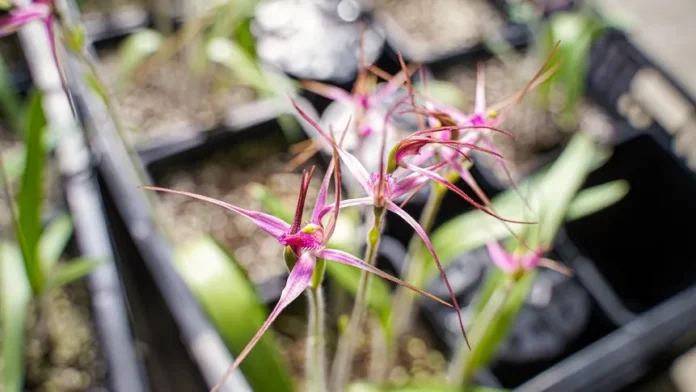
In a carefully guarded, undisclosed location approximately an hour from Melbourne, a critical conservation effort is underway to bolster the population of one of Australia’s most endangered orchids. Scientists and dedicated volunteers are meticulously planting hundreds of young rosella spider orchids (Caladenia rosella) in a bid to secure the future of this critically endangered species, found exclusively in Victoria.
The rosella spider orchid faces immense threats, and its survival hinges on a complex relationship with its environment and a specific pollinator. This painstaking reintroduction program, involving years of laboratory cultivation and the mobilization of numerous volunteers, aims to significantly increase the number of these rare plants in the wild, almost doubling the current known population.
The Challenge of Saving a Critically Endangered Orchid
The rosella spider orchid is classified as critically endangered in Victoria, with its natural habitat restricted to just four small areas in the north-east of Melbourne. As of 2023, scientists counted 655 mature plants, a significant increase from the 120 recorded in 2000, thanks to habitat protection and supplementary planting. However, this number is still considered precarious and insufficient to guarantee long-term survival without continued intervention.
“People don’t realise how much effort and how much money it is to get from a seed to this,” noted Alex McLachlan, a research scientist at the Royal Botanic Gardens Victoria, involved in raising the orchids from seed. “There’s about a thousand in total,” he added, referring to the plants being prepared for release.
The process of bringing an orchid from seed to a viable plant ready for reintroduction is arduous and lengthy. It begins with microscopic seeds that require a specific symbiotic fungal species, typically from the genus Serendipita for spider orchids, to germinate. These fungi are cultivated and introduced to the seeds in sterile laboratory conditions to prevent contamination. The resulting seedlings are then nurtured in growth rooms before being transferred to flasks for several months. Only when they reach a suitable size, often comparable to matchsticks, are they potted. It typically takes another one to two years for these potted plants to become robust enough for planting in their natural environment.
Understanding Orchid Crypticness and Specialization
Orchids, in general, are known for their elusive nature, often referred to as having “crypticness.” Megan Hirst, the project lead and a research scientist at the Royal Botanic Gardens Victoria, explained that most Australian orchids grow hidden under the soil, sometimes showing only a single grass-like leaf. Their survival depends on highly specialized relationships, including specific pollinators and soil fungi.
“They need specialised pollinators. They have to have a relationship with the soil, the fungi. They’re really picky,” Dr. Hirst stated. When conditions are right, these plants produce colourful and fragrant flowers, often evolved to attract a single species of pollinator.
The rosella spider orchid, for instance, emits a musky, sweet scent that attracts the native bee Leioproctus platycephalus. This bee plays a crucial role in pollination by carrying the orchid’s pollen packs, known as pollinia, which attach to its body. Ecologist Linda Riquelme from La Trobe University highlighted the specialized nature of this relationship, noting that while the bee is widespread, the orchid is highly dependent on it.
A Collaborative Effort for Conservation
The current reintroduction event involves dozens of volunteers who have gathered at the secret planting site. These individuals, ranging from members of orchid societies to ecology PhD students and concerned citizens, dedicate their time and effort to carefully plant the cultivated orchids. The operation requires meticulous attention to detail, with volunteers measuring plant length, counting flowers, and recording data for each individual.
“It’s not the end point but, this is the fun bit,” said Dr. Hirst, acknowledging the years of work that precede this stage. “It’s taken years of work to get here.” The collaborative spirit is palpable, with participants working together to place cages over the delicate plants and ensure optimal planting conditions.
The dedication of these volunteers underscores the growing concern for Australia’s threatened flora. “There’s got to be something behind that, and I think we’re tapping into it,” Dr. Hirst remarked, moved by the commitment shown by those present.
The Broader Context of Orchid Extinction Risk
While the rosella spider orchid’s reintroduction is a significant step, it represents just one battle in a larger war against extinction. According to the EPBC Act List of Threatened Flora, over 200 orchid species in Australia are at risk of extinction. Many of these unique plants, like the Canberra spider orchid (Caladenia actensis) and the flying duck orchid (Caleana major), possess extraordinary adaptations and are found nowhere else on Earth.
“It’s trying to rally enough support,” Dr. Hirst emphasized. “If you’re going to do it properly… there are things that need to be done. It’s not like we can just grab a couple of plants and whack them in.” She stressed that while such conservation efforts are “very doable,” they are critically dependent on adequate funding and sustained support to extend this vital work to other threatened species.
The success of this secret planting mission offers a beacon of hope, demonstrating that dedicated conservation efforts, combining scientific expertise with community involvement, can make a tangible difference in saving Australia’s rarest and most vulnerable plant life.