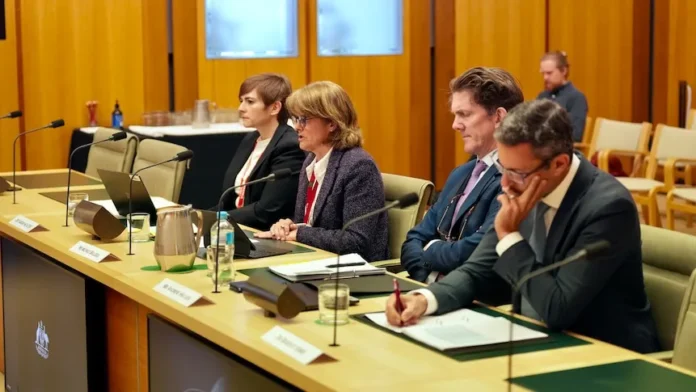
Financial markets are now overwhelmingly betting on an interest rate increase in September, with a 95% probability assigned to a hike following recent commentary from senior Reserve Bank of Australia (RBA) officials. This sentiment has solidified after RBA Governor Michele Bullock, Deputy Governor Andrew Hauser, and Assistant Governors Sarah Hunter and Brad Jones appeared before a parliamentary committee, signaling a potential shift in monetary policy.
RBA Officials Hint at Further Rate Increases
The RBA board is widely expected to approve an increase in the official cash rate to 4.6% at its next meeting. This expectation has been building following public remarks from Deputy Governor Andrew Hauser and Chief Economist Sarah Hunter in recent weeks. While some economists, like former RBA Assistant Governor Luci Ellis, believe November might be a more tactically advantageous time for a hike, the internal sentiment within the RBA board appears to lean towards action sooner.
The recent parliamentary appearance by RBA leadership has convinced many economists that a rate rise at the conclusion of the RBA’s two-day meeting on September 29 is highly probable. Robert Thompson, head of economics and rates strategy at RBC, has revised his forecast, now anticipating a September increase rather than his previous expectation of November. If this occurs, the cash rate would reach a peak of 4.85%, a level not seen since before the significant rate reductions following the 2008 global financial crisis.
Thompson noted in a market update, “September now seems all but a lock, with November becoming the more contentious decision-point.” He also indicated that the first rate cut is anticipated in November 2027. Marcel Thieliant from Capital Economics concurs, stating that a September hike “now looks like a done deal.” However, Thieliant believes this will be the RBA’s final move upward, citing that monetary policy is already restrictive and the bank will likely be cautious about significantly increasing the unemployment rate.
Factors Influencing the RBA’s Stance
Several key factors appear to be shaping the RBA’s current outlook. Deputy Governor Andrew Hauser has articulated a view, echoing prominent US economist Kenneth Rogoff, that the period of historically low long-term interest rates between the Global Financial Crisis and the COVID-19 pandemic was an anomaly. He suggested that a return to a more typical environment of higher long-term rates is underway, implying that current interest rate levels may represent a new normal.
“Interest rates were never going to be zero or near zero for a long while,” Hauser commented, questioning whether public anxiety about current rates stems from a difficulty in adjusting to this “new reality.”
Governor Michele Bullock also provided insights, indicating that the RBA’s tolerance for elevated oil and fuel prices might be diminishing. She observed a growing tendency among businesses to pass on cost increases, suggesting these price pressures are proving more persistent than initially anticipated. “I think there’s much more of an inclination [from businesses] to think that we need to pass through these cost increases because it’s going to be much more persistent,” Bullock stated. She added that these global factors are influencing the RBA’s views, as well as those of other central banks worldwide.
Global Economic Pressures
The RBA’s considerations are taking place against a backdrop of global economic challenges, including persistent inflation in the United States. Supply chain disruptions, potentially exacerbated by geopolitical events and significant investment in artificial intelligence, are contributing to price pressures that interest rate hikes alone may not fully resolve. Bullock highlighted that these global supply shocks, particularly from the Middle East, have worsened the trade-off between inflation and employment.
“And a typical textbook response people say is, ‘Well, it’s a transitory shock. You look through it, and then it will come back.’ But… it’s much harder to look through when there are persistent shocks, because of the risk that will flow through to inflation expectations,” Bullock explained.
Housing Market and Economic Activity
While acknowledging that conditions in the housing market have softened, with potential easing posing a downside risk to economic activity, Governor Bullock downplayed the extent of the decline. She pointed out that current housing prices remain substantially higher than pre-pandemic levels, with prices still around 50% above early 2020 figures.
Assistant Governor Brad Jones, responsible for financial system stability, provided context on the Australian housing market. He noted that the surge in Australian house prices leading up to recent declines was significantly larger than in comparable countries. “If your starting point for that comparison is prior to COVID, the run-up in Australian housing prices exceeds that of large advanced economies, also smaller open economies,” Jones commented. He characterized the recent 5% to 6% declines in Sydney and Melbourne, and 1% to 2% in other states, as “not overly material” given the preceding substantial run-up.
Market Expectations
The consensus among financial markets, as reflected by LSEG data, is a 95% chance of a rate hike in September. Furthermore, there is a 37% probability of another increase in November. This strong market conviction underscores the impact of recent RBA communications, which have signaled a heightened concern about inflation and a potential willingness to use interest rates to manage it.
Conclusion
The convergence of signals from RBA officials, coupled with persistent global inflationary pressures and a robust housing market that has seen significant prior growth, has led financial markets to price in a near certainty of a September interest rate hike. While the long-term trajectory of rates and the potential impact on employment remain key considerations, the immediate focus is on the RBA’s upcoming decision and its implications for borrowers and the broader economy.