
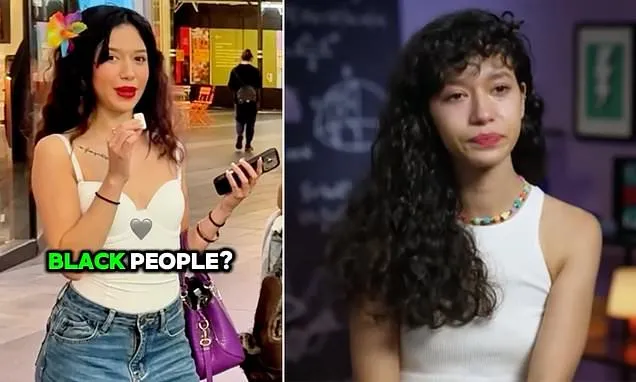
A former Australian reality television contestant has drawn widespread criticism for posting videos on social media that asked strangers on the street to describe Black people using a single word. Angelique Nguyen, who gained recognition on the 2022 season of “Beauty and the Geek,” shared two clips on Instagram this past Thursday and Friday, documenting her street interviews.
In the videos, Nguyen approached individuals and posed the question: “What’s one word you would use to describe black people?” The clips quickly garnered attention in the comments section, with many users expressing dismay and labeling the content as “weird” and “odd.”
“Why would you even ask a question like that?” questioned one commenter. Another user echoed this sentiment, stating, “This is just weird.” A particularly pointed response asked, “How are Black people any different to any other person? Why are we asking this question?”
The backlash intensified when one commenter posted the word “gorilla” in response to Nguyen’s prompt. Reports indicate that Nguyen reacted to this offensive comment with a series of laughing emojis.
Background of Angelique Nguyen
Angelique Nguyen, 25, was a contestant on the 2022 season of “Beauty and the Geek.” During her time on the show, she was noted for her distinctive personality, often describing herself as eccentric and even an “alien.” She told 9Now at the time, “I’m eccentric, I’m not the typical, big-booby beauty. I feel like I’m a rainbow gem that has yet to be discovered.”
Nguyen also expressed a desire for personal growth through the show, stating, “I feel like I’m hidden, and I want to learn more, I want to know more about the world around me and that’s why I’m here. To see if the geeks can teach me that.”
On-Screen Partnership
On “Beauty and the Geek,” Nguyen was paired with a contestant named Samuel Mitchell. Their on-screen dynamic appeared to be positive, with Nguyen commenting on their connection: “I can say I can be myself, and he doesn’t judge me!” However, it appears their friendship did not extend beyond the show, as they no longer follow each other on social media platforms.
Public Reaction and Ethical Concerns
The nature of Nguyen’s street interviews has raised significant ethical questions regarding the potential for perpetuating stereotypes and the impact of such public questioning. Critics argue that soliciting single-word descriptors for an entire racial group can oversimplify complex identities and inadvertently encourage prejudiced responses.
The act of asking strangers to define a racial group with a single word is inherently problematic,” stated Dr. Anya Sharma, a sociologist specializing in media and race relations. “It risks reducing individuals to caricatures and ignores the vast diversity within any population group. When such questions are posed in public spaces, they can also create an environment where harmful stereotypes are normalized or even amplified, especially when the responses are shared widely online.”
Social media platforms, while enabling rapid dissemination of content, also become arenas for immediate public judgment. The comments section on Nguyen’s posts became a focal point for this debate, with many users actively condemning the videos and the premise behind them.
The Role of Influencers and Social Media
The incident highlights the broader conversation surrounding the responsibilities of social media influencers and reality TV personalities. As individuals with a public platform, their content can reach a large audience, making the nature and impact of their posts particularly significant.
“Influencers have a considerable reach, and with that comes a degree of responsibility,” commented media analyst Ben Carter. “Content that touches on race and identity requires careful consideration. While the intention might be to spark conversation, the execution can easily lead to unintended negative consequences, such as the spread of harmful generalizations or the eliciting of offensive remarks, as seen in this case.”
The use of vox pop interviews, a common journalistic technique, can be effective for gathering diverse public opinions. However, when the subject matter is sensitive and the methodology relies on simplistic prompts, the results can be misleading and damaging. The context in which these interviews were conducted and shared – on a personal Instagram account rather than a professional news platform – further complicates the interpretation of intent versus impact.
Broader Societal Implications
Nguyen’s videos tap into ongoing societal discussions about race, identity, and perception. The ease with which a single word can be used to categorize or dismiss individuals is a recurring theme in discussions about prejudice and discrimination.
The incident serves as a stark reminder that even seemingly innocuous questions can have profound implications when dealing with sensitive topics like race. The public’s strong negative reaction underscores a societal expectation for greater awareness and sensitivity when engaging with such subjects, particularly in the digital age where content is instantly shared and scrutinized globally.
As the discourse continues online, the focus remains on the ethical considerations of content creation and the potential for social media to either foster understanding or perpetuate harmful stereotypes. The backlash against Nguyen’s videos suggests a growing public intolerance for content that is perceived as insensitive or potentially damaging to intergroup relations.