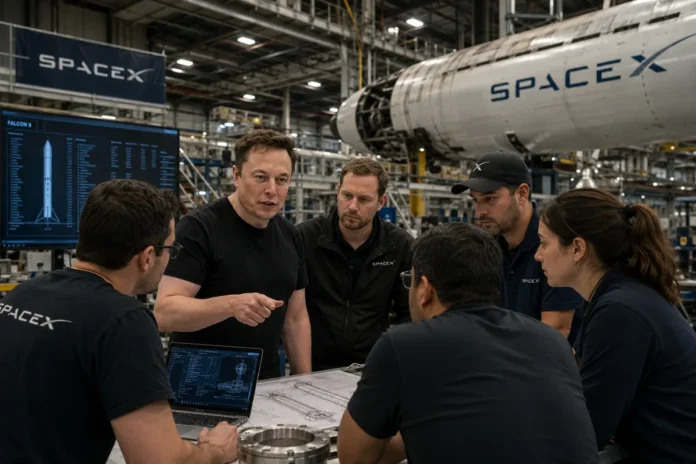
SpaceX’s stock experienced a notable downturn on Monday, continuing a downward trend and approaching its initial public offering (IPO) price of $135. The shares fell by more than 4%, trading around $139. This decline occurred within a broader context of pressure on U.S. equity markets, which were influenced by geopolitical developments.
Market Headwinds and Geopolitical Factors
The broader market saw a dip, with the S&P 500 losing 0.4% and the Nasdaq Composite falling 1%. The Dow Jones Industrial Average also registered a slight decrease. A significant factor contributing to the market’s unease was President Donald Trump’s announcement of a reinstated blockade on Iranian shipping through the Strait of Hormuz. This geopolitical development added to existing market pressures, impacting investor sentiment across various sectors.
Analyst Confidence Remains High
Despite the stock’s recent performance, financial analysts continue to express a positive outlook on SpaceX’s long-term prospects. Douglas Harned, an analyst at Bernstein, reaffirmed a ‘Buy’ rating on the company’s stock, setting a price target of $239. This target suggests a potential upside of over 70% from the current trading levels.
SpaceX’s Competitive Edge in Reusable Rockets
Harned highlighted that SpaceX’s established leadership in reusable rocket technology and launch services remains a key strength. This is particularly relevant in light of recent advancements by competitors, such as China’s successful landing of a Long March 10B rocket booster. While acknowledging China’s rapid progress and ambitious space goals—including plans for over 200,000 low-Earth orbit satellites and a lunar research station—Harned pointed out that China has yet to demonstrate operational reusable rocket capabilities.
In contrast, SpaceX has been pioneering reusable rocket technology for nearly a decade, successfully reusing its Falcon 9 boosters extensively. The company completed 165 launches in the previous year, underscoring its operational experience. Furthermore, Harned noted that while the Long March 10’s reusability is limited to its first stage, SpaceX’s Starship is engineered for full reusability. The successful deployment of Starship could significantly reduce launch costs and increase operational frequency, further solidifying SpaceX’s market position.
Ambitious Growth Projections and Starlink
Several Wall Street firms have outlined highly optimistic long-term scenarios for SpaceX, largely driven by the anticipated success of its Starlink satellite internet constellation and its potential role in AI infrastructure. Raymond James, for instance, has set a high price target of $800 per share. Citigroup presented an even more ambitious bull-case scenario, valuing the company at approximately $12 trillion.
Stock Performance Post-IPO
Monday’s dip represents a partial reversal of the strong gains SpaceX experienced in its initial trading days following its Nasdaq debut on June 12. The stock had initially surged over 30% in its first few sessions. However, it has since pulled back, trading below its $150 debut price and now nearing its $135 IPO price. This volatility is attributed to the company’s high valuation expectations, ambitious growth forecasts, and relatively short trading history, making its shares sensitive to shifts in investor sentiment.
Nasdaq-100 Inclusion and Passive Investment
SpaceX’s recent inclusion in the Nasdaq-100 index has attracted a new stream of passive investment. Funds that track the benchmark index have adjusted their portfolios to incorporate the company’s stock. This inclusion was facilitated by a revision in Nasdaq’s rules governing newly listed companies, allowing SpaceX to join the prestigious index within a month of its public offering. The move by the exchange acknowledges the company’s significance in the space and artificial intelligence sectors.
Future Outlook
While short-term market fluctuations and geopolitical events can impact SpaceX’s stock price, the company’s fundamental strengths in reusable rocket technology, its ambitious Starlink project, and its potential in emerging fields like AI infrastructure continue to underpin a positive long-term outlook among many analysts. The company’s ability to execute on its ambitious goals, particularly with the development of Starship, will be crucial in determining its future valuation and market leadership.