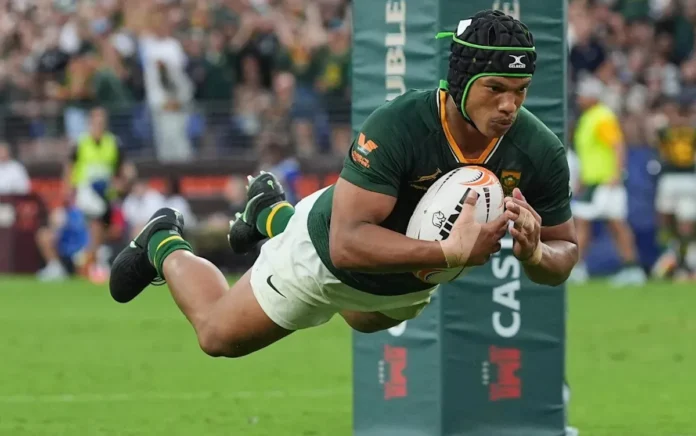
South Africa secured a 3-1 series victory over New Zealand in the highly anticipated ‘Greatest Rivalry’ series, concluding with a decisive 43-26 win in Baltimore, USA. The Springboks demonstrated their championship pedigree by overcoming an early deficit in the series to dominate their fierce rivals, ultimately claiming the coveted trophy.
Springboks Seal Series Dominance in Baltimore
The final match of the series, held at Baltimore’s M&T Bank Stadium, saw South Africa overcome New Zealand with a commanding performance. Despite a late consolation try from B. Barrett for the All Blacks, the Springboks had already established an insurmountable lead, with tries from Hanekom and Arendse effectively sealing the series win. The match concluded with a final score of 43-26 in favour of the Springboks.
The series win marks a significant achievement for the Springboks, particularly after dropping the opening Test. Captain Siya Kolisi expressed his gratitude to the South African supporters, emphasizing the team’s motivation to play for their nation. “I want to thank every single South African here in this stadium and back home,” Kolisi stated. “It was a special week, to see you guys come out in numbers we are so grateful. We do it for you every time. Thank you to the New Zealand fans for coming to our country. We go hard at each other on the field but we have so much respect for each other.” He also highlighted the influence of head coach Rassie Erasmus in connecting the team to their roots and driving their performance.
Match Breakdown and Key Moments
The match in Baltimore was a dynamic affair, with both teams showcasing their attacking prowess. South Africa established an early lead through a penalty and a try from De Allende, but New Zealand responded with a well-worked try from captain Codie Taylor. The first half remained tightly contested, with South Africa holding a narrow 17-14 lead at the break, despite a remarkable 30-phase try from Will Jordan for the All Blacks just before halftime.
The second half saw the Springboks assert their dominance. Tries from Marx and P.S. du Toit, coupled with conversions from Van den Berg, extended their lead. While Ethan Blackadder managed to score a try for New Zealand, bringing them closer, South Africa’s resilience and clinical finishing proved too much. Kurt-Lee Arendse’s sensational solo try from inside his own half further solidified South Africa’s advantage, and Cameron Hanekom’s late score put the game beyond doubt.
First Half Insights
The initial half was characterized by intense pressure from both sides. South Africa’s early discipline and efficiency in converting penalties and capitalizing on opportunities, particularly from set pieces, gave them an edge. New Zealand, while showing flashes of brilliance and enduring long periods of possession, struggled with discipline and often gifted the Springboks advantageous field position. The breakdown saw significant battles, with South Africa’s pack demonstrating their strength.
Second Half Turnaround
Following the interval, South Africa significantly increased their intensity. Their forward pack, including the impactful ‘Bomb Squad’ replacements, began to exert consistent pressure. The Springboks’ ability to convert sustained pressure into points, particularly through mauls and powerful drives close to the try line, proved decisive. While New Zealand fought back valiantly, South Africa’s tactical adjustments and ruthless execution in the final third secured their victory.
Series Performance Analysis
The ‘Greatest Rivalry’ series lived up to its billing, offering a compelling contest between two of rugby’s titans. New Zealand claimed a strong victory in the first Test, but South Africa responded with characteristic resilience, winning the subsequent three matches. This demonstrated the Springboks’ ability to adapt and overcome challenges, a hallmark of their world-champion status.
New Zealand captain Codie Taylor acknowledged the Springboks’ superior performance in crucial moments. “We talk a lot about moments during the week and South Africa have stacked a few more moments than us over these weeks,” Taylor commented. “We had some opportunities that we let them off the hook on. Full credit to them, they are a great side and proved why they are world champions.” Despite the series loss, Taylor expressed pride in his team’s effort and their growth throughout the tour, viewing it as a positive stepping stone for the future.
Statistical Overview
Possession was nearly even, with South Africa holding a slight 51%-49% advantage, mirrored in territory. However, South Africa’s efficiency in converting pressure into points was evident. Key statistics from the final match included:
- Possession: South Africa 51% – 49% New Zealand
- Territory: South Africa 51% – 49% New Zealand
- Handling errors: South Africa 9 – 11 New Zealand
- Turnovers conceded: South Africa 13 – 12 New Zealand
- Penalties conceded: South Africa 9 – 9 New Zealand
- Tackles made: South Africa 163 – 178 New Zealand
- Tackles missed: South Africa 32 – 30 New Zealand
Looking Ahead
The series conclusion in the United States underscores World Rugby’s ambition to expand the sport’s reach in the American market. The successful staging of this high-profile fixture is seen as a significant step towards hosting major international matches in the US, potentially paving the way for future Six Nations fixtures. For both South Africa and New Zealand, the series provided valuable insights and preparation ahead of future international competitions.
Man of the match Morne van den Berg shared his elation after the victory: “It is so emotional and it has been a massive honour to play for this team, this jersey, this country, my family. I am so proud of the boys for pulling it through. It is always good to score tries and a bit more special in this game. You dream of this as a kid in the garden. I am speechless.”