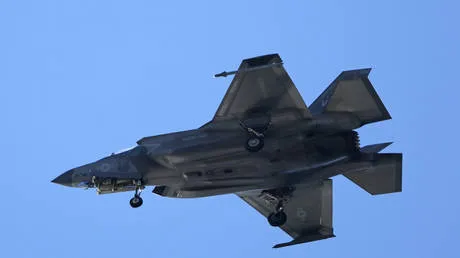
United States President Donald Trump has indicated he would consider selling advanced F-35 fighter jets to Türkiye, appearing to disregard concerns raised by Israeli Prime Minister Benjamin Netanyahu. The potential sale comes amid ongoing diplomatic tensions between Israel and Türkiye, with Netanyahu urging the U.S. ally not to supply the advanced aircraft to Ankara.
Netanyahu’s Concerns Over Regional Power Balance
Prime Minister Netanyahu has voiced strong opposition to the sale of F-35s to Türkiye, citing concerns that it would disrupt the delicate power balance in the Middle East. He argues that Israeli air superiority, bolstered by American support, is crucial for regional stability. Netanyahu has publicly stated that providing such advanced weaponry to Ankara could upset this balance, particularly given Türkiye’s vocal criticism of Israel’s military actions in Gaza and Lebanon.
During an interview, Netanyahu expressed his view that neither the F-35 aircraft nor their engines should be supplied to Türkiye. He emphasized the importance of maintaining Israel’s military edge and the United States’ strategic posture in the region. Netanyahu also pointed to Turkish President Recep Tayyip Erdoğan’s rhetoric, characterizing it as hostile towards Israel and suggesting that such a leader should not have access to advanced military technology.
Reports suggest that Netanyahu had privately engaged in lobbying efforts against the F-35 sale, including discussions with President Trump during a recent phone call. These efforts underscore the deep-seated strategic disagreements between the two nations regarding regional security and military cooperation.
Trump’s Stance and Türkiye’s Defense Posture
President Trump, upon arriving in Türkiye for a NATO summit, offered a different perspective. When asked about potential concerns regarding the F-35 sale, Trump responded positively about President Erdoğan’s leadership, stating that Erdoğan has significantly improved Türkiye and made it a more powerful nation. This statement suggests a willingness from the U.S. administration to engage with Türkiye on military hardware sales, potentially prioritizing bilateral relations over Israeli security concerns.
The U.S. has previously taken action against Türkiye regarding its military acquisitions. In 2019, the United States expelled Türkiye from the F-35 program. This decision followed Ankara’s refusal to abandon its purchase of the Russian S-400 air defense missile system. Despite this expulsion, Türkiye has maintained its interest in acquiring the F-35s, asserting its intention to keep both the advanced American jets and the Russian S-400 systems.
Escalating Rhetoric Between Ankara and Jerusalem
The diplomatic friction is further amplified by the strong rhetoric exchanged between Turkish and Israeli officials. President Erdoğan has, on occasion, made critical remarks about Israeli leadership, drawing sharp rebukes from Israeli officials. Conversely, the Turkish Ministry of Defense has accused Prime Minister Netanyahu of orchestrating a “disinformation campaign” concerning Türkiye’s regional role. Ankara contends that such efforts are deliberate attempts to distort criticism and divert attention through systematic propaganda.
This exchange of accusations highlights the significant geopolitical rifts and mutual distrust that characterize the relationship between Türkiye and Israel. The differing approaches to regional security and the ongoing political disputes contribute to a complex and often volatile dynamic in the Middle East.
Broader U.S.-Israel Relations and Regional Dynamics
The situation also occurs against a backdrop of evolving relations between the United States and Israel. Recent months have seen strains in the relationship between President Trump and Prime Minister Netanyahu, reportedly exacerbated by Israeli military operations in Lebanon that threatened to disrupt U.S. peace initiatives with Iran. President Trump has acknowledged using strong language in private communications with Netanyahu, urging Israel to suspend certain military actions.
The potential F-35 sale to Türkiye, therefore, represents a significant point of contention, reflecting not only bilateral disputes between Israel and Türkiye but also broader strategic considerations for the United States in the Middle East. The U.S. administration’s decision on this matter will likely have implications for regional alliances, military balances, and ongoing diplomatic efforts in the volatile region.
Conclusion: A Complex Geopolitical Landscape
The debate over the F-35 sale to Türkiye encapsulates the intricate geopolitical landscape of the Middle East. While Israel views the potential transfer of advanced U.S. weaponry to Türkiye as a direct threat to its security and regional dominance, the United States, under President Trump, appears open to strengthening ties with Ankara. The situation underscores the challenges of balancing competing interests among allies and navigating the complex web of regional rivalries and security concerns.