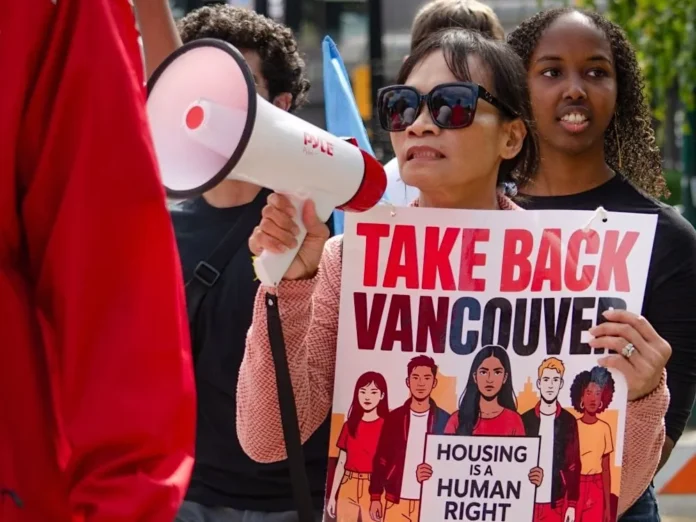
A significant increase in political engagement by Unite Here Local 40 has coincided with a contentious period at Vancouver City Hall, as council grappled with its “villages plan” and a proposal for a trio of towers, one of which would be the province’s tallest. The hotel workers’ union has been actively mobilizing supporters to gather outside City Hall and participate in public hearings, voicing opposition to several major hotel projects and advocating for affordable housing and improved wages.
Union Mobilizes for Affordability and Wages
Unite Here Local 40 states its heightened activity stems from critical issues of housing affordability and wages impacting its members and their families. Michelle Travis, a union organizer, explained that members are increasingly being priced out of Vancouver, making City Hall a crucial venue for their concerns. “We’re not against more hotels per se, but we do have a problem with this gold rush to hotels,” Travis stated. “We think it’s kind of the wrong priority for the city.”
The union, which represents hospitality workers across British Columbia, is part of an international organization with 300,000 members in Canada and the United States. While the union highlights successes in negotiating high wages, such as room attendants at prominent downtown Vancouver hotels set to earn over $37 per hour by 2027, many members feel their current earnings are insufficient to support families in the city.
Jennie Padilla, a cook at Vancouver International Airport, shared her struggles: “I’m hoping that they’re gonna listen to us as people who are suffering. They need to focus on us, not on businesses.” She pointed to the Metro Vancouver living wage, estimated at $27.85 per hour by the BC Society for Policy Solutions and Living Wage BC, as a benchmark for essential affordability.
Janet Budd, a long-time Vancouver resident and hotel worker, expressed frustration over the potential loss of affordable housing. “I’m upset with city council. They’re ripping down affordable housing just to build new condos that I’ll never be able to live in,” she said, referring to her own situation of facing eviction due to demolition for new development.
Accusations of Filibustering and Foreign Interference
The union’s extensive participation in public hearings has drawn criticism from some city councillors, particularly those from the ABC Vancouver party, which holds a majority on council. Hundreds of individuals registered to speak at hearings concerning the “villages plan” and a large downtown development project by Holborn, with many speakers identified as being from Unite Here and some admitting to being from the United States.
This led Vancouver Mayor Ken Sim to accuse the union of “foreign interference” and to call for amendments to the Vancouver Charter to restrict public hearing participation to Canadian residents. Councillors like ABC’s Brian Montague suggested that some speakers were using translators to extend their speaking time, thereby “filibustering” the proceedings. ABC Coun. Sarah Kirby-Yung questioned the fairness of American participants taking up time that could be used by local residents.
Unite Here Local 40 president Zailda Chan, speaking through a translator at one hearing, urged council to impose stronger requirements on the Holborn project to ensure the delivery of planned social and affordable housing units. “Without binding answers, nearly all risk falls directly on the people least able to absorb it,” Chan stated.
Expert and Councillor Perspectives
Experts suggest that while the union’s tactics may be unconventional, they represent a legitimate form of advocacy. Peggy Nash, a former labour official and NDP MP, views participation at City Hall as a powerful communication tool, akin to purchasing newspaper ads for those with financial resources. “It’s a way of public communication,” Nash said. “Bringing people out to convey a message is also a very powerful way of communicating.” She added that such actions highlight members’ affordability concerns and demonstrate the union’s organizational strength to employers.
Vancouver Coun. Pete Fry acknowledged the palpable frustration surrounding affordable housing delivery, noting the significant disconnect between median incomes and market housing rates. He suggested that residents are right to pressure City Council, especially with an upcoming municipal election. “Folks are right to be focused on those questions because I think those are decisions that shouldn’t just get a rubber stamp,” Fry commented.
David Hannah, a business professor at Simon Fraser University, noted that while union involvement in politics is normal, Unite Here Local 40’s public-facing campaign is unusually prominent. He suggested the strategy might be intended to pressure developers and City Hall, indirectly influencing hotel employers during collective bargaining. “This to me feels a little bit like they’re using developers and city hall to try to influence them and try to get them to put pressure on our employers,” Hannah observed.
Union’s Broader Campaign and City Council Decisions
The union’s actions extend beyond public hearings. Unite Here Local 40 has filed for a judicial review of City of Vancouver bylaw amendments that permit hotels to exclude a larger portion of floor area from density calculations. They have also joined the “Take Back Vancouver” campaign, advocating for affordable housing, subsidized transit, and better childcare.
Throughout July, the union organized rallies against various developments, including a casino expansion, the demolition of an apartment building (Myron Manor) for a hotel, and Holborn’s mixed-use project. Travis highlighted that a union member resides at Myron Manor, underscoring the personal impact of these decisions.
Despite the union’s opposition and advocacy, Vancouver City Council recently approved the Holborn hotel and housing project, rezoned the Myron Manor property, and voted against the villages plan. Peter Waldkirch, a Vancouver-based lawyer and housing advocate, noted that while the labour movement has a history of political endorsement, Unite Here Local 40’s direct involvement in public hearings and attempts to block development is a novel approach. He expressed disagreement with the union’s stance on the villages plan, which he believes is crucial for needed rental housing, and questioned how opposing hotel development directly advances affordable housing goals.
Travis reiterated the union’s motivation: “More people are kind of grappling with the affordability crisis and we think there’s a moment here.” She expressed concern that the city is approving hotels and market rentals that members cannot afford, especially as Vancouver falls short of its non-market rental targets. The union perceives a misalignment between City Hall’s priorities, which they feel favour hotel developers over everyday workers, and the needs of its members.
The union has invited Mayor Sim to discuss his concerns about foreign interference, though a response is pending. The ongoing debate underscores the complex interplay between development, housing affordability, and labour advocacy in Vancouver.