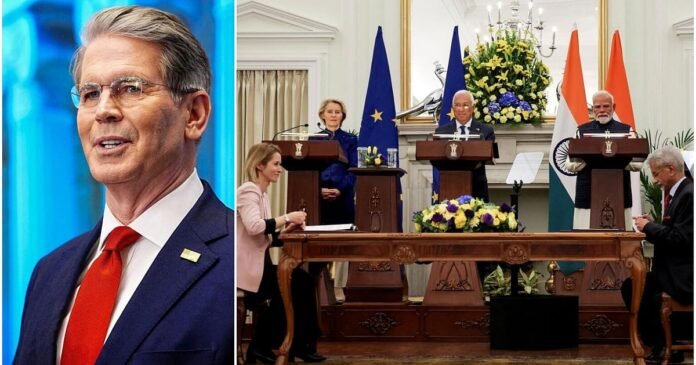
Treasury Secretary Scott Bessent expressed strong disappointment over the European Union’s recent trade agreement with India, suggesting that economic interests have taken precedence over support for Ukraine in the ongoing conflict.
New EU-India Trade Agreement Raises Concerns
The landmark trade deal, finalized on Tuesday, aims to eliminate or reduce tariffs on 96.6% of traded goods by value. Economic projections indicate the agreement could double EU exports to India by 2032, potentially generating duty savings of 4 billion euros ($4.8 billion) for European businesses.
US-EU Relations Under Strain
Bessent criticized European nations for purchasing refined products from India made with sanctioned Russian oil supplies. He highlighted that Brussels had refused to align with Washington’s 25% tariff policy on Indian goods last year, apparently due to ongoing trade negotiations.
‘Every time you hear a European talk about the importance of the Ukrainian people, remember that they put trade ahead of the Ukrainian people,’ Bessent stated during a recent economic briefing.
Broader Trade Tensions Emerge
The situation has become more complex amid President Trump’s recent threats to increase tariffs on certain European countries, although these threats were subsequently withdrawn. Adding to the tension, implementation delays persist regarding previously agreed-upon tariff reductions from the July framework trade deal between the US and EU.
South Korea Trade Developments
In a related development, the US has increased duties on South Korean imports from 15% to 25%, citing delays in implementing their bilateral trade agreement. Bessent defended this action as ‘helpful to get things moved along,’ emphasizing the need for South Korean parliamentary ratification.
South Korean officials are scheduled to meet with US trade representatives in Washington to address these concerns, with President Trump expressing optimism about reaching a resolution, though specific details remain undisclosed.
Looking Forward
The Treasury Secretary had previously indicated the possibility of removing the additional 25% US tariffs on India, contingent upon a significant reduction in Indian imports of Russian oil. This developing situation continues to highlight the complex interplay between international trade relationships and geopolitical considerations.