
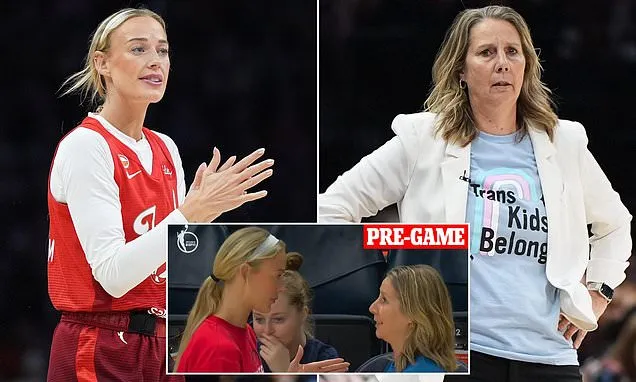
Minnesota Lynx coach Cheryl Reeve has addressed her on-court conversation with Indiana Fever forward Sophie Cunningham, which took place amidst protests and crowd boos directed at Cunningham in Minneapolis. The interaction occurred before the Lynx defeated the Fever 108-100. Cunningham has recently become a focal point in discussions surrounding transgender athletes in women’s sports following her public statements on the matter. Reeve herself made a visible statement by wearing a t-shirt that read ‘Trans kids belong’ during the game.
On-Court Dialogue and Shared Platforms
Following the game, Reeve spoke about the significance of her discussion with Cunningham. “I think it’s great,” Reeve stated, emphasizing that both athletes recognize the influence of their public platforms. “We both talked about wanting to, more than anything, educate.” Reeve suggested that while they might have differing views on some issues, the core of their conversation revolved around understanding and respectful dialogue. “There are some things that we have in common, and maybe some things you differ on, just like any issues. I think it’s how you handle things. It was nice to be in person, for sure.” While Reeve did not disclose the full extent of their private conversation, she had previously articulated her perspective on the broader issue before the game.
Coach Reeve’s Stance on Inclusion
Reeve, who also holds a coaching position with the U.S. Women’s National Basketball Team, expressed her commitment to an inclusive environment. “I come from a space of inclusion,” she said. Reeve also voiced her concern about the framing of the debate, stating, “The narrative that I think is problematic is to suggest that transgender athletes are the biggest problem in women’s sports.” She elaborated, “This is what’s bothersome. There is a faction of people in our country that are making this a massive issue.” Reeve’s comments highlight a perspective that challenges the notion that transgender participation is a primary concern within women’s athletics, suggesting it is being disproportionately amplified.
Context of Transgender Athletes in Sports
It is noteworthy that the WNBA currently does not have any players who were assigned male at birth. Similarly, there have been no such players in the league’s history. At the collegiate level, the presence of transgender athletes is also minimal. NCAA President Charlie Baker estimated in 2024 that fewer than 10 transgender student-athletes were competing across all NCAA sports. This statistical context underscores Reeve’s point about the scale of the issue within professional and collegiate women’s sports.
Protests and Clashes Outside the Arena
The tensions surrounding Cunningham’s views extended beyond the court, manifesting in significant demonstrations outside the Target Center in Minneapolis. Organized rallies brought together opposing groups, leading to clashes between supporters of Sophie Cunningham and pro-trans demonstrators. Reports and video footage indicated that the situation escalated to a physical altercation when a supporter of Cunningham allegedly took a t-shirt from a pro-trans demonstrator. This action reportedly led to a group of pro-trans protesters intervening, resulting in a struggle over the shirt and heightened shouting. Security personnel and arena staff were compelled to step in to de-escalate the situation and maintain order.
Pattern of Demonstrations
This incident in Minneapolis marked the third consecutive road game for the Indiana Fever where demonstrations have occurred outside the arena. Similar protests took place in Seattle and Portland, reflecting a consistent response to Cunningham’s public comments regarding transgender athletes in women’s sports. These protests have become a recurring backdrop to the Fever’s recent games, even as the team has achieved a five-game winning streak.
Cunningham’s Comments and Reactions
The controversy intensified following comments made by Cunningham to ESPN, where she stated that young girls “shouldn’t have to go against biological men” when competing in sports. While Cunningham has garnered support from protestors at various WNBA venues, she also faced significant boos from the home crowd in Portland. During that game, a video appeared to show Cunningham making a hand gesture towards the booing fans. However, Cunningham later clarified on social media that she “didn’t call them losers but I did talk s***.” In subsequent posts, she seemed to further engage with the situation, sharing a video with her finger to her lips, as if quieting detractors, and also posting a clip of herself giving her game-worn shoes to a supportive young fan.
Conclusion
The interaction between Coach Reeve and Sophie Cunningham, set against a backdrop of public debate and external protests, highlights the complex intersection of sports, activism, and personal platforms. Reeve’s emphasis on dialogue and inclusion, contrasted with Cunningham’s controversial statements and the ensuing public reactions, underscores the ongoing discussions about transgender rights and participation in women’s sports. The events in Minneapolis and previous cities demonstrate the passionate engagement surrounding these issues among fans and the broader public.