
The FIFA World Cup, a tournament that began as a modest international gathering in 1930, has evolved into a colossal global sporting spectacle. Over nearly a century, the competition has undergone profound changes, impacting everything from the number of participating nations and the technology used to the scale of its infrastructure and the very nature of fan engagement. Examining these transformations reveals the dramatic journey of soccer’s premier event.
Expansion and Global Reach
The most striking evolution of the World Cup is its dramatic expansion. The inaugural tournament in 1930 featured just 13 national teams. Fast forward to the 2026 edition, and the field has grown to accommodate 48 teams, marking an unprecedented increase in participation. This expansion reflects the sport’s burgeoning global popularity and the desire to include more nations in the quest for soccer’s ultimate prize.
Furthermore, the geographical representation has broadened significantly. While the 1930 World Cup was predominantly contested by teams from Europe and the Americas, the modern tournament proudly includes competitors from Asia, Africa, and Oceania, showcasing a truly worldwide athletic endeavor. This inclusivity is a testament to the sport’s universal appeal.
Technological and Tactical Advancements
The technological leap in the World Cup is equally remarkable. In 1930, match footage was scarce, and fans relied on radio broadcasts or delayed newsreels to follow the action. Today, games are accessible through live television, multiple streaming platforms, social media, and, of course, in-person attendance, offering unparalleled access to the tournament.
Training and performance analysis have been revolutionized. Early World Cup squads focused on basic fitness and natural talent. Modern teams, however, employ sophisticated, science-based programs. Specialist coaches, sports scientists, and data analysts utilize advanced technology, including GPS trackers, motion-sensing cameras, and sensor-equipped balls, to meticulously monitor player performance, optimize training, and manage workloads. Communication between coaches and players has also advanced from sideline shouts to real-time digital systems.
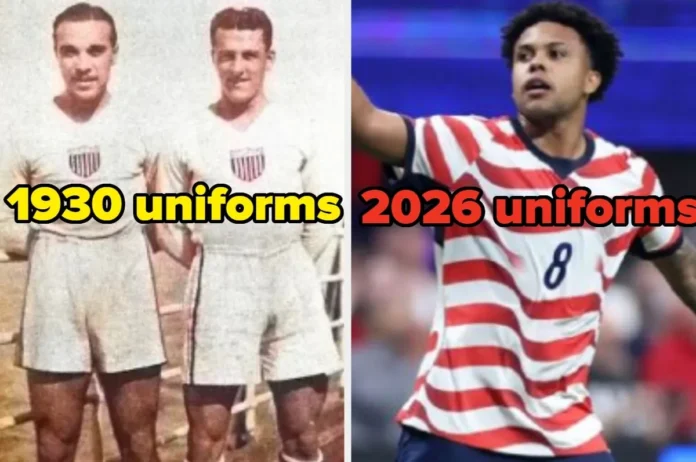
The equipment itself has seen a significant upgrade. The heavy wool jerseys, baggy shorts, and leather boots of the 1930s have been replaced by high-performance apparel designed by leading global brands. The official match balls have also evolved from the simple T-model to the technologically advanced Adidas TRIONDA used in contemporary tournaments.
Infrastructure and Logistics
Hosting the World Cup has scaled up exponentially. The 1930 tournament was held in just three stadiums in Montevideo, Uruguay, with capacities ranging from 10,000 to 90,000. For the 2026 World Cup, 16 venues across the United States, Canada, and Mexico will be utilized, with capacities generally between approximately 43,000 and 80,000. This massive infrastructure development is necessary to accommodate the increased number of teams and the massive global audience.
Travel for teams has also transformed. In 1930, players journeyed to the tournament site via train and ship. Today, chartered flights ensure swift and efficient travel between host cities for the 48 participating nations.
Commercial and Cultural Shifts
The financial landscape of the World Cup has undergone a seismic shift. While winning the 1930 tournament brought prestige and a trophy, there was no prize money. In stark contrast, the 2026 World Cup will distribute a record $871 million among the competing teams, reflecting the tournament’s immense commercial value.
Fan culture has also become far more vibrant and expressive. The formal attire of early spectators has given way to a modern era of face paint, elaborate costumes, widespread flag displays, and passionate chanting. The global nature of modern fandom means supporters travel from all corners of the earth to experience the event firsthand.
Inclusivity and Officiating
The role of women in football has expanded dramatically. In 1930, opportunities for women in the sport were minimal, with no female players participating. Today, women are integral to the World Cup ecosystem, serving as players, referees, coaches, journalists, broadcasters, and organizers. This increased inclusivity reflects broader societal changes and a growing recognition of women’s contributions to sports.
Officiating has also seen significant development. The 1930 tournament relied on a small team of 15 referees. The modern World Cup employs over 100 match officials, augmented by sophisticated Video Assistant Referee (VAR) technology to ensure greater accuracy in decision-making.
The Evolving Game
The World Cup’s journey from 1930 to the present day is a narrative of continuous growth and adaptation. From the number of teams and the scale of venues to the technological integration and the commercial value, nearly every facet of the tournament has been reshaped. The qualification process itself, which was non-existent in 1930, now involves over 200 nations competing for a spot, a testament to the sport’s global reach and competitive intensity.
The visual identity of the tournament has also evolved. The simple, hand-drawn poster for the first World Cup contrasts sharply with the collaborative artistic efforts of multiple artists from host nations for the 2026 event, symbolizing the tournament’s international collaboration and artistic expression.
Conclusion
The transformation of the FIFA World Cup over 96 years is a compelling story of globalization, technological advancement, and evolving cultural norms. What began as a relatively small gathering of nations has blossomed into a worldwide phenomenon, captivating billions and setting new benchmarks for sporting events in terms of scale, participation, and impact.