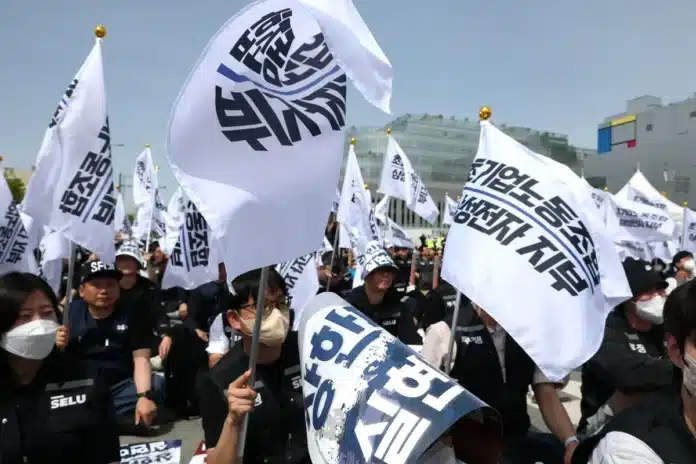
Thousands of Samsung Electronics employees gathered at the company’s computer chip facility in Pyeongtaek, South Korea, demanding larger bonuses and issuing strike warnings amid soaring memory-chip revenues fueled by artificial intelligence demand.
Mass Rally Under Heavy Police Watch
Workers displayed signs and banners while chanting calls for transparent compensation and the elimination of bonus caps. Union representatives estimate around 40,000 members joined the demonstration, which took place under a significant police presence. The event unfolded shortly after rival SK Hynix announced record quarterly revenue and operating profit for the first three months of the year, driven by global expansions in data centers and AI infrastructure.
AI Boom Boosts Chipmakers’ Earnings
Samsung and SK Hynix together supply roughly two-thirds of the world’s memory chips. Samsung recently projected its first-quarter operating profit at a historic 57.2 trillion won ($38.6 billion), exceeding SK Hynix’s 37.6 trillion won ($25.4 billion) figure. Samsung’s broader portfolio, encompassing smartphones and consumer electronics, contributes to its edge.
Union Rejects Bonus Offers, Prepares Walkout
Representing approximately 74,000 Samsung workers, the union criticizes the company for insufficient pay despite robust financial results. It dismissed management’s restricted stock bonus plan and insists on lifting bonus limits. Negotiations continue, but the union warns of an 18-day strike beginning May 21 if demands remain unmet, projecting daily losses exceeding 1 trillion won ($676 million) for the company.
“We won’t stop this fight until our fair demands are met,” declared union leader Choi Seung-ho via loudspeaker from a crane platform.
Geopolitical Risks Loom Over Industry
While the AI surge benefits semiconductor firms, Middle East tensions threaten supplies of essential materials like helium, vital for chip production, alongside rising energy costs. SK Hynix CFO Woo Hyun Kim noted during a conference call that the firm monitors the situation closely but anticipates minimal production disruptions, thanks to diversified sourcing of helium and bromine outside the region and ample stockpiles.