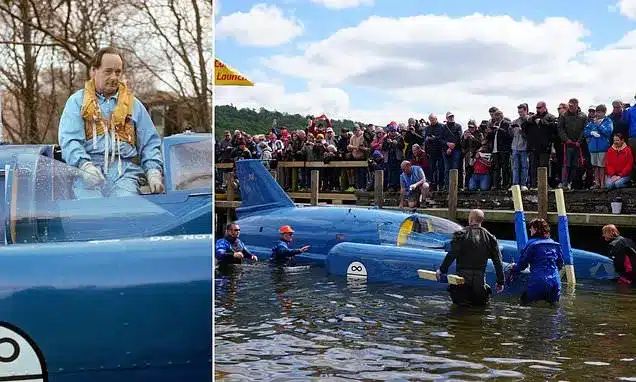
The legendary Bluebird K7 hydroplane has made a triumphant return to Coniston Water in the Lake District, marking the first time in nearly 60 years since the fatal crash that claimed its pilot’s life.
Historic Speed Records and Tragic End
Donald Campbell piloted the jet-propelled craft to a top speed of 276 mph, shattering several world water speed records. On January 4, 1967, while pursuing a 300 mph milestone, the hydroplane lifted out of the water at an estimated 320 mph, somersaulted, and disintegrated on impact. Campbell, aged 45, perished instantly.
The wreckage, including Campbell’s body, sank 142 feet to the lake bed. His teddy bear mascot, Mr. Whoppit, floated to the surface amid the debris. Over his career, Campbell achieved eight land and water speed records, becoming the only person to hold both in the same year.
Recovery and Restoration Efforts
The hydroplane lay submerged for 40 years until divers recovered it in 2001, alongside Campbell’s remains, which were laid to rest with his race suit intact. The Bluebird Project, led by engineer Bill Smith, restored the hull in Tyneside.
The craft first ran again in 2018 at Loch Fad on the Isle of Bute, Scotland. Legal disputes over ownership ended in 2024 with an Intellectual Property Office ruling, placing the Bluebird at Coniston’s Ruskin Museum.
Bluebird K7 Festival Draws Crowds
Thousands gathered for the Bluebird K7 Festival, running through Sunday. Gina Campbell, daughter of the late pilot, attended the opening day to witness the restored hydroplane in action. She has long advocated for its return to the lake.
Australian pilot Dave Warby, son of current water speed record holder Ken Warby (317.6 mph), handles the runs. Safety limits cap speeds at 150 mph, with no record attempts planned. Weather permitting, demonstrations occur daily.
This event coincides with the 70th anniversary of Campbell’s first world water speed record of 225.63 mph, set on September 19, 1956.