
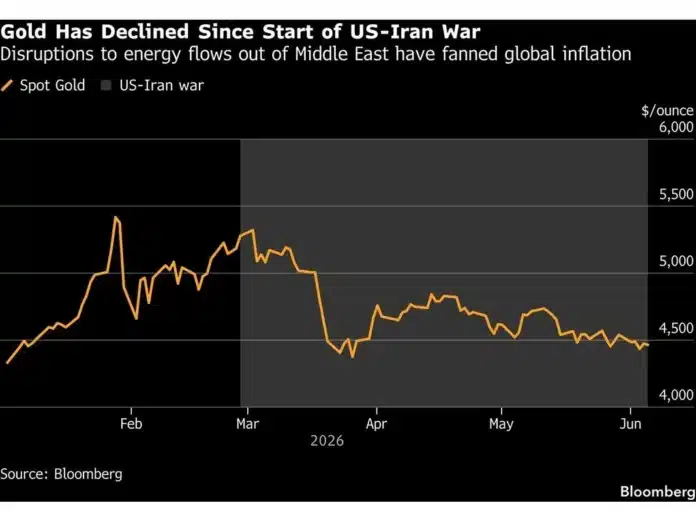
Gold experienced a decline, heading for a weekly loss as ambiguity surrounding the progress of US-Iran negotiations to end the ongoing conflict continues to impact global markets. Bullion dipped below $4,450 per ounce on Friday, marking a significant drop of approximately 2% for the week. This period has witnessed the most intense confrontations in the Middle East since a ceasefire was established in early April.
Geopolitical Tensions Escalate
The volatility intensified on Thursday when Iran-backed Hezbollah dismissed a US-brokered truce between Israel and Lebanon. This development followed missile and drone assaults on Kuwait and Bahrain, alongside an American strike on an oil tanker en route to Iran. Efforts to resolve the broader conflict appear to have stalled, despite earlier indications of an impending resolution last week.
US President Donald Trump stated on Thursday that peace talks were in their “final” stages. However, earlier that day, Iranian Foreign Minister Abbas Araghchi reported that “no tangible progress has been achieved.” The protracted conflict, now in its fourth month, has significantly disrupted energy supply routes through the Strait of Hormuz, consequently driving up oil prices and fueling concerns about global inflation.
Impact on Monetary Policy and Precious Metals
The inflationary pressures stemming from the conflict make it more probable that central banks will maintain current interest rates or consider increases. This scenario presents a challenge for precious metals like gold, which do not yield interest. The growing perception that the standoff around the Strait of Hormuz is moving further away from a resolution heightens the risk of an energy shock, which in turn suggests a tighter monetary environment. This tightening effect acts as a drag on gold prices.
Analysis of market trends indicates that gold is trading below key technical levels on both daily and 4-hour charts, suggesting a negative trajectory in the short to medium term. Following the conflict’s commencement in late February, gold experienced a sharp decline and has since been trading within a limited range. Currently, its price remains approximately 16% below its pre-conflict level.
Economic Uncertainty and Market Movements
In parallel, Federal Reserve Bank of San Francisco President Mary Daly commented on Thursday that the US economy faces too much uncertainty to provide a definitive outlook on future interest rate movements. She conveyed preparedness to “respond either way, whatever the economy brings.”
As of 10:03 a.m. in Singapore, spot gold had fallen by 0.6% to $4,447.22 per ounce. Silver also saw a decrease, dropping 1.6% to $72.70 per ounce. Platinum and palladium prices also registered slight declines. The Bloomberg Dollar Spot Index remained unchanged, having closed the previous trading session down by 0.1%.