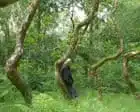
A Vital Woodland Sculpture Withers, Replaced by New Growth
A decade ago, a captivating circular arrangement of ash trees stood as a testament to artistic vision. Back then, the destructive ash dieback disease had yet to penetrate this secluded Welsh landscape. Returning to this cherished spot now, a somber reality confronts the observer. The Ash Dome, a dynamic outdoor artwork conceived by acclaimed artist David Nash, has transformed into a stark tableau of decay.
Gaunt, contorted branches now frame a mound of fallen timber. While a few trunks exhibit resilient new shoots, the majority are visibly ailing, their bark peeling away like desiccated skin. Nash, who sought refuge from the bustling London art scene in his youth, began this ambitious project on his father’s land in Blaenau. His motivation was to forge outdoor sculpture from wood, not by preserving a static form, but by cultivating it.
A Vision for the Future, Challenged by Nature
In 1977, Nash planted a ring of 22 ash trees, which evolved into a celebrated work of art, even appearing in broadcast identifiers. Nash himself described the project as “aimed at the 21st century.” However, neither a changing climate nor a virulent fungus could have been foreseen. Nash, meeting at the site, approaches the ailing trees with the familiarity of old companions, leaning against a weathered trunk, a reflection of the enduring, yet fragile, nature of both man and tree.
He explains that the Ash Dome is fundamentally a conceptual artwork. “This is outdoor sculpture that’s actually of its place,” Nash stated. “So going back to that concept, I had to accept the fungus as a natural element.”
Embracing Change: The Rise of the Oak Dome
Rather than engaging in a futile battle to save the ash trees, Nash opted for a different approach. He initiated the planting of a secondary ring, this time of 22 oak trees, encircling the original ash circle. These oaks, now seven years old, are thriving and robust. The task of shaping and pruning them into their intended form awaits Nash’s sons and future generations, a legacy to be fulfilled long after his passing and the eventual demise of the ashes.
Standing amidst the dappled green light of the woodland, the transition is palpable. Nash has dedicated his life to working with natural processes, guiding and nurturing rather than imposing. His philosophical acceptance of the ash trees’ inevitable decline is a profound act of creativity and acceptance. The heartbreak of loss is tempered by the promise of renewal; the Oak Dome is ascendant.