
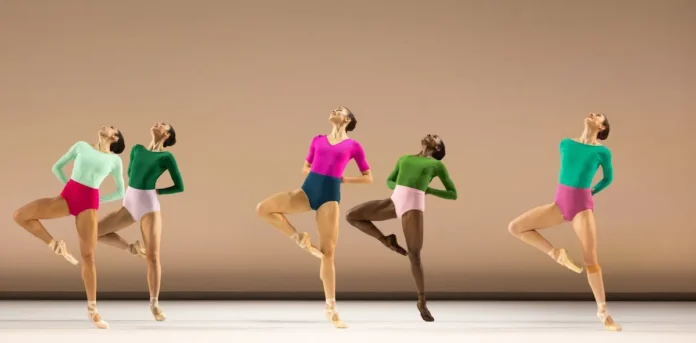
Thirty dancers from The Australian Ballet recently took to the stage for Justin Peck’s Copland Dance Episodes, a vibrant production set to the iconic music of American composer Aaron Copland, performed by Orchestra Victoria. Copland, a towering figure in 20th-century classical music, earned the moniker “Dean of American Composers” for his distinctive American sound, heavily influenced by folk melodies.
A Choreographic Exploration of American Sound
The ballet draws from some of Copland’s most celebrated works, including the powerful Fanfare for the Common Man (1942) and evocative excerpts from his ballets Rodeo (1942), Appalachian Spring (1944), and Billy the Kid (1938). The seamless integration of these pieces, each echoing the spirit of American folk music, creates a cohesive and compelling auditory landscape. While the music harks back almost a century, the choreography is distinctly contemporary, showcasing the innovative spirit of choreographers like George Balanchine and Jerome Robbins, with whom Peck has been associated.
The performance is characterized by its rapid pace and joyous energy. Dancers execute intricate movements – kicks, flicks, slides, and points – interspersed with moments of pause and interaction. The 22 distinct episodes provide ample opportunity for solos, duets, and trios, many of which are masterfully crafted. Peck’s choreography is often quick, demanding, and features original steps and lifts, all performed with precision by the dancers.
An Open Invitation to Interpretation
Similar to works by Balanchine and Robbins, Copland Dance Episodes offers a subtle narrative. The recurring presence of two couples, one navigating relationship challenges and the other strengthening their bond, provides a narrative thread without imposing an overarching story. Additionally, two trios, one of men and one of women, engage in playful interactions, hinting at individual personalities and mini-scenarios. Fleeting glimpses of singular characters emerge and then are reabsorbed into the collective movement, adding layers to the performance.
Peck himself has described the ballet as one that “meets the audience halfway,” encouraging viewers to “find their own way.” This narrative openness invites the audience to actively participate in creating and interpreting the unfolding events on stage.
A Tale of Two Worlds and Expansive Spaces
Structurally, the ballet, though presented in two acts, feels akin to three distinct parts. The initial act is largely driven by the male dancers, followed by an act focused on the female dancers, culminating in a grand finale with the full ensemble. This segmentation by gender highlights traditional gender identities within the ballet. The performance opens by introducing the energetic world of the men, set to the spirited hoedown music from Rodeo. This transitions into the realm of the women, whose movements are characterized by agility and grace, accompanied by the lighter, more lyrical tones of Appalachian Spring.
The final act brings a larger cast together, featuring dynamic formations and patterns across the stage. A pervasive sense of space unifies all the scenes. The minimalist, all-white set designed by Jeffrey Gibson powerfully evokes the vastness of the American plains, a landscape that also inspired Copland’s music.
Gibson’s set not only captures the sonic expanse of Copland’s compositions but also serves as a striking backdrop for Ellen Warren’s colorful and eclectic costumes. These costumes, a vibrant mix-and-match of patterned geometric fabrics, create the visual effect of dancers as elements within a larger woven tapestry. This kaleidoscopic aesthetic is introduced even before the ballet begins, with a boldly patterned stage curtain.
A Contemporary American Voice in Australia
Copland Dance Episodes represents a significant moment in contemporary American choreography, brought to life by an Australian ballet company and orchestra. Historically, Australian ballet has maintained closer ties with European dance traditions than with American ones. While numerous European companies have toured Australia, the New York City Ballet has visited only once in 1958. The Australian Ballet’s performance of an American work, therefore, carries particular weight.
The company’s commitment to staging new works by emerging international artists is clearly demonstrated in this production. This performance, the first outside of New York City, also signifies a moment of cultural exchange and post-colonial solidarity, a sentiment that the dancers embody with remarkable skill.
Copland Dance Episodes is scheduled to run in Melbourne until July 2, before moving to Sydney in November.