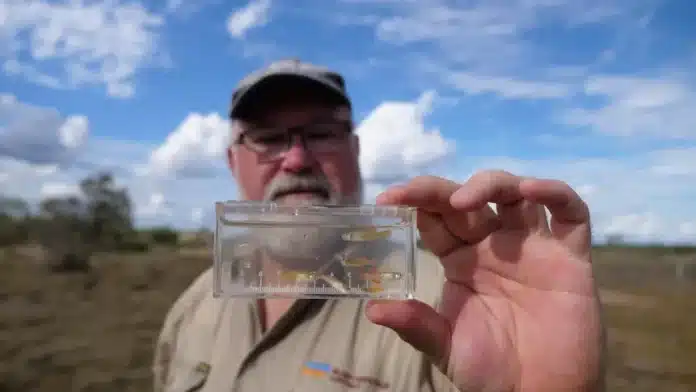
Australia’s unique red-fin blue-eye desert fish, found exclusively in a remote network of artesian springs in western Queensland, has narrowly escaped extinction due to an influx of invasive mosquitofish. These predatory newcomers, known as gambusia, have reached critical levels in the fish’s natural habitat, threatening the survival of this critically endangered species. Efforts are underway to protect the remaining populations, but experts warn that current containment measures may not be sufficient for long-term survival.
The Plight of the Red-Fin Blue-Eye
The red-fin blue-eye (Scaturiginichthys vermeilipinnis) is a small, vibrant fish endemic to a series of hidden springs near Aramac, Queensland. Its existence is precarious, relying entirely on these isolated aquatic environments. The species was first scientifically documented in 1990, discovered across seven springs on what was then Edgbaston Station. Recognizing its ecological importance, Bush Heritage Australia purchased the property in 2008, removing livestock and establishing the Edgbaston Reserve to protect its unique biodiversity.
However, the reserve’s delicate ecosystem has faced repeated assaults from invasive species. Dean Gilligan, a fish ecologist with Bush Heritage, explained the dire consequences of gambusia entering a spring inhabited by blue-eyes. “Once gambusia get into a spring that’s occupied by blue-eyes, the blue-eyes have six to 18 months [at] most before the population goes extinct,” he stated. The invasive mosquitofish are voracious predators, preying on the eggs and young of the native blue-eyes, and also causing physical damage to adult fish. Volunteer Sarah Butler described the devastating impact: “Every red-fin blue-eye we’ve caught has had some damage from gambusia. Sometimes, [the damage] presents as fungus from scales missing, [and] the fish get sick. Otherwise, there can be big chunks of the tail missing. Their fry, or their babies, are just immediately getting eaten. Eggs are laid, [then] they’re eaten.”
Floodwaters Unleash Predator Invasion
The most recent crisis occurred earlier this year when extensive flooding inundated the Edgbaston Reserve. Floodwaters, reaching approximately one meter in height, breached the reserve’s natural and artificial barriers, carrying large numbers of gambusia into previously pristine springs. Prior to this event, a mesh fence had been partially successful in separating the springs, but the sheer volume and height of the floodwaters overwhelmed these defenses.
According to Mr. Gilligan, the floodwaters compromised all but three of the reserve’s springs. In some of these springs, the native red-fin blue-eye populations have been completely eradicated. “All but three of the reserve’s springs have been compromised, with some of the rare fish populations already totally wiped out,” he confirmed. The situation was so severe that it prompted an “emergency response” from conservationists and volunteers.
A Race Against Time: Past Successes and Future Challenges
The red-fin blue-eye has a history of near-extinction. Introduced from North America in the 1920s for mosquito control, gambusia have since become a widespread invasive pest. When they first appeared in the Edgbaston springs shortly after the blue-eye’s discovery, the native fish populations plummeted. Within a few years, the number of occupied springs dwindled significantly, with only one surviving the initial onslaught.
Over two decades, dedicated breeding programs and reintroduction efforts slowly rebuilt the red-fin blue-eye populations. These programs aimed to restore the fish to springs where they had previously disappeared. The single surviving spring, affectionately nicknamed a “puddle in the desert,” holds all the remaining genetic diversity of the species. This vital genetic reservoir was painstakingly nurtured back to health.
The recent flood event brought the conservation efforts perilously close to disaster. Mr. Gilligan noted the alarming proximity of the floodwaters to the most crucial spring: “If the flood had been another 15 or 20 centimetres higher, we would have lost this spring as well.” The success of the breeding programs meant that the species had been reintroduced to several springs, but the recent floods have now jeopardized these gains.
Rethinking Conservation Strategies
The perimeter fence, designed with mesh small enough to exclude gambusia while allowing water flow, proved inadequate against the record flood levels. Volunteer Steve Baines observed the immediate aftermath: “Unfortunately, the water level of the flood exceeded the fence that we’ve got [here], so, as everyone’s pointed out, invasive species are now in this spring. I can see a massive drop in [red-fin blue-eye] numbers.”
Several factors contributed to the fence’s failure. The floodwaters were exceptionally high, representing a record for the 15 years Bush Heritage has managed the reserve. Additionally, a multi-decade program to cap bores and allow the Great Artesian Basin aquifers to recover has led to an increase in the size and water flow of the springs, potentially making them more vulnerable to inundation.
Recognizing the limitations of the current fencing strategy, Mr. Gilligan is collaborating with the National Recovery Team for red-fin blue-eye to devise more robust solutions. This includes seeking assistance from both the Queensland and Australian governments. “We know that our old strategy of 50cm-high fences isn’t going to work in the long term,” Mr. Gilligan stated. “We’ve got to come up with something more secure. [We] really don’t know what that is yet, but that’s what we have to figure out and move on with.”
The urgency of the situation has galvanized conservationists. Ms. Butler responded to the emergency call-out immediately, emphasizing her commitment: “It was last-minute. I just felt that I needed to help.” The ongoing efforts highlight the critical need for innovative and adaptive strategies to protect Australia’s unique and vulnerable freshwater species from the persistent threat of invasive predators.