
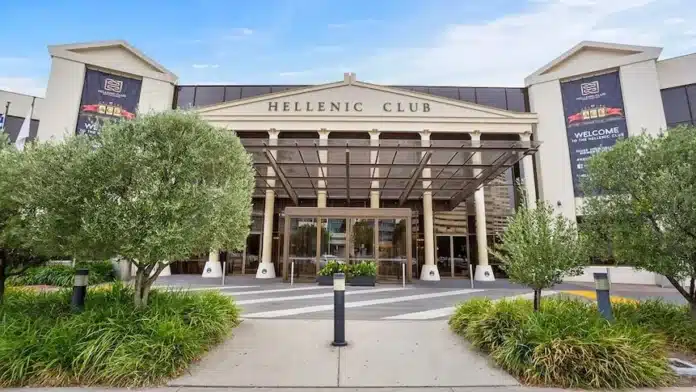
The Hellenic Club of Canberra has been cleared by the ACT Civil and Administrative Tribunal (ACAT) of allegations that it failed to record signs of problem gambling by a couple who lost at least $345,000 on poker machines. However, the tribunal did find the club breached other regulations concerning cash withdrawal limits via EFTPOS machines.
Tribunal’s Findings on Gambling Breaches
ACAT ruled that the Hellenic Club did not violate gaming regulations by failing to record problem gambling incidents involving Marlene and Raimo Kasurinen. The couple reportedly spent up to 150 days a year at the club, with Mr. Kasurinen, known as Ray, dying by suicide in March 2020 amidst mounting debts. The tribunal’s decision was based on the evidence provided by current and former employees, none of whom stated they were aware of any signs of problem gambling exhibited by the Kasurinens. This lack of awareness meant the club could not be found in breach of the clause requiring the recording of such incidents within three days of becoming aware of them.
The tribunal noted that while employees made genuine efforts to identify problem gambling, their training was insufficient, leading to a lack of awareness regarding the specific behaviours they were supposed to monitor. Furthermore, staff members were led to believe the Kasurinens were financially stable, based on conversations with the couple, which contributed to the misdirection of their efforts. ACAT also found that employees had only a vague recollection of a 32-item checklist used in their Responsible Conduct of Gambling (RCG) training.
EFTPOS Withdrawal Regulations Breached
Despite being cleared on the primary gambling recording allegations, the Hellenic Club was found to have breached regulations prohibiting gambling machine players from withdrawing more than $200 cash in a single transaction via an EFTPOS machine. ACAT identified 45 instances where Mrs. Kasurinen exceeded this limit. In one notable case in December 2017, she made multiple withdrawals within a two-hour period, accumulating $1,400. The club’s argument that each transaction was separate if completed physically and electronically before the next was rejected by ACAT.
Background of the Kasurinen’s Gambling
The Kasurinens began frequenting the Hellenic Club in 2008, initially visiting for dinner once or twice a week. Their circumstances changed significantly in 2014 when Mrs. Kasurinen’s brother passed away, followed by the discovery in 2015 that their home was a “Mr Fluffy” house, necessitating its sale to the ACT government. This period of distress, marked by the loss of their family home, led the couple to increase their visits to the club, particularly from 2017 onwards. During this time, their visits often included complimentary meals and drinks, followed by extended sessions on the gaming machines, sometimes lasting until the club’s closing time of 4 am.
Evidence presented to ACAT indicated that in 2017, Mrs. Kasurinen visited the club on 150 days, while her husband visited 119 days. Similar high attendance was recorded in 2016 and 2018. The reported loss of $345,000 only accounted for wagers made when their membership cards were used. Mrs. Kasurinen indicated that she used her card only about 40% of the time she gambled.
Impact and Future Proceedings
David Chambers, the son-in-law of Marlene and Raimo Kasurinen, expressed that the financial losses have had a devastating impact on Mrs. Kasurinen, who is currently hospitalized and facing severe health issues. Mr. Chambers stated, “Marlene’s currently in hospital at the moment, she doesn’t have enough money to feed herself or keep herself healthy or buy medication. We don’t know if she’s going to survive this current hospital stay; her life is completely ruined.” He welcomed the ACAT’s decision regarding the EFTPOS withdrawals, believing it will prevent similar situations and potentially save lives by mitigating financial stress associated with problem gambling.
The Hellenic Club CEO, Ian Cameron, welcomed the tribunal’s findings, stating they support the club’s position and reaffirm its commitment to responsible gambling and providing a safe environment for members. He noted that the club has always maintained its dedication to its responsibilities in this area.
ACAT has scheduled further hearings for November to determine the appropriate fine for the club, considering that one of the two alleged breaches has been dismissed. The original fine of $1.2 million was imposed by the Racing and Gaming Commission in December 2024, prior to the club challenging the decision at ACAT.