Small and medium-sized enterprises (SMEs) across Australia are grappling with a challenging economic climate, marked by escalating operational costs, increased interest rates, and a general tightening of credit conditions. This confluence of factors is leading to rising insolvency rates, a greater reliance on credit, and an increase in business owners choosing to exit the market.
Economic Headwinds Strain SMEs
The current economic landscape presents a multi-faceted challenge for small businesses. Beyond the widely discussed impact of rising interest rates, many are contending with increased fuel prices, persistent inflation, and a series of regulatory changes. These include new requirements for ‘payday super’ (superannuation paid with salary and wages), adjustments to credit card surcharge rules, and the phasing out of junior pay rates.
These pressures are occurring against a backdrop of declining consumer confidence and the usual annual increases in essential business expenses like rent and wages. The cumulative effect is creating significant financial strain for many operators.
A Glimpse from Central Queensland
The impact is palpable even in remote areas. Jeff Bowman, who owns a tourist shop and cafe in Barcaldine, central Queensland, recounted how a combination of factors nearly forced him to close for six months. Soaring petrol prices and fears of fuel rationing, exacerbated by geopolitical events in the Middle East, deterred tourists. He noted that the mere mention of potential fuel rationing caused tourism to halt abruptly, with visitors expressing concern over the long drive to reach the region.
“We were 42 per cent down, which is quite dramatic for us,” Bowman stated, highlighting the significant drop in business. He also pointed to the rising costs of electricity for his cafe equipment and, crucially, the escalating freight charges to his remote location, which have made it impossible to source goods from some suppliers.
Financial Indicators Signal SME Distress
Concerns about the health of the SME sector were amplified in June following a profit downgrade from Judo Bank, a lender specializing in small and medium enterprises. The downgrade was attributed to issues with three significant loans, totaling approximately $75 million, affecting businesses in manufacturing, financial planning, and construction. While each loan had unique problems, the lender’s need to set aside $20 million for potential bad debts unsettled the market, causing Judo Bank’s shares to plummet by 46%.
Credit reporting agency Equifax indicates that while the SME sector generally shows resilience, specific areas are experiencing considerable stress. Small business insolvency rates have seen an uptick, with a 13% increase in business failures in the six months to May 2026 compared to the previous year. Furthermore, business exit rates rose by 37% in the second quarter of 2026 compared to the same period in 2025.
Payment behaviors are also shifting, with an increase in the number of firms taking longer to pay their suppliers. In May 2026, 9.5% of companies took between 31–60 days to settle invoices, up from 8.3% the previous year.
Increased ‘Credit Shopping’ and Reduced Growth Appetite
Brad Walters from Equifax observed a rise in ‘credit shopping’ among higher-risk SMEs, suggesting that these businesses are encountering difficulties in securing finance. This trend is particularly pronounced in sectors like construction, manufacturing, transport, and logistics, as well as among businesses with low liquidity.
“For the high-risk small business community we’ve seen that trending up, and that’s now at four times the rate that it is for their low-risk counterparts. That’s really problematic,” Walters explained. He added that this behavior often signifies businesses approaching multiple lenders simultaneously, indicating a struggle for readily accessible finance.
Moreover, there appears to be a pullback in the desire for growth capital among smaller businesses. “For smaller businesses we’re actually seeing a flat line of their credit appetite. In fact, we’re seeing a bit of a pullback in their interest around growth capital,” Walters noted. This cautiousness is attributed to concerns about immediate cash flow given the prevailing economic pressures.
Interest Rates Directly Impacting Business Operations
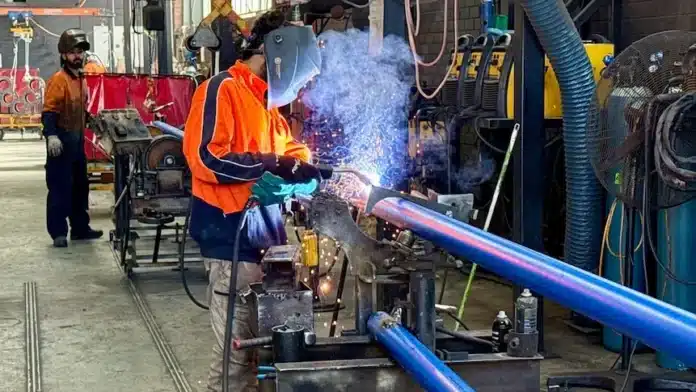
For manufacturers like Solidity, a Victorian-based producer of helical piles used in foundation systems, variable interest rate loans represent a significant cost increase with every RBA rate hike.
“We’re a debt company business so we have a pretty significant bank loan that allows us to operate the business, and that’s at a variable rate. Every time the RBA increases the interest rate our cost of business increases pretty significantly,” said managing director Brodie Houghton. His company, which employs around 40 people, also faces challenges from rising fuel prices impacting its construction division, which saw a 30% increase in operating costs during a peak period in April.
Adding to the pressure, Solidity is experiencing rising steel prices, approximately 4% every two months, while simultaneously facing intense competition from cheaper imported fabricated products. Houghton also expressed concerns that government support programs, such as the Economic Resilience Program offering zero-interest loans, have eligibility criteria that are too restrictive for businesses like his, and that his company does not receive priority on state-run building projects.
“The current period right now, it feels a lot like 2020. There’s a lot of uncertainty,” Houghton remarked, anticipating a difficult period ahead.
Calls for Targeted Government Support
Industry bodies are urging the government to consider measures to alleviate the pressure on SMEs. Skye Cappuccio, chief executive of the Council of Small Business Organisations of Australia, suggested raising the tax threshold for the instant asset write-off scheme. Currently set at $20,000, she argued that a higher threshold is necessary to genuinely support small businesses in acquiring essential equipment and tools that boost productivity.
“Small businesses across the country are resilient, but times are tight and the pressures are really high. A lot depends on what happens over the next six months,” Cappuccio stated.
In response, Small Business Minister Anne Aly highlighted existing government support, including tax incentives, the removal of certain tariffs, and access to mandatory standards. She noted that over $3.8 billion in measures have been introduced to lower taxes for businesses and startups. Aly also defended reforms like payday super, asserting they benefit workers and streamline payroll management, ultimately helping businesses attract and retain staff.
For business owners in remote areas like Jeff Bowman, the plea is for greater recognition of the challenges posed by distance. “We’d just like to be considered more. We need tourism in outback Queensland to continue growing,” he said.