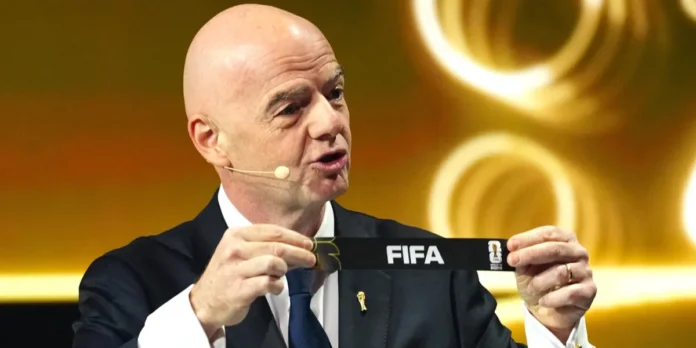
FIFA President Gianni Infantino has garnered support from five member nations following a controversial proposal to sell stakes in the World Cup to private investors. The plan, which aimed to generate significant revenue for FIFA and its member associations, faced widespread criticism before being withdrawn by Infantino earlier this week. Despite the backlash and calls for his resignation, these five nations have publicly reaffirmed their confidence in his leadership and vision for global football development.
Controversial Investment Proposal
The proposed plan, reportedly valued at approximately £15 billion, involved offering private investors a stake in the future planning and commercial aspects of the World Cup. In exchange for their investment, these entities would gain involvement in key decision-making processes. FIFA’s 211 member associations were offered a substantial financial incentive to approve the deal: an immediate payment of £15 million (approximately $20 million) per association, with an additional £50 million (around $66 million) promised before 2038.
Gianni Infantino, who has led FIFA since 2016, presented this initiative as a strategic move to secure long-term funding for football’s growth worldwide. The proposal, however, quickly ignited a firestorm of opposition. UEFA, the governing body for European football, emerged as one of the most vocal critics. Its president, Aleksander Ceferin, urged European nations to withdraw their support for Infantino, suggesting that the plan was detrimental to the sport’s principles and integrity. The criticism extended beyond Europe, with CONMEBOL (South America), CONCACAF (North, Central America, and Caribbean), and the AFC (Asia) also releasing statements expressing condemnation.
Support Amidst Criticism
Despite the significant pressure and the withdrawal of the investment plan, a core group of member nations has continued to back Infantino. The opposition from UEFA, representing 55 European nations, was not unanimous. David Trunda, president of the Czech Republic’s Football Association, was the sole European representative to publicly support the initiative. He argued that the additional funding generated would be invaluable for developing grassroots football and improving infrastructure within the country.
Following the Czech Republic’s stance, four other nations have publicly aligned themselves with Infantino. Qatar, the host nation of the 2022 World Cup, issued a statement that lauded Infantino’s “wisdom” and pledged full support for his “efforts to continue growing and strengthening the game globally.” This endorsement from a recent World Cup host highlights a different perspective on Infantino’s strategic direction.
Kuwait, Sri Lanka, and Lebanon have also reiterated their confidence in Infantino’s leadership, according to reports. These affirmations of support, particularly from nations outside the traditional power blocs of European and South American football, demonstrate the diverse opinions within FIFA’s vast membership regarding Infantino’s governance and future plans.
The Political Landscape of FIFA
The dynamics within FIFA’s 211 member associations play a crucial role in the president’s tenure. While UEFA and CONCACAF together represent 90 member associations, their combined opposition, though substantial enough to trigger a vote of no confidence, falls short of the majority required to remove Infantino from office. This political reality underscores the challenge faced by Infantino’s critics.
The Asian Football Confederation (AFC) has 40 member associations, and many have not publicly commented on the recent controversy. This silence suggests a level of contentment with the confederation’s current stance, which has not directly challenged Infantino’s presidency. Australia, an AFC member, acknowledged the abandonment of the investment plan, stating that the focus should now shift to future endeavors, indicating a pragmatic approach to the situation.
Currently, the public opposition, primarily led by UEFA and CONCACAF, accounts for approximately 43 percent of FIFA’s membership. This figure is below the 50 percent plus one vote threshold needed to unseat the president. However, the political landscape within FIFA is complex, and member associations are not always bound to vote in alignment with their confederations. A shift of just 16 votes from undeclared or wavering nations could significantly alter the balance of power and place Infantino’s presidency in a precarious position ahead of the scheduled elections in March.
Future Outlook
The withdrawal of the World Cup investment plan marks a significant moment in Gianni Infantino’s presidency. While it demonstrated the considerable opposition he faces, the continued support from a select group of nations highlights the divisions within global football governance. The coming months will likely see continued political maneuvering as various factions within FIFA position themselves ahead of future leadership decisions and strategic planning for the sport.
Infantino’s ability to navigate these internal politics and maintain the confidence of a sufficient number of member associations will be critical to his continued leadership. The financial incentives offered, though ultimately withdrawn, revealed a strategy aimed at securing long-term financial stability for FIFA and its members, a goal that continues to be a central theme in discussions about the future of international football.