
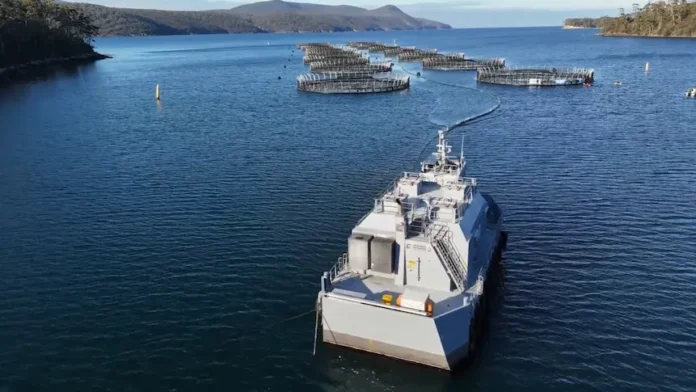
Tasmania’s Environment Protection Authority (EPA) has granted a two-year lease extension for the Tassal salmon farm located in Long Bay, near the historic Port Arthur site. The decision comes despite ongoing community concerns regarding the farm’s environmental impact, particularly its contribution to nutrient levels and algae growth in the shallow bay. The EPA’s assessment concluded that while the farm does release nutrients, it is not the primary driver of the observed algae blooms, attributing them instead to water temperature fluctuations.
EPA’s Findings on Long Bay Salmon Farm
The EPA’s monitoring data indicated elevated levels of ammonia and nitrogen near the fish farm during the summer months. However, these nutrient levels reportedly decreased significantly within weeks of the fish pens being seasonally emptied. The authority also noted the presence of ‘nuisance’ algae but described these levels as low and not showing an increase compared to previous years.
A key point of contention has been the impact on the local ecosystem, including seagrass. The EPA acknowledged a decline in seagrass at three sites since a 48-tonne nitrogen limit was introduced in 2023. However, the authority stated that there is limited understanding of how seagrass responds to nutrients from fish farms and that the sample size for these observations was small. Furthermore, the EPA found no substantial evidence linking the farm’s nutrient releases directly to negative impacts on water quality within Long Bay.
The EPA’s decision document stated, “EPA monitoring has found no substantial evidence of negative impacts of nutrients to water quality in Long Bay.” It also noted that the impact on an inshore reef area could not be fully assessed due to a lack of baseline data collected before the salmon farm commenced operations.
Attributing Algae Growth to Water Temperature
The EPA’s assessment placed significant emphasis on water temperature as the main factor influencing algae growth in Long Bay. The authority argued that the bay’s shallow waters and its connection to offshore water masses, such as the Southern Ocean, lead to natural nutrient exchange. “The effect of shallow water temperatures on algal growth… does not support that persistent nuisance algal blooms are being caused by fish farming,” the EPA decision reads. This perspective contrasts with concerns raised by local residents and independent scientific bodies.
Community and Scientific Concerns
The Tasmanian Independent Science Council (TISC) was among over 80 submissions opposing the lease extension. TISC met with the EPA in January to voice its concerns, arguing that Long Bay’s sheltered and poorly flushed nature makes it unsuitable for salmon farming. The council contended that the majority of human-induced nutrient loads in the bay likely originate from the salmon farm. TISC also questioned the methodology of the EPA’s monitoring studies, suggesting a lack of precautionary approach in favour of a “continuous improvement” strategy. They highlighted that baseline surveys did not include monitoring sites in the less-flushed northern parts of the bay and that reports often lacked context regarding the timing and scale of farming activities.
Local residents submitted samples of algal mats to the EPA, which the authority categorized as anecdotal evidence. The EPA stated a preference for a more rigorous, science-based approach involving assigned photo points captured consistently over extended periods and across seasons, without bias. Concerns about seagrass loss were also a significant point raised by the community.
Tassal Welcomes Lease Extension
Tassal, the operator of the Long Bay salmon farm, expressed satisfaction with the EPA’s decision to extend its lease for another two years. A company spokesperson described the EPA’s assessment as one of the most comprehensive undertaken within Tasmania’s marine farming sector. “This decision provides important certainty for our people, our operations and the wider Tasman Peninsula community,” the spokesperson stated.
The EPA’s decision also took into account Tassal’s broader compliance record across its 18 marine farm licenses, four freshwater hatcheries, and four processing sites in Tasmania. While Tassal has had two environmental breaches at the Long Bay site, the EPA characterized them as short-lived and rare. The company has faced other environmental notices and warnings at different sites since 2021, including issues with feed dumping, a diesel spill, effluent quality, and pollutant discharges. Tassal has also accumulated convictions for non-environmental matters, primarily related to marine debris offences.
Political and Environmental Opposition
The lease extension was met with strong criticism from the Tasmanian Greens and various environmental groups. Rosalie Woodruff, leader of the Tasmanian Greens, challenged several of the EPA’s conclusions and the monitoring practices employed since 2017. “There wasn’t a baseline survey done before salmon companies went in there, and that was done with a purpose,” Woodruff stated, adding that assessments of environmental harm have commenced only after the salmon companies had already begun operations and made changes to the waterway.
Future Monitoring and Research
Moving forward, the EPA has recommended further monitoring and dedicated studies for Long Bay and its surrounding areas. The goal is to better understand the ecosystem’s dynamics, particularly in relation to changes in fish feed levels implemented in 2023. The recommendations include conducting more research into the environmental variations within the shallow, enclosed bay, comparing conditions with the broader Port Arthur and Storm Bay regions, and continuing to measure changes since the 2023 adjustments.
The authority’s decision highlights the ongoing challenge of balancing aquaculture operations with environmental protection and community concerns in sensitive marine environments. The lack of comprehensive baseline data prior to the farm’s establishment continues to complicate definitive assessments of long-term environmental impacts.
The EPA’s decision to renew the lease for Tassal’s Long Bay operation underscores a complex regulatory landscape where scientific findings, community input, and industry operations are weighed. While the EPA asserts that current evidence does not link the farm’s nutrient output as the primary cause of algae blooms, further research is deemed necessary to fully comprehend the ecosystem’s response to aquaculture activities in the region.