
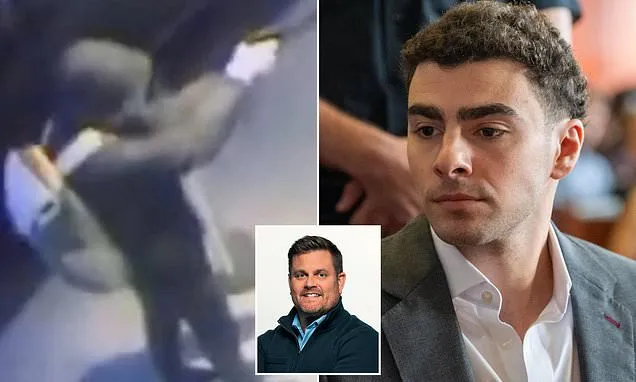
Luigi Mangione, the man accused of murdering UnitedHealthcare CEO Brian Thompson, has indicated he intends to plead guilty to federal stalking charges. This development comes just weeks before Mangione was scheduled to stand trial for the state murder charges.
Federal Stalking Charges and Potential Plea
In federal court, Mangione, 28, is prepared to admit guilt to one count of interstate stalking resulting in death and one count of stalking through the use of interstate facilities resulting in death. Both charges carry a maximum penalty of life imprisonment. The U.S. Department of Justice had initially sought the death penalty for Mangione in the federal case, but U.S. District Judge Margaret Garnett disallowed this in January.
The announcement of the impending guilty plea was made during a court hearing where Mangione addressed Judge Garnett, answering questions about his mental state. His legal team had previously informed the court of his intention to plead guilty. The federal charges stem from the alleged stalking of Thompson, 50, prior to his death.
The Murder of Brian Thompson
Brian Thompson, the CEO of UnitedHealthcare, was fatally shot on December 4, 2024, in Midtown Manhattan. He was reportedly walking to a conference when he was attacked. Mangione faces both federal and state charges in connection with the murder.
Thompson’s family was present during Friday’s hearing and came face-to-face with Mangione for the first time. They observed as Mangione’s plea intentions were discussed with the judge.
Legal Strategy and Double Jeopardy Concerns
Legal analysts suggest that Mangione’s decision to plead guilty to federal charges could be a strategic move by his defense team, led by Marc Agnifilo and Karen Friedman Agnifilo. The concern is that this federal plea might be used to challenge the state murder charges under New York’s double jeopardy laws.
While federal and state governments are generally considered separate entities, allowing prosecution for the same conduct, New York state law offers more robust protections against double jeopardy. If a prior prosecution concludes with a guilty plea or a trial conviction for the same actions, subsequent prosecution for those same actions can be barred.
“In New York state, there’s more robust protections for defendants around the double jeopardy laws. And so that could be a real issue here, at least one that would merit litigation, if not dismissal,” observed CBS News legal analyst Caroline Polisi.
David S. Weinstein, a former federal prosecutor, echoed this sentiment, stating that if the defense can structure the federal resolution to align with New York’s double jeopardy statute, it could effectively resolve the state case. “If they [Mangione’s legal team] craft their resolution in a way that allows the NY state law to apply then it takes care of the New York state case,” Weinstein explained. “If they say these are crimes that arise out of the same matter then they can’t prosecute him. They will file a motion to dismiss based on double jeopardy, so there won’t be a trial on Sept 8th.”
Potential Motivations for the Plea
Beyond the double jeopardy implications, some experts speculate that Mangione’s plea could be aimed at securing a more favorable sentencing environment. Retired FBI Special Agent James Gagliano suggested that the move might be an attempt to have Mangione serve his sentence in a federal prison, which are often perceived as having more comfortable conditions, rather than a state facility.
“What is confounding to all of us is why the Southern District would be doing this without working with the state because the only thing that can be the possible outcome here is, Luigi Mangione’s attorneys are trying to get him to the comfy confines of FCI Otisville and avoid Sing Sing, Attica, Clinton or places like that in the state system,” Gagliano told Fox News.
Weinstein also noted that any plea deal that offers a sentence less than life imprisonment would be considered a victory for the defense. “Any time they’re going to get a penalty that’s anything better than Mangione spending the rest of his life in jail, that’s a victory,” he said.
High-Profile Case and Public Interest
Mangione was apprehended five days after the shooting at a McDonald’s in Altoona, Pennsylvania. The case has garnered significant public attention, with a notable following, particularly among women, who have shown up in support at his court appearances.
An online defense fund established for Mangione has reportedly raised over $1.5 million since his arrest in December 2024. He has also reportedly received substantial fan mail and emails while held at the Metropolitan Detention Center in Brooklyn.
Trial Preparations and Jury Anonymity
Earlier in the week, the judge presiding over Mangione’s state trial ruled that the jury would be anonymous due to the high-profile nature of the case. This decision means that the names and personal details of the jurors will be kept confidential from the public.
Both the prosecution and defense will be required to submit questions for prospective jurors. These questionnaires will help assess potential jurors’ knowledge of the case, their legal experiences, and other relevant factors. The judge will ultimately decide which questions are posed to the jury pool.
The court is also preparing for a large number of attendees expected for the trial, with over 80 news outlets, including major publications and independent journalists, set to cover the proceedings. The judge will determine the capacity of the main courtroom and manage the expected crowd.
Evidence and Investigation
Surveillance footage captured the moment of the shooting, showing a masked gunman firing at Thompson from behind. Investigators noted that the ammunition used in the attack reportedly had the words ‘delay,’ ‘deny,’ and ‘depose’ inscribed on it, a phrase often associated with insurance company practices aimed at avoiding claim payments.
The federal plea agreement represents a significant turn in the legal proceedings against Luigi Mangione, potentially altering the course of the state murder trial and raising complex legal questions regarding double jeopardy protections in New York.