
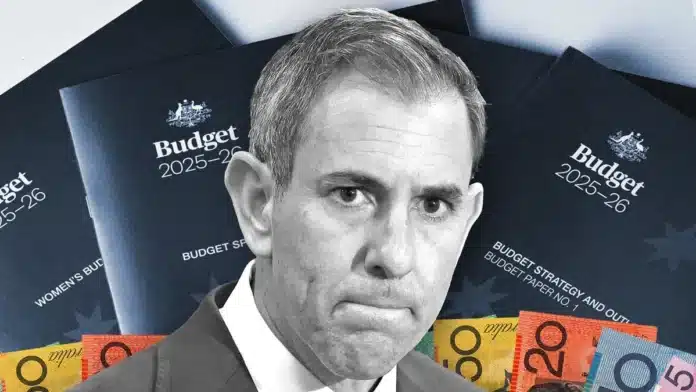
Australia’s gross federal debt is poised to exceed the significant $1 trillion threshold for the first time, a development occurring amidst ongoing fiscal pressures highlighted by the May Budget. The Australian Office of Financial Management (AOFM), responsible for managing the nation’s borrowing, reported a debt level of $983.7 billion as of August 14. Subsequent borrowing activities, including a $13 billion syndication and an additional $4 billion scheduled for Thursday, are projected to push the total figure to approximately $1,000,800,000,000.
While a brief dip below $1 trillion is anticipated on Friday due to the maturity of about $6 billion in notes, this milestone is expected to become a more permanent fixture. Government debt is forecast to consistently remain above the $1 trillion mark starting in September. The Treasurer, Jim Chalmers, indicated in the May Budget that gross debt was projected to reach $1.051 trillion within the current financial year, a figure representing roughly 34 per cent of the Gross Domestic Product (GDP).
Understanding Government Debt and GDP
According to Treasury figures, government spending is estimated to account for 26.8 per cent of GDP in the current financial year. While this is a substantial figure, it remains below the extraordinary levels witnessed during the COVID-19 pandemic. Projections suggest that the national debt will continue its upward trajectory, potentially reaching 35.8 per cent of GDP by the 2028-29 financial year.
The approaching $1 trillion debt mark has ignited a renewed political debate concerning the government’s fiscal management and spending policies. Treasurer Jim Chalmers has defended the government’s economic stewardship, citing the nation’s retained AAA credit rating as evidence of responsible management. He asserted that the current Labor government has improved the financial standing inherited upon taking office.
Treasurer’s Defense and Opposition’s Critique
“Moody’s, the second global ratings agency in the course of the last couple of weeks, reaffirmed Australia’s AAA credit rating and they did that because of the responsible way we have gone about managing a Budget, getting gross debt down $200bn lower than we inherited and the trajectory that those opposite left us when we came to office,” Dr Chalmers stated. He emphasized that the government has reduced gross debt by $200 billion compared to the level inherited.
Conversely, the Coalition has attributed the rising debt levels to the current government’s spending. Opposition Leader Angus Taylor characterized the $1 trillion debt as a “grim milestone for Australia,” arguing that it reflects a failure to control spending and manage the budget effectively. “It is what happens when you have a Labor government that cannot control its spending or the Budget,” Mr Taylor commented. He further contended that Labor’s spending levels are comparable to those seen outside of recessionary periods in the last four decades, despite Australians facing increased taxes and higher prices.
Future Fiscal Challenges: Interest Payments and Public Sentiment
The Parliamentary Budget Office has issued a warning regarding the increasing burden of interest payments on government revenue. These costs are projected to consume a larger portion of the national budget, consequently reducing the funds available for other essential public services and priorities. The office’s analysis indicates that interest payments on debt are forecast to rise from 4.1 per cent of government revenue in 2024-25 to 6.2 per cent by 2029-30.
This escalation in national debt occurs against a backdrop of persistently elevated interest rates. Australia has experienced three interest rate hikes of 0.25 percentage points each this year. Furthermore, financial markets are pricing in approximately a 60 per cent probability of another rate increase before the year concludes. This economic environment adds to the pressure on government finances and the cost of servicing the national debt.
Public apprehension regarding the level of government debt is also notable. Recent polling data from Newspoll suggests that a significant majority, 70 per cent of voters, express at least some level of concern about the nation’s debt, with 31 per cent indicating they are “very worried” about the situation. This sentiment underscores the public’s awareness and concern about the long-term implications of Australia’s growing national debt.