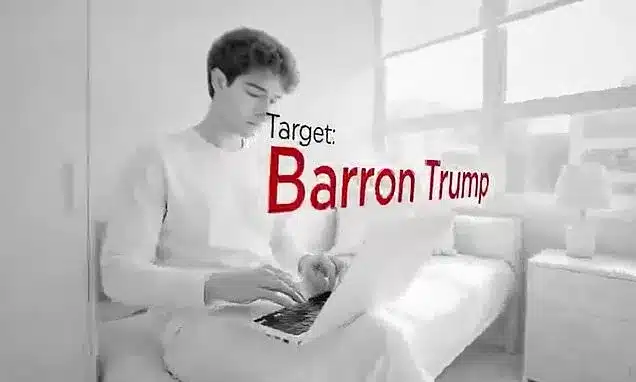
An Iranian state television broadcast has reportedly featured a segment containing threats directed at Barron Trump, the youngest son of former U.S. President Donald Trump. The three-minute video, which appears to incorporate AI-generated elements, focuses on Barron, a student at New York University, and allegedly explores methods of reaching him within the United States. Graphics within the clip reportedly depict surveillance of the younger Trump, with attempts to identify his social media presence, friends, and potential vulnerabilities in his Secret Service protection.
Concerns Over AI-Generated Content and Surveillance
The broadcast included imagery suggestive of AI generation, such as clips of Barron Trump wearing an Arsenal football club shirt and engaging with an Xbox gaming console. One particular AI-generated scene depicted a masked individual in front of a computer, appearing to search for information about the former president’s son. The segment also made reference to a $10 million reward, though the source or beneficiary of this sum was not specified in the report.
Iran International, the outlet reporting on the broadcast, stated that there is no evidence to suggest any actual attempt on Barron Trump’s life has been made. While Iran has previously produced similar videos concerning Donald Trump and his wife, Melania, this latest segment is noted as one of the more explicit threats made against members of the Trump family and their associates.
Context of Previous Threats and Rewards
This incident occurs against a backdrop of heightened tensions and past actions involving Iran and individuals associated with the U.S. government. In 2024, the U.S. Department of Justice announced a $20 million reward for information leading to the arrest of Shahram Poursafi, an Iranian national identified as a member of Iran’s Islamic Revolution Guard Corps (IRGC). Poursafi was accused of plotting to assassinate former U.S. National Security Adviser John Bolton.
According to U.S. officials, Poursafi allegedly attempted to hire individuals within the United States between October 2021 and April 2022 to carry out the assassination of Bolton, a vocal critic of Iran. The proposed payment for this act was reportedly $300,000. The plot was intended to take place in either Washington D.C. or Maryland.
Further underscoring Iran’s alleged involvement in such activities, an operative trained by the IRGC was convicted in March of this year for attempting to commit an act of terror. Asif Merchant admitted during his trial that he was dispatched to the U.S. by the IRGC with the objective of arranging political assassinations and acquiring sensitive documents. However, law enforcement authorities successfully thwarted the plot before any attack could be executed.
At the time of Merchant’s conviction, former Attorney General Pam Bondi remarked on the vigilance of American law enforcement in preventing such acts. She stated that the Department of Justice remains committed to protecting Americans, prosecuting terrorists, and intercepting acts of terrorism before they materialize.
Iran’s Stance on Economic Warfare and Regional Security
In separate but related developments, Iran has previously dismissed threats of economic warfare from the Trump administration as mere “empty talk.” Iranian officials have also issued warnings to neighboring countries against cooperating with the U.S. in its efforts to exert economic pressure on Tehran. Mohsen Rezaei, a prominent figure in Iran’s security apparatus, has threatened retaliation against any regional nation that aligns with the U.S. crackdown.
Rezaei specifically warned that Tehran could disrupt oil flow through the Persian Gulf if neighboring countries assist Washington’s economic campaign. He asserted that Iran does not seek to escalate conflict across the Middle East but emphasized that such cooperation would lead to severe consequences for regional interests. “If countries neighboring Iran cooperate with the Americans in the economic war, we will target their interests,” Rezaei declared.
He further commented on the perceived ineffectiveness of President Trump’s economic policies, stating, “The world has realized that Trump’s bluster is nothing but empty talk.” Rezaei indicated that Iran could significantly broaden its economic confrontation if its neighbors side with Washington. His remarks suggested that even alternative oil export routes developed by Gulf energy producers might not be beyond Tehran’s reach, implying a potential threat to oil transit through the Strait of Hormuz and other pathways.
These statements signify a clear warning from Iran’s hardline security establishment, suggesting that any collaboration with the U.S. economic campaign could be interpreted as participation in a wider conflict. Iran’s strategy, as articulated by Rezaei, aims to “neutralize the economic war” being waged by the U.S., particularly as the Trump administration prepared to announce further sanctions.