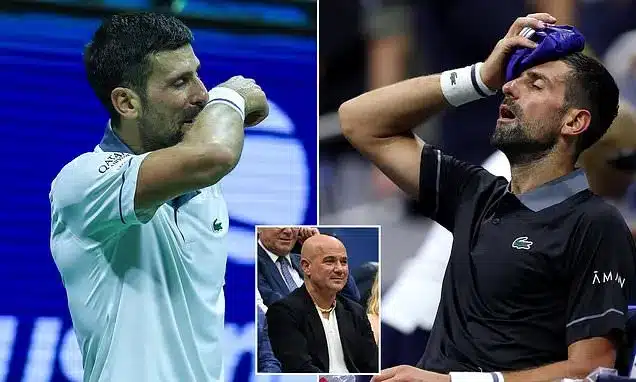
Novak Djokovic’s unexpected early exit from the US Open, marked by emotional tears on court, has brought renewed attention to his physical condition and the potential twilight of his illustrious career. The Serbian tennis legend was defeated in the first round by a resurgent Mariano Navone, a result that signifies his earliest Grand Slam departure in two decades.
Djokovic’s US Open Upset and Emotional Outburst
The match against Navone, held at the iconic Arthur Ashe Stadium, stretched for four hours and 36 minutes, concluding with a 7-6(5), 5-7, 4-6, 6-2, 6-1 loss for Djokovic. This defeat follows a pattern of uncharacteristic performances in recent majors, including a third-round exit at the French Open earlier this year. The stark contrast to his dominance in the previous year, where he reached the semifinals of all four Grand Slams, has fueled speculation about his future at the sport’s highest level.
During the grueling five-set encounter, Djokovic was visibly distressed, at one point breaking down in tears while the match was still in progress. He later shared his perspective on this emotional display, attributing it to a combination of immense physical suffering and an overwhelming sense of gratitude for the crowd’s support.
“They were super nice. So grateful to experience this,” Djokovic told ATP Tour reporters after the match. “When it comes to [the] match itself and overall feeling of how I felt with body and playing, it was really not enjoyable. I pretty much despised every moment that I spent on the court for that. But from the perspective of the crowd and support, it was incredible, honestly from the beginning.”
He expressed regret for not performing to his own high standards for the fans who rallied behind him. “They were trying to lift me up in important moments, and I’m very sorry that I didn’t perform as well as I should have or could have or wanted for them. But the love and appreciation they gave me in the end was really touched my heart.”
Physical Suffering and Andre Agassi’s Prophetic Warning
Djokovic candidly detailed the extent of his physical struggles throughout the match, revealing that he has been battling significant issues for much of the current year. “It’s something that I’ve been carrying, unfortunately, pretty much every match this year,” he explained. “Vomiting, throwing up, a serious issue there. Then my whole body starts to collapse, basically cramping and pain. Yeah, the back just gave up in the end and shoulder, and I couldn’t close it out.”
These physical ailments lend a poignant resonance to a recent warning issued by Andre Agassi, the American tennis icon and former coach of Djokovic. Featured in a new Amazon Prime Video documentary, ‘Novak Djokovic: The Wolf In Winter,’ Agassi offered a stark observation about the nature of ending a professional tennis career.
“I don’t know when the end will come for Novak,” Agassi stated. “But the one thing I can say is the end, when it does come, always comes fast.” This sentiment appears to be materializing as Djokovic grapples with his body’s limitations, suggesting that the final chapter of his career might arrive more abruptly than anticipated.
Reflections on Legacy and Appreciation
Despite the current challenges, Agassi also emphasized Djokovic’s unparalleled legacy in the sport. He asserted that Djokovic’s contributions and achievements have not been fully appreciated and declared him the greatest of all time.
“I don’t feel like he’s been appreciated nearly as much as he’s worthy of for what he’s brought to the game of tennis,” Agassi commented. “Nobody can touch what he’s accomplished. It is as clear as it gets: he’s the best of all time.”
Djokovic’s journey through the US Open underscores a critical juncture in his career. While the physical pain and the emotional toll of his first-round exit are undeniable, his reflections highlight a deep connection with his fans and a profound sense of gratitude, even amidst the difficult reality of his current physical state.
Looking Ahead: The Uncertain Future
The coming months will be crucial for Djokovic as he navigates these physical challenges and contemplates his future in professional tennis. The early exit from a Grand Slam, coupled with Agassi’s sobering words, serves as a stark reminder of the finite nature of athletic careers, even for those at the pinnacle of their sport. Fans and analysts alike will be watching closely to see how Djokovic addresses his physical condition and whether he can continue to compete at the elite level he has defined for so long.
The narrative of Djokovic’s career has always been one of resilience and overcoming adversity. However, the current physical battles present a different kind of challenge, one that may ultimately dictate the terms of his departure from the game he has so profoundly shaped.