
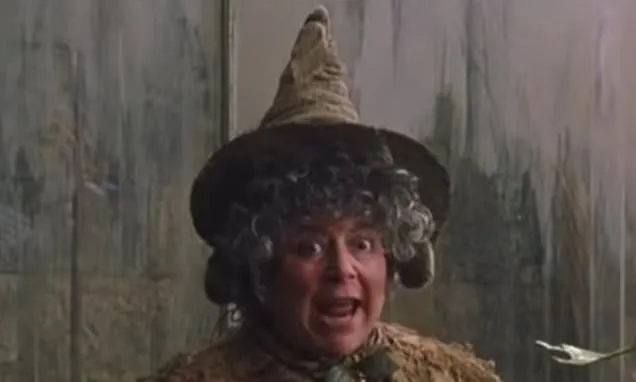
Actress Miriam Margolyes has recently drawn attention for her candid remarks about her earnings from the Harry Potter film franchise, describing her £60,000 salary as “rubbish.” This statement follows a period of controversy surrounding comments she made about ITV presenter Andi Peters. Margolyes, who portrayed Professor Sprout in two of the eight Harry Potter films, Harry Potter and the Chamber of Secrets and Harry Potter and the Deathly Hallows – Part 2, expressed dissatisfaction with being primarily associated with the role.
Margolyes’s Discontent with Harry Potter Role and Earnings
During a live panel discussion, Margolyes voiced her frustration, stating, “I’m not thrilled that everybody thinks of me as Professor Sprout. Because I have done other, better things.” She then revealed the sum she received for her work on the popular series: “£60K – it’s f***ing rubbish!” While acknowledging that such pay disparities are common in the entertainment industry, she indicated her unhappiness with the amount.
The actress, aged 85, is currently promoting her new book, Full English. Her recent public appearances have also been marked by discussions regarding an incident involving Andi Peters on the ITV program This Morning.
Controversy Surrounding Comments on Andi Peters
The controversy erupted when Margolyes used an offensive term, “high yalla,” to describe Peters’s skin color during a segment on This Morning. The term, an archaic and derogatory slang from the United States, refers to a Black person with a light complexion. The clip of the exchange was initially removed from the ITVX recording of the show but subsequently circulated online, prompting widespread criticism and expressions of outrage on social media platforms.
Margolyes addressed the backlash during an audience event for her memoir in Southend. Videos shared by attendees captured her explaining her perspective. She stated that she had no intention of embarrassing or hurting Peters, whom she had met for the first time and did not initially recognize as Black. “I didn’t know who he was and I didn’t know he was black until I saw him,” Margolyes explained. “When you see someone, of course you know they’re black. I wanted to know what he thought about it because that’s what interests me.”
She further elaborated on her curiosity about people’s identities and experiences, extending her inquiry to various groups. “How do black people feel? How do brown people feel? How do cripples feel? How do fat people feel?” she asked. “You see what I mean? All of us feel something about who we are and how people see us, what they think of us.” When the host clarified that she wanted to discuss his identity, Margolyes agreed, emphasizing her fascination with understanding people’s life stories and the factors that shape them.
Details of the ‘This Morning’ Exchange
The conversation on This Morning began with Margolyes impersonating host Christine Lampard’s accent before turning to Peters. She inquired about his accent, to which Peters responded that his current speech was normal for him. Margolyes then commented on his mixed heritage, suggesting he had a Black father and a white mother. Peters corrected her, confirming that both his parents are Black. He then lightheartedly questioned if he was a lighter shade than usual.
Margolyes proceeded to use the term “high yalla,” explaining it as a term used in America for individuals who are not “deeply black.” Peters indicated he was unaware of such distinctions in skin tone terminology. It was at this point that producers reportedly issued a warning through Peters’s earpiece, leading him to remark aloud, “They’re getting nervous now.” Margolyes reassured him, stating, “Don’t be nervous. We welcome everybody. That’s what I want to write about in my book. It’s about inclusion.”
Public Reaction and Defense
The incident sparked a strong reaction online. Many viewers accused Margolyes of racism, with comments on social media ranging from “Miriam Margolyes just sounds like a run-of-the-mill racist here” to comparisons with historical racism on plantations. Some critics found her remarks to be “uncomfortable viewing” and outdated.
However, not all reactions were negative. Some individuals defended Margolyes, suggesting her comments stemmed from ignorance rather than malice, with one user stating, “What is racist about that? Ignorance maybe but this isn’t racism.”
Andi Peters himself has since commented on the situation, stating that he must be “ready for anything” in his role. Fellow journalist Jeremy Vine shared the clip, describing Margolyes’s comments as “seriously nerve-wracking” and praising Peters for his handling of the live interaction. Peters thanked Vine for his support, acknowledging the need to be prepared for unexpected situations during broadcasts.
Conclusion
Miriam Margolyes’s recent statements have reignited discussions about her public persona and the impact of her words. While she defends her remarks as stemming from a genuine interest in people’s identities and experiences, and her book promoting inclusion, her use of offensive language has led to significant criticism. The controversy highlights the ongoing sensitivity surrounding discussions of race and identity in public discourse.