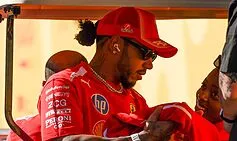
Lewis Hamilton is under scrutiny following an incident during final practice for the Spanish Grand Prix that could lead to a penalty. While the initial event was his car making contact with the barriers, it was his subsequent actions that drew significant attention and criticism, particularly from commentators.
Hamilton’s Crash and Post-Incident Actions
The incident occurred while Hamilton was on a fast lap. He lost control of his Ferrari, resulting in the front of the car impacting the tire barrier. The session was immediately red-flagged to allow for the recovery of the vehicle. Hamilton managed to extricate his car from the barrier himself.
However, due to the circuit’s layout at the Madrid circuit, Hamilton had to complete a full lap to reach the pit lane entry. The problem was that his damaged front wing had become lodged underneath the front of his car. As he proceeded slowly, the dragging wing generated sparks and caused the front tire to rub against the debris, leading to a significant smoking effect and eventually a puncture.
Radio Exchanges and Driver’s Decision
During this slow lap back to the pits, Hamilton’s race engineer repeatedly instructed him to stop the car in a safe location. The engineer’s messages included directives such as, “Stop in the safest place, in the safety place possible.” Despite these clear instructions, Hamilton indicated his intention to try and return to the pits, responding, “If I can make it back, I will. If not, I will do it safely.”
The engineer reiterated the urgency, stating, “We have a puncture on the front right. Stop the car.” Hamilton acknowledged the information, replying, “I can see that,” but continued driving for a period before eventually pulling over to the side of the track and exiting the vehicle.
Expert Criticism and Potential Consequences
Hamilton’s decision not to stop the car immediately, despite the evident damage and clear instructions, drew sharp criticism from former driver and Sky Sports F1 commentator Anthony Davidson, and lead commentator David Croft. Croft highlighted the rules of racing, stating, “I know he’s done 393 Grands Prix, but the rules are, you don’t drive the car in an unsafe condition.” He emphasized that the team had instructed Hamilton to stop, and his continued driving against those orders was a serious matter that race control would likely review.
Davidson suggested that Ferrari’s radio instructions might not have been sufficiently explicit. He proposed that the team should have provided more specific details, such as informing Hamilton that the front wing was trapped beneath the car and that the situation could lead to a penalty from the race director.
Furthermore, Davidson expressed concern about the example Hamilton’s actions set for aspiring drivers. “Any young driver that is watching this right now, you don’t do that. You just don’t do that,” he stated. He elaborated on the potential dangers, explaining that if the wing had completely jammed the front wheels or if marshals were present on the track, the consequences could have been severe.
FIA Guidelines and Penalty Outlook
The FIA, motorsport’s governing body, has established penalty guidelines for stewards to follow. Depending on the stewards’ assessment of the severity of Hamilton’s actions and the potential risks involved, he could face consequences ranging from a formal reprimand to a grid penalty for the Spanish Grand Prix. As of the time of reporting, no official investigation or decision had been announced by race control.
Broader Implications for Driver Conduct
This incident underscores the critical importance of driver adherence to safety protocols and team instructions in Formula 1. While drivers often push the limits and strive to maximize their chances of success, safety regulations are paramount. The FIA’s rules are designed to protect drivers, marshals, and spectators, and any perceived breach is taken very seriously.
The situation also highlights the complex communication dynamics between drivers and their teams during high-pressure race conditions. Ensuring clear, unambiguous instructions are given and understood is vital, especially when dealing with potentially hazardous car damage. The stewards’ final decision will set a precedent for how similar situations are handled in future races, reinforcing the non-negotiable nature of car safety on track.
Hamilton’s experience serves as a stark reminder that even seasoned champions must comply with the established safety framework. The potential penalty, while not yet confirmed, reflects the gravity with which such incidents are viewed within the sport.