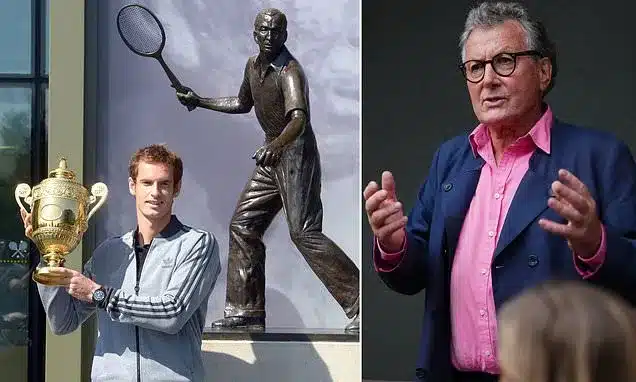
A new statue honoring two-time Wimbledon champion Andy Murray is in development, with sculptor David Williams-Ellis revealing a unique approach to capturing the tennis star’s dynamic athleticism. Williams-Ellis, chosen to immortalize Murray for the All England Club, is employing a younger sportsman as a model to represent Murray in his prime, aiming to depict the athlete’s energy and “softer side” rather than his current, more weathered appearance. The bronze sculpture, slated for a 2027 unveiling to coincide with Wimbledon’s 150th anniversary, will be larger than life-size, depicting Murray in mid-action with a tennis racquet.
Capturing Movement and Character
Williams-Ellis, known for his D-Day landings sculpture, explained that while Murray, now 38, has been actively involved, posing patiently and consulting on the project with his wife Kim Sears, the sculptor opted to use a 23-year-old athlete. “Andy at 38 is a bit gnarly,” Williams-Ellis stated, noting that the statue will represent Murray between the ages of 23 and 25. The stand-in model, named Joe, was selected for his athletic build and ability to replicate the demanding poses required.
“Andy’s muscles are not as light or as fluid,” Williams-Ellis elaborated. “So I trawled everywhere to find a young athletic stand-in – Andy is quite stocky and muscular so the person that stands in has to be strong enough to do the pose. He needed to be similar and Andy is really quite big.” The sculptor has amassed around 150 photos and video screenshots of Murray, meticulously studying them frame by frame to ensure accuracy in movement and form.
The artist’s vision extends beyond mere physical representation. “What I want to capture in the sculpture is movement and energy and what I hope I will also capture is Andy’s determination and also his incredibly nice soft side,” he shared. Williams-Ellis observed that while Murray appears intense and even aggressive on court, off the court he possesses a “laconic, wonderful smile and a very dry sense of humour.” This duality is something the sculptor aims to convey.
Collaboration and Artistic Process
The collaboration with Andy Murray and his wife Kim Sears has been integral to the process. Williams-Ellis confirmed multiple meetings with the couple, who have been “definitely very involved” and “played a big part in the selection.” They have reportedly approved of the progress made so far.
Murray’s primary concern, according to the sculptor, was that the statue should avoid the pitfalls of some less successful sporting sculptures seen elsewhere. “Andy’s only concern was that it didn’t end up like some of the sporting sculptures you see around at stadiums around the world,” Williams-Ellis said.
The statue, standing at approximately 7 feet tall (life-size plus a fifth), will be cast in bronze and placed on a plinth at an undisclosed location within the Wimbledon grounds. Williams-Ellis described the practical challenges of working with the large clay model, which weighs half a tonne and requires constant attention to prevent drying out or becoming too wet, especially in warm weather.
Challenges in Sculpting Modern Details
One of the most unexpected difficulties has been recreating modern tennis shoes. “They are incredibly difficult to sculpt and are computer designed,” Williams-Ellis noted. “I have had lots of problems with them but I will get them right. They’re not like normal shoes – it’s the hardest pair of shoes I have ever had to do.”
Williams-Ellis expressed the immense pressure of the project, admitting to “sleepless nights” over the need for absolute accuracy in likeness, movement, and character. “The likeness is essential, and the likeness of his movement and character is also essential, so there are lots of risks,” he stated. He is determined to avoid creating a sculpture that falls short of expectations, drawing a parallel to his work on the D-Day sculpture where he aimed to capture the “weight of their bodies coming off the beach,” the “spring and that power and that instantaneousness that great tennis players have as well as his character.”
A Legacy in Bronze
The decision to honor Murray with a statue at Wimbledon is a significant recognition of his impact on British tennis. Murray is the last British man to win Wimbledon before Fred Perry, achieving his victories in 2013 and 2016. The Fred Perry statue at Wimbledon, erected in 1984, stands as a testament to the enduring legacy of British champions at the tournament.
Williams-Ellis, a self-proclaimed tennis fan who has followed Murray’s career closely, described the opportunity to work with the player as “fabulous” and a “wonderful, wonderful chance to get to know someone and get to know his character.” He praised Murray’s professionalism and ability to take direction, likening it to his experience on court. “He took instruction incredibly well and someone commented that it was probably because he was used to being coached. I described what I wanted him to do and he knew exactly and did the same thing every time. It was natural to him.”
Looking ahead, Williams-Ellis anticipates the toughest critics might be Murray’s four children, joking that he awaits their reaction with “trepidation” due to their inherent honesty.