
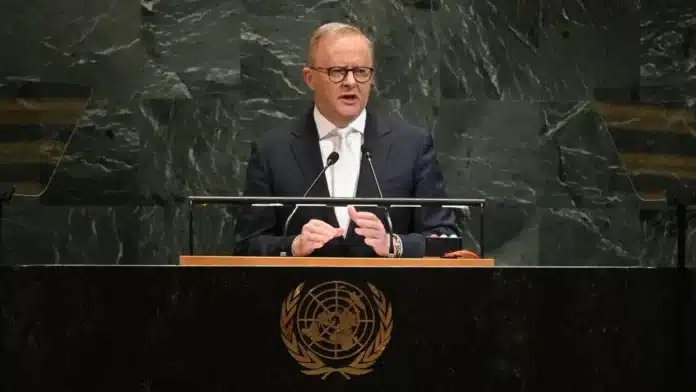
Australia is preparing to formally launch its bid for a non-permanent seat on the United Nations Security Council, with Prime Minister Anthony Albanese asserting that middle powers like Australia are essential for enhancing the council’s effectiveness, particularly amidst ongoing global conflicts. The nation is vying for a two-year term on the 15-member body, specifically for the 2029 and 2030 period. While the official vote is not scheduled until mid-2028, intensive lobbying efforts are expected to commence as world leaders converge for the UN General Assembly’s high-level week.
Australia’s Case for Security Council Membership
Prime Minister Albanese highlighted the critical role middle powers can play in a Security Council grappling with complex international challenges, such as the protracted wars in Europe and the Middle East. He emphasized the need for the UN, and specifically the Security Council, to adapt and become more effective in the current geopolitical climate. “The Security Council needs reform and it needs to be made more effective; there’s no doubt about that,” Albanese stated in a recent interview. “Clearly, there’s a need for the UN to step up. There’s a need for middle powers as well, such as Australia, to exercise the influence that we have.”
Australia’s foreign policy has long championed multilateralism, and securing a seat on the Security Council is seen as a key objective to further this commitment. The nation’s strong global standing, its significant financial contributions to the UN – ranking as the eighth-largest funder – and its history of participating in international peacekeeping missions form the cornerstone of its campaign. “We have, I think, a strong case. We have been prepared to lead the world and to be a part of peacekeeping missions,” Albanese added, underscoring Australia’s readiness to contribute actively to global security efforts.
The Election Process and Australia’s Position
The Security Council comprises 15 members: five permanent members with veto power (China, France, Russia, the United Kingdom, and the United States) and ten non-permanent members elected for two-year terms. These non-permanent members are chosen from regional groups. Australia belongs to the Western Europe and Others Group, which typically elects two non-permanent members. Currently, Australia and Finland are the only declared candidates from this bloc for the 2029-2030 term. However, other nations within the group could still submit their candidacies before the deadline.
Even if Australia and Finland were to run unopposed within their group, securing a seat requires a substantial endorsement. Australia must garner support from at least two-thirds of the 193 UN member states participating in the vote. This broad consensus underscores the diplomatic effort required, extending beyond regional alliances to a global appeal.
Australia’s Previous Security Council Tenure
Australia has previously served on the Security Council, with its most recent term occurring in 2013 and 2014. During that period, Australia played a notable role in international responses to crises, including its involvement in the investigation and aftermath of the downing of Malaysia Airlines flight MH17. This past experience provides a foundation of understanding and established relationships within the UN framework.
Lobbying Efforts and Diplomatic Engagements
Prime Minister Albanese’s visit to New York is strategically timed to coincide with the UN General Assembly’s high-level week, a period when global leaders are actively engaged in diplomatic discussions. His agenda includes addressing the General Assembly, providing a platform to articulate Australia’s vision for the Security Council and its commitment to multilateralism. The lobbying campaign will involve direct engagement with heads of state and government, foreign ministers, and permanent representatives of UN member states, aiming to build the necessary coalition of support.
The Significance of Middle Powers in Global Governance
The concept of “middle powers” refers to states that, while not superpowers, possess significant influence due to their economic strength, diplomatic engagement, and commitment to international norms. Countries like Australia are often seen as crucial bridges between major powers and smaller nations, capable of fostering consensus and driving pragmatic solutions. Their contributions are vital for the legitimacy and operational effectiveness of international institutions like the UN Security Council, especially when global consensus is fractured.
Albanese’s emphasis on the role of middle powers suggests a strategic approach to the campaign, aiming to appeal to a broad spectrum of UN members who may seek a more balanced and inclusive approach to international security decision-making. By highlighting its track record and its dedication to multilateralism, Australia aims to present itself as a reliable and constructive partner on the global stage, well-equipped to contribute to the Security Council’s mandate.
Conclusion
Australia’s pursuit of a seat on the UN Security Council for 2029-2030 signifies a strategic move to enhance its influence on global security matters and champion the role of middle powers in international diplomacy. With a strong emphasis on multilateralism, a history of contributing to UN peacekeeping, and a significant financial commitment, Australia is building a compelling case. The upcoming lobbying efforts during the UN General Assembly will be crucial in securing the broad international support needed to achieve this important foreign policy objective.