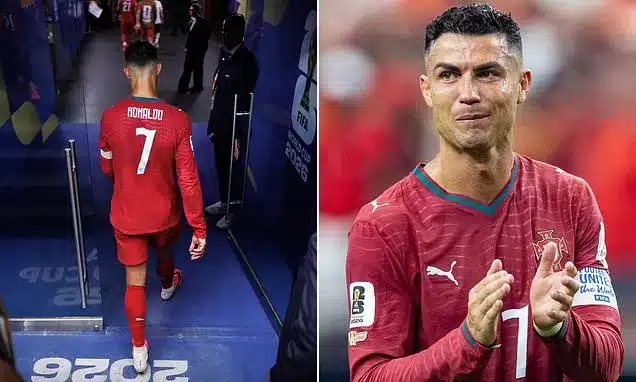
The final moments of Cristiano Ronaldo’s likely last World Cup match were marked by a solitary walk through the stadium’s corridors, a poignant image of a legendary career drawing to a close. Tears streamed down his face as he moved away from his teammates, who offered no visible gestures of support. This solitary departure underscored a narrative shift for the Portuguese national team, suggesting that their long-held reliance on their greatest ever footballer may have come at a strategic cost.
The Fading Aura of a Football Icon
In past tournaments, particularly the 2018 World Cup in Sochi, Ronaldo’s individual brilliance was instrumental in carrying a less dominant Portuguese side. His hat-trick against Spain in that competition showcased the kind of game-changing genius that once defined him. However, eight years later, the dynamic had reversed; Portugal carried him. While fleeting glimpses of his former prowess appeared, such as a shot that forced a save from the Spanish goalkeeper Unai Simon and a moment where he deftly controlled a cross, the overall impact was diminished.
For those who have witnessed Ronaldo’s peak – the soaring headers for Manchester United in the Champions League or the spectacular bicycle kick for Real Madrid – his final World Cup appearance was tinged with sadness. The statistics from the match against Spain reflected this decline: Ronaldo touched the ball only 19 times in total, with a mere seven touches in the second half. More telling, however, were the expressions of his teammates. When Pedro Neto drove forward, seeking to create a decisive opportunity, Ronaldo had positioned himself at the far post. Yet, the explosive acceleration that once propelled him into the six-yard box to meet such crosses was no longer evident, and the chance passed.
Spain’s Tactical Advantage
Spain’s tactical approach to the match highlighted Ronaldo’s reduced threat. Unlike a previous encounter where the fear of Erling Haaland’s pace kept opponents deep in their own half, Spain played with a high defensive line. They were confident that the 41-year-old Ronaldo, positioned further up the field, posed no significant danger of breaking through their defense. This allowed Spain to play with greater freedom, knowing they could easily contain him.
The game’s progression seemed to cry out for tactical adjustments. The introduction of Gonçalo Ramos, who had proven decisive in an earlier match against Croatia, was conspicuously absent for much of the game. By the final minutes, Portugal’s desperate attempts to find an equalizer involved crosses aimed at players significantly shorter than Ronaldo, such as the 5’8″ Bernardo Silva and the 5’9″ João Neves, who both rose to contest the aerial balls. This tactical approach seemed to bypass the veteran striker.
Circumstances Beyond the Pitch
The atmosphere surrounding Ronaldo’s final tournament was further complicated by external factors. His sister, Katia Aveiro, made several social media posts that were perceived as unhelpful, potentially impacting team morale. One such post, seemingly criticizing Bruno Fernandes, quickly gained international attention. Fernandes, who served as the de facto captain, had respectfully acknowledged Ronaldo’s significance in pre-match press conferences, highlighting the nominal captain’s enduring importance.
Ronaldo himself made a notable statement during a press conference, expressing frustration with certain journalists. “The hardest thing at 41 is talking to certain journalists, especially those who don’t like me,” he remarked, offering a glimpse into his complex relationship with the media. His prior confirmation that this tournament would be his last for Portugal seemed to cast a shadow over the proceedings even before the knockout stages began.
Reflections on a Storied Career
Speaking in the mixed zone after the match, Ronaldo expressed that he left with a clear conscience, having contributed to Portugal winning three major titles – a feat unmatched before his tenure. “Before Cristiano, they hadn’t won any. I’m happy,” he stated, his use of the third person a recurring element in discussions of his legacy.
While the tone in Portugal remained largely respectful and appreciative of their national idol, critical voices emerged. Former national team manager António Oliveira, in an opinion piece titled “Above all, Portugal,” suggested that manager Roberto Martínez should have substituted Ronaldo against Spain. Oliveira acknowledged Ronaldo’s immense contributions, stating, “For his talent, discipline, ambition, longevity, and everything he gave to Portuguese football, he deserves respect, admiration, and gratitude. His legacy is eternal.” However, he emphasized the primacy of the collective: “When the game demands a different physical or competitive response, it is up to the coach to decide with courage and clarity what best serves the team.” Oliveira posited that a different decision could have protected both the team and Ronaldo himself, concluding, “Because, in the national team, there is only one jersey above all others: that of Portugal.”
A Final Comparison and a Melancholy Farewell
Ronaldo’s career has often been juxtaposed with that of Lionel Messi, and his desire to replicate Messi’s national team triumphs was evident. He had expressed excitement about a potential quarter-final clash with Argentina after a strong group stage performance. However, the challenge of facing Spain at 41 proved far more formidable than facing Uzbekistan.
As Ronaldo prepares to step away from the international stage, his journey reflects the natural progression of a footballer’s career. “That’s the life of a footballer; sometimes you win, sometimes you lose. You have to keep going. Tomorrow is another day,” he remarked before departing the tournament. The melancholy surrounding his exit from football’s grandest stage was palpable, marking an end that felt unbefitting of one of the game’s undisputed greats.