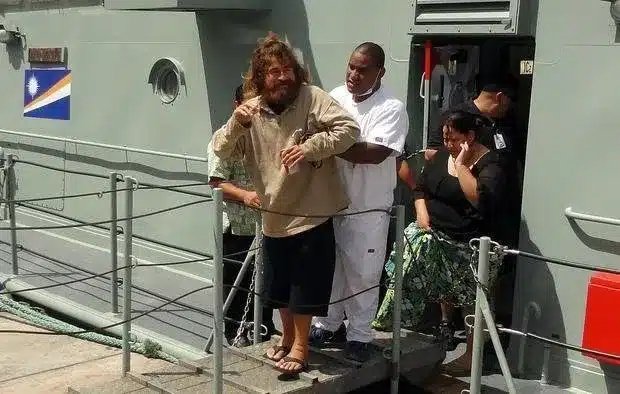
José Salvador Alvarenga emerged from a patrol boat onto the dock in Majuro, the capital of the Marshall Islands, a shadow of the man who had set sail 14 months prior. His hair was matted, his face obscured by a thick beard, and his steps were tentative, betraying the immense toll of his ordeal. After 438 days adrift in a small fishing vessel, Alvarenga, then 36, was weak, suffering from malnutrition and likely infected with parasites from consuming raw birds and turtle blood. A nurse stayed by his side as he set foot on dry land for the first time in over a year.
A Fishing Trip Gone Catastrophic
Alvarenga’s harrowing journey began in November 2012 with what was meant to be a routine two-day shark fishing trip from Costa Azul, Mexico. However, a severe storm struck shortly after he and his 22-year-old apprentice, Ezequiel Córdoba, set out. The storm disabled their boat’s GPS and motor, leaving them adrift and at the mercy of the vast Pacific Ocean. They were swept far offshore, beyond the reach of any immediate rescue.
The vessel itself was a basic, 25-foot fiberglass craft, described as more of a glorified rowboat than an ocean-going vessel. It lacked a cabin or roof, offering only a small, fridge-sized crate for storing their catch, which would become Alvarenga’s sole shelter for the duration of his survival.
Ingenious and Desperate Survival Tactics
The initial days were marked by freezing temperatures and disorientation. Huddled together for warmth under an overturned ice box, Alvarenga and Córdoba soon faced the brutal equatorial sun. Hunger became an all-consuming force. Alvarenga recounted resorting to extreme measures, including eating his own fingernails and even fantasizing about consuming his own finger.
To combat dehydration, they drank their own urine and licked the interior of the boat for any residual moisture. Scavenging became a daily necessity; they would retrieve floating debris, once finding and sharing a piece of chewed gum. Alvarenga even resorted to chewing on a wooden plank until it turned to pulp in a desperate attempt to ingest something.
His survival strategy involved catching and consuming whatever the ocean provided. He described luring birds onto the boat, snaring them, and drinking their blood, saving the meat for later. Turtles and fish also became sustenance. Alvarenga attempted to make each meal a ritual, sharing with Córdoba. However, the younger fisherman struggled to stomach the raw blood, which ultimately contributed to his decline.
The Loss of Ezequiel Córdoba
Four months into their ordeal, Córdoba informed Alvarenga that he was dying. Despite Alvarenga’s efforts to sustain them both, the apprentice succumbed to the harsh conditions. Alvarenga recounted wrestling with the immense trauma of this loss, keeping Córdoba’s body propped up and talking to him for days before eventually sending him overboard. The experience left Alvarenga deeply affected, leading to a period of intense grief and despair.
Enduring Solitude and Hallucinations
Following Córdoba’s death, Alvarenga faced months of solitude, punctuated by cycles of hunting, desperation, and vivid hallucinations. He witnessed a container ship pass incredibly close, its occupants visible, yet they failed to see him, a moment of profound heartbreak. At times, he contemplated suicide and even considered offering himself to sharks.
Despite the overwhelming despair, Alvarenga’s resilience as a fisherman kept him going. He found small comforts, such as fashioning a pillow from seaweed, only to discover it was teeming with life. He developed coping mechanisms, including talking to birds and testing the waters for sharks before swimming.
Discovery and Rescue
After 14 months adrift, Alvarenga spotted land, initially dismissing it as another hallucination. It was, in fact, the remote Ebon Atoll in the Marshall Islands, an astonishing distance from his starting point. He rowed for hours and swam the final stretch, crawling onto the beach in a state of disbelief.
Local residents, Emi Libokmeto and Russel Laikidrik, took him in, offering him coconut water and food. Initially, they were wary, mistaking him for a disoriented tourist. As Alvarenga began to recount his story, his Spanish was unintelligible to the Marshallese locals. It was only when U.S. Ambassador Tom Armbruster and his deputy met him that his incredible tale began to be formally documented.
Skepticism and Vindication
Alvarenga’s story was met with considerable skepticism from the global press. The idea of surviving over a year adrift in such conditions seemed almost unbelievable. However, Ambassador Armbruster, who spoke with Alvarenga extensively, became convinced of the veracity of his account. He noted Alvarenga’s coherent, albeit shocked, state and the sheer improbability of his location if the story were untrue.
Alvarenga’s account detailed moments of extreme despair and near-complete breakdown, yet his resourcefulness and will to survive ultimately prevailed. He had traveled an estimated 9,000 miles from his point of origin.
The Aftermath and a Message of Hope
Upon returning to land, Alvarenga struggled to readjust. He experienced a period of intense fear of water and, despite the joy of reuniting with his daughter, became withdrawn, needing company but struggling to communicate, plagued by nightmares.
He later collaborated with journalist Jonathan Franklin on a book detailing his experience, aiming to offer hope to others facing hardship. Alvarenga stated, “I suffered so much and for so long. Maybe if people read this they will realise that if I can make it, they can make it. Many people suffer only because of what happens in their head; I was physically being tortured. I had no food. No water. If I can make it so can you.”
Following the book’s release, the family of Ezequiel Córdoba filed a lawsuit alleging cannibalism and defamation, a claim that was eventually dropped after experts found no evidence of foul play and Alvarenga passed a lie detector test.
Alvarenga has since maintained a low profile, seeking to live quietly with his family. His survival is widely regarded as one of the most extraordinary feats of human endurance and resourcefulness in modern history.