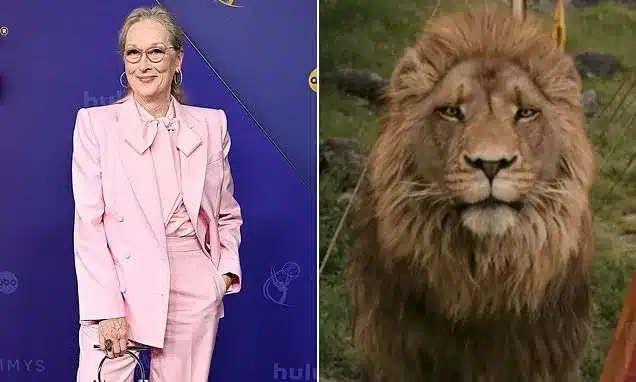
The casting of Meryl Streep to voice the iconic character Aslan in Netflix’s upcoming adaptation of C.S. Lewis’s The Magician’s Nephew has ignited a significant backlash among some Christian viewers and critics. The decision to have the acclaimed actress portray the mythical lion, a figure often interpreted as a Christ-like figure in Lewis’s work, has led to accusations of a “woke” agenda and a departure from the source material’s spiritual underpinnings.
Controversy Surrounds Aslan’s Portrayal
Meryl Streep, 77, is set to lend her voice to Aslan in the new film, which is being written and directed by Greta Gerwig. The film is scheduled for a theatrical release on February 12, 2027, followed by its debut on Netflix in April 2027. Aslan, the majestic talking lion central to the Narnia chronicles, holds deep symbolic meaning for many readers, particularly within Christian communities, due to his parallels with Jesus Christ—his sacrifice, resurrection, and role as the creator of Narnia.
This casting choice has drawn sharp criticism on social media platforms, with many expressing dismay at a woman voicing a character traditionally depicted and understood as male, and who is intrinsically linked to a male religious figure. One prominent concern voiced online stated, “Aslan is based on the story of Jesus. Jesus is male, and Aslan is obviously a male lion. What’s this about?” Others have directly appealed to Streep, with one message reading, “Dear Meryl Streep. I have watched your films and loved your talent for 40 years. Please do not do this. They are using you and your good name to blaspheme Christians.”
Critics have also labeled the move as “woke nonsense,” with one user on X commenting, “Hollywood hates money. Going woke, going broke. And extremely stupid.” The perceived incongruity of Streep’s voice for a male lion was also highlighted: “It doesn’t even make sense why a MALE LION would sound like Meryl Streep! It’s ridiculous!”
Concerns Over Adaptation’s Faithfulness
Beyond the casting itself, a significant portion of the criticism centers on the perceived dilution or alteration of the Christian themes inherent in C.S. Lewis’s work. “It’s rather sad what Greta is doing to CS Lewis classic. It has a Christian undertone and for some reason it’s not acceptable,” lamented one user. Another expressed a similar sentiment: “Stripping the Christian themes out of Narnia leaves you with something that is a complete different story. Typical Hollywood. They want Christian art but without the Christ. It doesn’t work like that.”
Political commentator Isabel Brown weighed in, emphasizing Lewis’s intentions: “In case there’s ANY confusion, CS Lewis literally intended Aslan to be the incarnation of Christ inside the world of Narnia.” She further elaborated, “Aslan is more than an allegory for Christ, he *is* how the creatures of Narnia experience Christ in their world just as we experience Jesus Christ as an incarnate MAN in ours.”
The backlash suggests a fear that the adaptation may stray too far from the spiritual core that resonates with many fans. “This is insane. It’s a male lion, the king of beasts and it parallels Christ. This completely changes the story. This movie is DOA!” declared one social media user. Another commented, “Bold decision but the type that could destroy buzz for a story with a strong Christian influence. Feels very Snow White-esque. Why does Hollywood keeping doing this.” Some viewers have stated they will boycott the film, with one user asserting, “That’s okay, we already have great Narnia movies. This one just won’t exist in my household.”
Director’s Vision and Inspirations
Greta Gerwig, known for her work on films like Barbie and Little Women, has shared her perspective on casting Streep. In an interview with Empire, Gerwig explained her criteria for the role of Aslan: “I wanted someone who was profound but not pretentious, who had gravitas but not morose self-seriousness. Someone who could communicate depth and pathos as well as joy and delight.” She further sought an actor “older than 70, so there was a wisdom of experience, but who also had the capacity of fresh wonder, like a child. And also to be one of the greatest actors to ever do it.”
Gerwig also revealed that the late musician David Bowie served as an inspiration for her interpretation of Aslan and the film’s aesthetic. She described her childhood fascination with Lewis’s work, stating, “I fell in love with the gorgeously improbable but completely brilliant concept of a cosmic lion singing the world of Narnia to life.” For Gerwig, bringing this story to life is an “honor of a lifetime,” evoking the sense of magic and wonder she experienced as a child reading the Narnia series.
Understanding Aslan’s Role in Narnia Lore
The theological interpretation of Aslan has been a subject of discussion among scholars and fans. In his book, A To Z With C.S. Lewis, author Louis Markos addresses the nature of Aslan’s relationship with Christ. Markos notes that while many assume Aslan is a direct allegory for Christ, Lewis himself distinguished between an allegory and the actual Christ within the Narnia universe. According to Markos, Lewis suggested that Aslan is not merely a stand-in but “the Christ of Narnia.”
Markos explains Lewis’s view: “As Lewis explained, Aslan is what the second person of the Trinity (God the Son) might have been like had he been incarnated in a magical world of talking animals and living trees.” This perspective imbues Aslan with a unique reality and force within the narrative, allowing him to deeply engage readers.
The Magician’s Nephew, the book on which the film is based, is considered an origin story for Narnia and was originally published as the sixth book in the series. The film marks the first screen adaptation of this particular Narnian tale.
Historical Context of Narnia Films
The previous film trilogy, released between 2005 and 2010, featured Liam Neeson as the voice of Aslan. These films achieved considerable commercial success, grossing approximately $1.5 billion worldwide. The enduring appeal of the Narnia stories, combined with the symbolic weight of Aslan, makes any new adaptation a focal point for discussion and debate among its devoted audience.
As Netflix and Greta Gerwig move forward with their interpretation, the conversation highlights the deep connection many feel to C.S. Lewis’s creation and the varied expectations for how its spiritual and thematic elements should be translated to the screen.