
Mexico City Devastated by Quakes Ahead of 1986 World Cup
In September 1985, nine months before Mexico was set to host its second FIFA World Cup, the nation was rocked by a catastrophic earthquake. The initial tremor, registering 8.0 on the Richter Scale, struck at 7:17 am, unleashing four minutes of intense seismic activity. The devastation was widespread, reducing parts of Mexico City, including its financial district, to rubble. Towering buildings collapsed like playing cards, hospitals and schools were flattened, and subway trains plunged into darkness, forcing passengers to navigate treacherous tracks.
The impact of the disaster on the upcoming World Cup was immense, echoing the tragedy of a government massacre of students that preceded Mexico’s first hosting in 1970. As the country grappled with the immense task of recovery, a powerful aftershock of magnitude 7.0 struck just over a month before the tournament’s opening match, further compounding the challenges.
Scenes of Devastation and Remarkable Survival
Upon arrival, the scenes were reminiscent of wartime landscapes. Areas most affected were those built on the unstable, sandy soil of the former Lake Texcoco, a testament to poor urban planning. Amidst the destruction, stories of profound tragedy and astonishing survival emerged.
The early morning timing of the first quake spared countless office workers, but tragically, children were among the victims, crushed by collapsing school buildings where morning assemblies were underway. In a heartwarming display of hope, rescuers worked for seven agonizing days to reach a nursery buried in the wreckage of the city’s oldest hospital. Miraculously, most of the newborn babies were pulled to safety after a week without food, water, or warmth, an event that became known as the ‘Miracle of Hospital Juarez’.
Another extraordinary tale of survival involved a foreign tourist. While taking an early morning swim in a rooftop pool, the entire structure detached from the building during the quake, plunging 15 floors. Remarkably, the pool remained upright, its water cushioning the man’s fall. He emerged from the wreckage, dripping wet but unharmed, to the cheers of onlookers.
Government Response and Public Resilience
The disaster also exposed dire working conditions. The destruction of a clothing factory and numerous fabric workshops revealed the exploitation of garment seamstresses, who worked long hours in oppressive conditions for meager wages. Reports indicated that only a few were saved by colleagues digging with their bare hands.
The government’s response was criticized as slow and shambolic. President Miguel de la Madrid delayed his first public statement for 48 hours and took several more days to accept international aid. Meanwhile, the death toll, initially understated by officials, was later estimated to be as high as 45,000. In stark contrast, the vast majority of Mexico’s population demonstrated remarkable optimism, helpfulness, and pride in their country’s culture, welcoming visitors with smiles despite the devastation.
Maradona’s ‘Hand of God’ and England’s Exit
The 1986 World Cup itself became intertwined with the nation’s struggles. Mexico’s team reached the quarter-finals, exceeding many expectations. England, after a shaky start, advanced to the same stage, fueled by Gary Lineker’s hat-trick against Poland and a brace against Paraguay.
The quarter-final match between England and Argentina in Mexico City’s Azteca Stadium was charged with historical tension, exacerbated by the recent Falklands War. Diego Maradona, the Argentine captain, reportedly rallied his team, emphasizing the need for victory on the football pitch. Chants of ‘Las Malvinas’ (Argentina’s name for the islands) echoed from their fans.
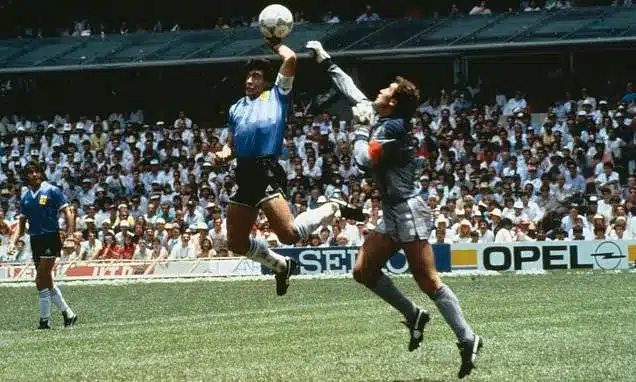
In the 51st minute, with the score goalless, a miscued clearance from England’s Steve Hodge sent the ball looping towards his own goal. Maradona, jumping alongside England goalkeeper Peter Shilton, punched the ball into the net. Despite English protests, the referee, with his view obstructed, allowed the goal, famously dubbed ‘The Hand of God’.
Four minutes later, Maradona scored what is widely considered the greatest World Cup goal of all time. He embarked on a mesmerizing solo run from the halfway line, evading multiple English defenders before rounding Shilton and slotting the ball home. England’s captain, Bryan Robson, who was sidelined with injury, later remarked that Maradona would not have advanced so far had he been playing.
Gary Lineker scored a late consolation goal, his sixth of the tournament, securing him the Golden Boot. However, it was not enough to prevent Argentina’s 2-1 victory. Argentina went on to defeat West Germany 3-2 in the final, clinching their second World Cup title.
A Nation Rebuilds and Demands Change
Following the tournament, the people of Mexico turned their focus back to rebuilding their lives and demanding accountability from their government. Community action groups emerged across affected regions, with ordinary citizens taking charge of reconstruction efforts. Water, gas, and electricity were restored through the initiative of local councils, highlighting a newfound self-reliance and a desire for a government that prioritized their needs.
In a testament to community spirit and artistic contribution, a statue of opera legend Placido Domingo would be erected, recognizing his role in financing the construction of a town for those left homeless. The collective realization of the populace’s power led to a significant political shift. Five years later, the Institutional Revolutionary Party, which had held power for over 70 years, was swept out of office, marking a turning point in Mexican political history. The ‘Hand of God’ goal, while iconic in football, became a symbol of a profound political own goal for the Mexican government of the time.