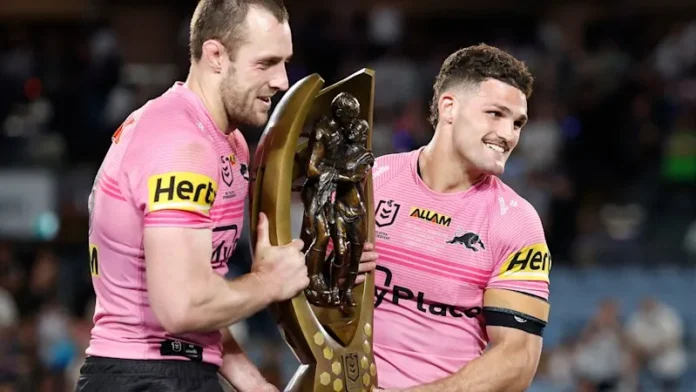
The potential season-ending pectoral injury to Penrith Panthers’ star Isaah Yeo has ignited a critical discussion within the NRL: can the reigning champions still contend for the premiership without one of their most vital players? Yeo, alongside halfback Nathan Cleary, is widely considered indispensable to Penrith’s success. This situation prompts a broader question for all NRL contenders: which single player’s absence would derail a team’s championship aspirations?
Assessing Player Dependency Across NRL Teams
Several clubs face similar dilemmas regarding key personnel. The Cronulla Sharks, for instance, have demonstrated resilience, securing victories even when key playmakers Nicho Hynes or Braydon Trindall were sidelined. However, the depth of their challenge is tested by the potential absence of hooker Blayke Brailey, whose dynamic style draws comparisons to Melbourne Storm’s Harry Grant. Brailey’s absence could significantly hamper their grand final ambitions.
In Newcastle, the Knights possess the talent to absorb the loss of five-eighth Dylan Brown. However, the absence of fullback Kalyn Ponga would be a devastating blow, fundamentally altering their campaign. The emergence of new star Francis Manuleleua also adds to the Knights’ critical player dependency.
The Dolphins have experienced firsthand the impact of a playmaker’s absence. Their form dipped significantly during Isaiya Katoa’s injury spell, but they have since surged back following his recovery, highlighting his importance to their structure and success.
Examining Sydney Clubs and the Warriors
When considering teams that might benefit if Penrith falter, the Sydney Roosters and the New Zealand Warriors emerge as strong contenders. However, even these well-rounded squads have players whose absence would be keenly felt. The Roosters, despite their depth, would struggle immensely if forward Naufahu Whyte were unavailable. His crucial go-forward sets the platform for playmakers like Sam Walker and impacts the effectiveness of veterans such as James Tedesco.
Victor Radley is another player whose role at first receiver is critical to the Roosters’ attacking shape, making him arguably their other indispensable figure. The Warriors, conversely, appear to be the least reliant on any single individual. While James Fisher-Harris remains arguably the premier prop in the game, the Warriors’ formidable pack possesses the depth to potentially cover his absence. A more subtle linchpin might be hooker Wayde Egan, whose vision from dummy-half orchestrates the dominance of their forwards.
The Specter of Meaningless Playoff Games
Beyond team dynamics, the article touches upon the controversial idea of a post-season “bronze medal playoff” in rugby league, drawing parallels to a similar fixture in the FIFA World Cup. The author recounts the widely criticized FIFA third-place playoff between England and France, described by The Guardian’s Jonathan Liew as “the match nobody wants to play.” The low stakes led to coaches fielding reserve players, resulting in a lopsided, uninspired contest that garnered little interest.
The prospect of a similar NRL fixture, potentially featuring reserve-grade players competing for minimal recognition, is presented as a dubious proposition. Such an event, driven by a desire for “content,” is argued to satisfy no one and devalue the sport’s competitive spirit. The author suggests this idea ranks among the most ill-conceived proposals in recent sports history.
Controversy in the AFL: Geelong’s Secret Contract
A significant portion of the discussion shifts to an extraordinary situation in the Australian Football League (AFL), involving Geelong Cats coach Chris Scott. Scott faced intense scrutiny following revelations of a secret contract between the club and player Jake Kolodjashnij. This agreement reportedly waived the player’s future claims related to the effects of head injuries, a practice deemed ethically questionable and potentially unlawful.
Scott’s response to the controversy was particularly striking. He claimed ignorance of the contract’s specifics and expressed a deliberate desire to remain at arm’s length from such matters, framing it as a modern approach to club governance. “It’s not 1980. The coach doesn’t run everything these days,” Scott stated, suggesting he is intentionally kept uninformed to avoid involvement in operational details outside his direct coaching remit. He further elaborated, “I don’t want to know too much… I’m one of the least-informed people… It’s not part of my remit.”
This stance drew sharp criticism, with comparisons made to the “I Know Nothing!” defense often associated with scandals. The author questions the logic of a head coach being deliberately kept unaware of potentially unlawful agreements concerning player welfare, especially given coaches’ frequent assertions of caring for players beyond their athletic roles. The piece calls for the NRL to investigate whether similar contracts exist within its clubs and if coaches are similarly shielded from such knowledge, emphasizing the critical need for transparency and accountability.
Indigenous Round Jersey Mix-Up
The article concludes with a critique of a jersey mishap during the NRL’s Indigenous Round. While acknowledging the NRL’s progress in Indigenous inclusion, surpassing the AFL in this regard, the author highlights a logistical blunder in the North Queensland Cowboys vs. Gold Coast Titans game. Both teams wore jerseys featuring similar panel designs, and crucially, they swapped their traditional team colours. The Titans wore the Cowboys’ dark blue, and the Cowboys donned the Titans’ teal, making identification difficult.
The confusion was compounded by the fact that both teams were scheduled to wear their Indigenous Round jerseys again the following week. The author questions the decision-making process that led to this colour swap, suggesting it was an avoidable error that detracted from the game’s experience. The only lasting impression of the match, aside from the scoreline, was the bewilderment caused by the jersey confusion.