Pyrography, the art of decorating wood or other materials by burning a design onto its surface with a heated tool, is experiencing a modern renaissance. This ancient technique, often referred to as fire painting, combines intricate craftsmanship with a unique artistic process. While contemporary artists like Emily Rose Hastie are pushing its boundaries in exhibitions and television, its roots run deep, connecting to Indigenous Australian traditions spanning thousands of years.
From Cheese Board to Exhibition: Emily Rose Hastie’s Pyrography Journey
For Gold Coast-based artist Emily Rose Hastie, the path to becoming a pyrography specialist began unexpectedly with a simple request for a cheese board. Having recently rediscovered her passion for drawing, focusing on charcoal and toned paper, Hastie was asked by her mother to add a design to a new wooden platter. The challenge was that traditional drawing or painting would render the board unsuitable for washing.
Hastie’s initial attempt using a school laser printer proved unsatisfying. “For me as an artist I was like, ‘I can do better’,” she recalls. This led her to a hardware store, where she purchased an affordable soldering kit. “It was like I got the soldering iron and this whole world emerged,” Hastie explains. What started as a practical solution quickly evolved into a profound artistic calling.
Now an established pyrography artist and co-founder of her own studio, Hastie’s career has flourished. Her first solo exhibition was held in 2021. More recently, she entered the prestigious Archibald Prize with a pyrography portrait of former Greens party leader Christine Milne. Her skills were also showcased on ABC iview’s Portrait Artist of the Year, where she created a likeness of Danni Minogue within a four-hour timeframe using only fire. “I love it, I can’t even transition back to canvas anymore — it feels strange to me,” Hastie admits. “But it was a total happy accident. And I always attribute it to my mum, bless her.”
Ancient Traditions: Pyrography and Indigenous Australian Heritage
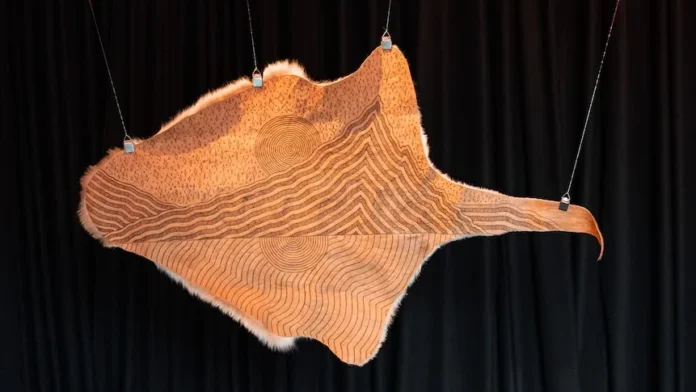
While Hastie’s exploration of pyrography is relatively recent, the practice itself is ancient, with a rich history across various cultures. In Australia, pyrography is deeply intertwined with the traditions of Aboriginal and Torres Strait Islander peoples, particularly in the creation of highly valued possum-skin cloaks.
These cloaks, decorated using pyrographic techniques, served as more than just garments; they were vital historical records. “Our ancestors would use these cloaks as a record of one’s journey; certain things, depending on your connection to the tribe, would be inscribed on these cloaks,” explains Iluka Sax-Williams, a 26-year-old artist from the Taungurung people of the Kulin Nation and Zenadth Kes (Torres Strait Islands). “As time went on, the cloak would grow with its wearer, and by the time you were ready to rest, you would also be buried with your cloak.”
The colonial era led to the suppression and loss of many of these cultural practices. Possum-skin cloak making, in particular, fell into silence for a significant period. However, a powerful resurgence began in the late 20th century, driven by a desire to reclaim and revitalise this heritage.
Reawakening the Songlines
A pivotal moment occurred in 1999 when three women—Aunty Vicki Couzens, Aunty Lee Darroch, and Aunty Treahna Hamm—were shown two First Nations possum-skin cloaks from the late 1800s, held in Museum Victoria’s collection. This encounter was deeply moving, described by Dr. Vicki Couzens as “a call from the ancestors to reawaken the song lines of the possum cloak story, to return the cloaks to our people, to reclaim, regenerate, revitalise and remember.”
Inspired by this call, Dr. Couzens, alongside other Gunditjmara people from western Victoria, began hosting possum-skin cloak workshops. These initiatives aimed to reconnect community members with the art form and its cultural significance. This movement has been instrumental in breathing new life into the practice.
A New Generation of Fire Artists
Iluka Sax-Williams, who grew up witnessing the artistic traditions of his family, was significantly influenced by the work of artists like Dr. Couzens. He learned the intricate techniques for decorating possum-skin cloaks and has since built a successful career in pyrography. His work, including a pyrography piece on kangaroo skin titled Woora Liwik, has earned accolades such as the RMIT Emerging Artist Award and was featured on Melbourne’s Art Trams.
Sax-Williams finds deep pride in the cultural connection his art provides. “These women had to fight hard to get these [cloaks] back into the hands of our people,” he notes, referring to the efforts to reclaim ancestral artefacts. “But it’s not just that, it’s the knowledge as well, and spreading that back to us. That inspires me.” His work is set to be exhibited at the Koorie Heritage Trust in Naarm/Melbourne.
The Meditative Power of Pyrography
Despite the inherent intensity of working with heat and fire, both Hastie and Sax-Williams describe pyrography as a calming and meditative practice. Hastie, who identifies as a perfectionist, finds that the irreversible nature of pyrography fosters a sense of peace with her creations. “I have to commit and be at peace with what I’ve done,” she says.
The precision required for intricate designs demands intense focus. “Every medium has its own gift. I suppose when it comes to pyrography that one’s mindfulness,” Hastie observes. She also highlights the unique beauty of working with wood, appreciating its natural grain and grounding qualities as a collaborative element in her art.
Sax-Williams echoes these sentiments, finding the slow, deliberate process of pyrography to be deeply therapeutic. “In this fast-paced world it’s kind of hard to get two seconds to yourself, so it’s really nice to be able to really zone out, or zone in, and just really dive into it,” he states. “I won’t say it’s a breath of fresh air, because it’s definitely smoky, but it’s a lot of fun.”
Accessibility and Education
Pyrography is also noted for its accessibility. While advanced tools exist, Hastie often uses the basic nib she initially purchased. Sax-Williams has experimented with various materials, favouring the larger, thicker kangaroo skin over possum skin for some projects. He actively engages in teaching pyrography to both children and adults, finding that students are consistently surprised by the enjoyable and therapeutic nature of the art form.
Education is a cornerstone of Sax-Williams’ artistic practice. Influenced by his parents’ work in Indigenous education, he understands the critical importance of knowledge sharing. “It’s part of our culture, it’s something that was stripped away from us, and so growing up as a young black fella, we know these are things that we have to pass on to the next generation,” he explains. He shares this cultural heritage and artistic skill not only within Indigenous communities but also with the wider public through workshops and international travel, fostering a sense of shared love and understanding.
The art of pyrography, whether practiced as a modern artistic pursuit or a revitalised ancient tradition, offers a unique blend of discipline, creativity, and connection. It demonstrates how fire, a primal element, can be harnessed to create art that is both visually striking and deeply meaningful.