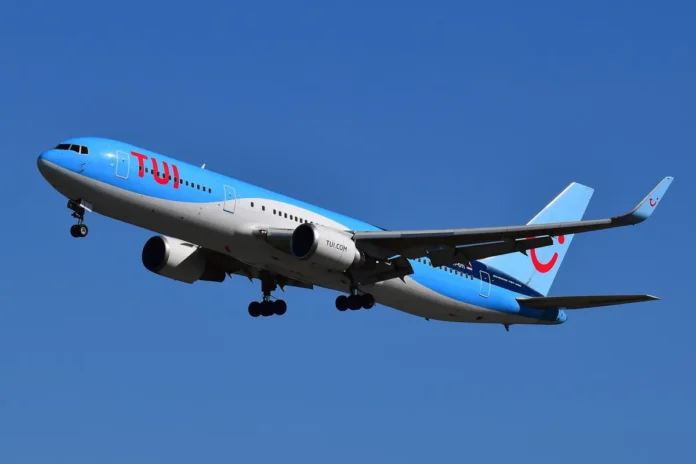
TUI Airlines is set to implement a significant change to its in-flight service for economy class passengers on long-haul journeys, discontinuing the provision of complimentary alcoholic beverages outside of meal times. This new policy, effective from November 1, 2026, means that passengers will no longer receive up to three free alcoholic drinks as previously offered on these flights. While soft drinks, water, and juices will continue to be complimentary throughout the flight, alcoholic options such as beer and wine will now only be included with the main meal. Any additional alcoholic drinks will be available for purchase.
Details of the TUI Alcohol Policy Change
A spokesperson for TUI confirmed the upcoming adjustments to the food and drink service for economy travellers on long-haul routes. The airline stated that customers will still receive complimentary soft drinks and one beer or wine with their main meal. For passengers who had already booked their flights before this change is implemented, TUI will offer a refund of £12.50 per flight, per direction, to compensate for the removed perk. It is important to note that the in-flight experience for passengers in the Premium cabin will remain unaffected by this new policy.
Passenger Reactions to the New Policy
The announcement has elicited a range of responses from travellers, particularly on social media platforms. On TikTok, some users have expressed support for the change. One user, @chrisbr, described it as “good news,” while @flyingjames commented that the previous policy “lasted longer than I thought it would.” Another user, @angiec009, welcomed the move, recounting a negative experience on a 10-hour flight where a large group of adults became heavily intoxicated before boarding and continued to be served alcohol for several hours, creating a disruptive atmosphere. This user felt it was akin to a flight filled with rowdy teenagers.
Conversely, many passengers have voiced their dissatisfaction. @emma.glynn2 stated, “TUI are dead to me,” and @reggie6386 remarked that the airline “has gone down the pan.” Exclamations like “How RUDE,” from @catfantastic5 and “One drink my a**e! Ffs!!!!!” from @rich46528 highlight the frustration felt by some. Others, such as @thedonnellyedit, argued for personal responsibility, suggesting that a blanket ban is unfair to those who enjoy one or two drinks responsibly, and that the actions of a few should not penalize the majority.
Broader Trends in Airline Alcohol Policies
TUI’s decision aligns with a growing trend among airlines to re-evaluate their alcohol policies, often in response to concerns about passenger behaviour and operational costs. Ryanair, for instance, has been vocal about the issue of disruptive passengers. CEO Michael O’Leary has suggested that airports, rather than airlines, should be responsible for restricting alcohol sales before flights, particularly for early morning departures. Ryanair has implemented measures such as a €500 fine for disruptive passengers, introduced in June 2025, and maintains crew discretion to limit drink purchases on board.
The problem of unruly passengers is statistically significant. According to the UK’s Civil Aviation Authority (CAA), the number of incidents involving intoxicated, violent, or unruly passengers reported by airlines rose from 390 in 2019 to 1,245 in 2023, remaining above 1,000 in 2024. Being intoxicated on a plane is a criminal offence, potentially leading to fines of up to £5,000 and two years’ imprisonment. A Which? investigation in 2025 identified alcohol as the most common cause of misbehaviour on flights, according to cabin crew.
Other airlines are also seeking stricter regulations. Jet2 has advocated for a national database to ban disruptive passengers from flying with all UK airlines. Surveys indicate a divided public opinion on alcohol restrictions. A GoCompare survey in 2024 revealed that 29% of UK respondents believed alcohol should be banned in airports, and 34% thought it should be banned on airlines. However, a majority (57%) opposed the introduction of such restrictions for air travel.
Financial Considerations for Airlines
Beyond passenger conduct, financial pressures are also influencing airline decisions regarding alcohol service. The International Air Transport Association (IATA) has revised its profit forecasts for the aviation industry downwards for 2026, citing factors such as the Iran war. The projected net profit for 2026 is now estimated at $23 billion, a significant decrease from earlier projections and previous years. This financial climate may incentivize airlines to reduce costs associated with complimentary services.
Industry experts suggest that the decision by TUI to maintain complimentary alcohol for premium cabin passengers, while removing it for economy, points to a dual motivation. Ben Westoby, a senior business consultant, noted that while managing disruptive behaviour is a challenge, the distinction between cabins implies that financial recovery is also a key driver. He highlighted that TUI experienced a substantial financial loss due to events in the Middle East, and recouping these losses could be a motivating factor behind the policy change.
Chad Teixeira, a consumer brand expert, concurred that both commercial and behavioural factors are likely at play. He emphasized that airlines are increasingly focused on providing a safe and comfortable environment for all passengers. Furthermore, he suggested that travellers are prioritizing reliability, comfort, and a pleasant journey over complimentary in-flight drinks when choosing an airline. This indicates a potential shift in consumer expectations within the air travel market.
Conclusion
TUI’s forthcoming policy change regarding complimentary alcohol on long-haul economy flights represents a notable shift in their customer service offering. While intended to address issues of passenger behaviour and potentially offset financial pressures, the decision has sparked debate among travellers. As other airlines continue to review their own policies and industry-wide challenges persist, the future of in-flight alcohol service may see further adjustments across the sector.