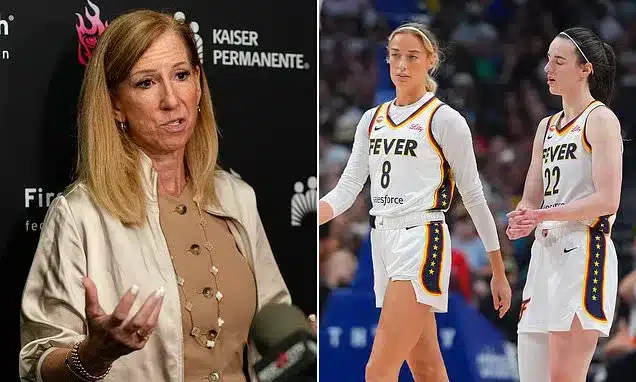
WNBA Commissioner Cathy Engelbert has spoken out against what she describes as external forces attempting to leverage the league for divisive purposes, particularly amid a surge in popularity and increased media attention. Engelbert stated that individuals with little connection to the WNBA are using the league as a “political football” to sow discord, diverting attention from the sport itself.
Navigating a Complex Cultural Landscape
The WNBA has recently found itself at the center of a “culture war,” with prominent storylines often extending beyond on-court performance. This has been particularly evident in the attention surrounding player Caitlin Clark and, more recently, Indiana Fever teammate Sophie Cunningham. Cunningham ignited a significant debate after expressing views on “protecting young girls” in women’s sports, a stance that drew both support and considerable backlash.
The controversy surrounding Cunningham led to visible reactions at games, including Minnesota Lynx head coach Cheryl Reeve wearing a shirt that read “Trans kids belong.” Cunningham herself has been met with boos at many games, and fan demonstrations, both for and against her views, have become a recurring sight. In one incident, fans wearing supportive t-shirts were reportedly asked by league security to cover them up, a situation the WNBA later acknowledged was handled improperly.
Player and League Responses to Controversy
Engelbert addressed the heightened vitriol directed at players, stating, “There’s always going to be haters out there and we denounce it. The vitriol has got to stop against our players.” She characterized the situation as a consequence of the league’s growing prominence as a “legitimate sports media and entertainment product.” Engelbert emphasized that the league is being targeted by those who “never watched the WNBA, never have written about the WNBA or reported on the WNBA,” suggesting their motives are not genuine engagement with the sport.
The WNBA’s policies regarding transgender athlete eligibility have also come under scrutiny. Two former NBA players have reportedly explored the possibility of entering the 2027 WNBA Draft, prompting discussions. A league task force recently convened to examine the issue, concluding that “There are no immediate eligibility matters affecting the WNBA, and we strongly denounce the bad-faith efforts to use these topics to demean or marginalize others.”
Criticism and Contract Uncertainty
Engelbert’s leadership has faced criticism, with some players expressing dissatisfaction. Sophie Cunningham, in comments to USA TODAY, suggested a need for a commissioner who is “bold, who is confident, who wants the best for the players and not maybe for themselves all the time.” Cunningham indicated that while Engelbert has achieved positive developments, a change in leadership might be beneficial as the league evolves. This sentiment echoes earlier criticisms from players like Napheesa Collier, who last year accused the league of having “the worst leadership,” and A’ja Wilson, who has noted a lack of interaction with the commissioner.
Engelbert’s contract is set to expire at the end of the year, adding a layer of uncertainty to her future with the WNBA. This period of transition coincides with significant growth and increased public interest in women’s basketball.
NBA Commissioner’s Perspective
Adam Silver, the NBA Commissioner to whom Engelbert reports, has also commented on the external pressures affecting the WNBA. He used the term “political football” to describe the situation, particularly concerning Caitlin Clark. Silver noted that the intense focus on Clark often overshadows the game itself, stating, “I think that ultimately the issues around Caitlin Clark are not largely about officiating… She’s become a bit of a political football in this country, and I think that’s incredibly unfair to her.”
Silver highlighted Clark’s desire to concentrate on her game and acknowledged the broader talent within the league. He reflected on the WNBA’s journey over the past 30 years, noting its past struggles to meet financial projections before a significant turnaround. The league has seen a dramatic increase in team valuations and a surge in popularity, partly attributed to the influx of new fans drawn by players like Clark, who initially captured attention during her college career.
A Rising Tide for Women’s Sports
Silver emphasized that the WNBA’s recent success is not solely attributable to one player but represents a collective “rising tide.” He pointed to the significant talent across the league and the growing audience, which includes young girls, women, and men who may not have previously followed women’s basketball. This broader engagement, he suggested, is a testament to the league’s increasing appeal and the overall advancement of women’s sports.
Engelbert’s remarks and the ongoing discussions underscore the challenges and opportunities facing the WNBA as it navigates increased visibility and external pressures. While celebrating the league’s growth and the dedication of its players, leadership aims to mitigate the impact of divisive narratives and maintain focus on the sport’s athletic achievements.