A Century of Secrets: The Remarkable Life of a WWII Linguist
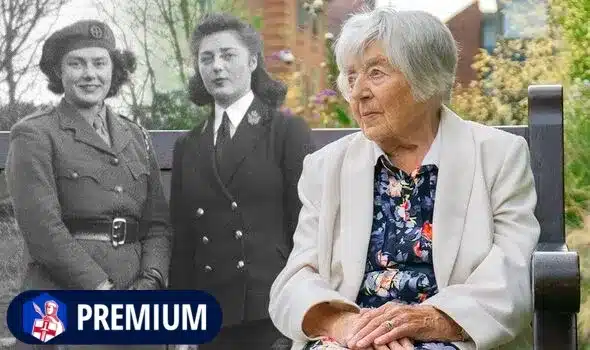
At 103 years old, Patricia Owtram stands as a living testament to a generation defined by courage and quiet service. Today, June 18th, marks her milestone birthday, celebrated by those who recognize her as one of the last surviving members of an elite group of women who played a crucial, yet long-hidden, role in Britain’s World War II efforts.
Owtram was part of an exclusive contingent of approximately 400 young women within the Women’s Royal Naval Service (Wrens). These individuals were recruited as Special Duties Linguists for the clandestine Naval Y Service, tasked with intercepting and deciphering German radio communications. For decades, the nature of her work remained a closely guarded secret, a burden shared by many of her generation who simply moved forward with their lives.
From Lancashire to the Blitz: A Call to Duty
In 1941, amidst the pervasive threat of invasion and the relentless bombing of the Blitz, an 18-year-old Owtram left her Lancashire home for London. Writing to her mother, she ed a profound sense of duty, stating, “I would hate to run away while everyone else stayed put… all my life I should feel I had run away from it.” Her decision to join the Women’s Royal Naval Service was driven by this unwavering commitment.
A childhood bout of bovine tuberculosis had initially presented an obstacle to her enlistment. However, a crucial detail on her application – that she could speak conversational German – altered her path. This linguistic skill, acquired from Austrian Jewish refugees who had found sanctuary in her childhood home, proved invaluable to a navy desperate for German speakers. These refugees, Lily Getzel and Edith Krochmalnik, would remain lifelong friends.
Intercepting the Enemy: The Secret of Station X
Owtram’s wartime mission involved long hours of intense concentration, listening to German naval radio transmissions. Alongside her fellow Wrens, she meticulously transcribed coded Enigma messages. These intercepted communications were then transmitted via teleprinter to Station X, which would later be identified as Bletchley Park, where they were decoded and forwarded to the Admiralty.
Having signed the Official Secrets Act in 1942, Owtram maintained silence about her wartime duties for nearly fifty years. It wasn’t until the 1970s that she confided in her sister, Jean, only to discover that Jean too had served, as a Code and Cipher Officer with the Special Operations Executive in Italy.
A Secret Listening Post: Abbots Cliff House
One of Owtram’s most memorable postings was at Abbots Cliff House, a covert listening station situated near Dover with a commanding view of the English Channel. From this strategic location, German-speaking operators intercepted enemy radio traffic from aircraft and E-boats operating in the Channel. The work demanded unwavering focus, with operators enduring four-hour shifts, day and night, tuning receivers for German signals amidst the chaos of falling bombs, blaring sirens, and distant gunfire.
“It was strange to hear so much of the war from the other side,” Owtram recalled. The accuracy of their work was critical, and later, GCHQ would acknowledge these women as instrumental in protecting the White Cliffs of Dover.
Defending the Cliffs: Learning to Fight Back
The threat of German commando-style raids prompted the Wrens at Abbots Cliff to undergo training in self-defense. Owtram recounted, “With the threat of German Commando style raid at the Cliff, we Wrens felt we would rather like to know how to help defend our base.” She added with a touch of humor, “I’ve sometimes thought I might be the only respectable old lady in London who still knows how to use a light machine gun.”
An Unforgettable Encounter: Churchill and Montgomery
During her time at Abbots Cliff, Owtram experienced a surreal wartime memory. Dressed informally in a jersey and duffle coat, she encountered a small party that included Winston Churchill and General Montgomery. Unable to offer a formal salute due to her attire, she simply waved and offered a cheerful “Good morning!” To her delight, both men returned the greeting.
With German-occupied France a mere 23 miles across the water, visibility on clear days allowed her to see sunlight glinting off vehicle windscreens on the distant shore. Her contribution to the war effort was formally recognized in 2019 when France awarded her the Legion d’Honneur, the nation’s highest honor, for her role in supporting the D-Day landings.
A Lifelong Bond: “Freddie’s Fairies” and Unsung Heroes
Among Owtram’s wartime companions was Pam Harding, a fellow Y Service member and recipient of the Legion d’Honneur. The two women remained close friends throughout their lives. Ahead of the 80th anniversary of D-Day, they reunited to share their wartime recollections.
Owtram later traveled to Normandy and attended commemorations for D-Day and VE Day. She was deeply saddened by the passing of Pam Harding shortly after her own 103rd birthday last year, leaving Owtram as potentially the last surviving member of the group affectionately known as “Freddie’s Fairies.” This nickname stemmed from their instructor, Lieutenant Commander Freddie Marshall, who had written to them ing a wish for them to “all live forever.” Owtram and many of her former colleagues felt it was a disservice that Lieutenant Commander Marshall never received formal recognition after the war.
Post-War Service and a Distinguished Career
As the war concluded, Owtram moved to London for another secret role with Supreme Headquarters Allied Expeditionary Force, assisting in the identification of German agents attempting to cross Allied lines. She wore an identity bracelet as a precaution against the V-1 flying bombs and V-2 rockets targeting the capital.
During this period, Owtram also carried the weight of worry for her father, Colonel Cary Owtram, who was a prisoner of war in Japan following the fall of Singapore. She recalled the immense anxiety for her family, particularly her mother, who managed a household, ARP duties, and cared for two grandfathers and two children serving in the armed forces, one overseas. Colonel Owtram returned home in October 1945, having served as British Camp Commandant at Chungkai. Owtram later helped fulfill his wish to publish his secret wartime diaries, overseeing the publication of 1,000 Days on the River Kwai in her nineties.
Despite her extraordinary experiences, Owtram has consistently shied away from recognition, a characteristic modesty shared by many of her generation. She ed surprise upon learning that her generation is often referred to as the “greatest generation.”
Following her military service, Owtram forged a distinguished career in television, becoming one of the pioneering women television producers. She worked for Granada, where she met her late husband Ray Davies, and later at the BBC from 1964 until her retirement. Her academic achievements, including degrees from St Andrews, Somerville, and Harvard, are rarely mentioned.
One of her cherished professional memories involves her work on “The Sky at Night” during the era of the moon landings.
A Legacy of Courage and Quiet Strength
As Patricia Owtram celebrates her 103rd birthday, she reflects on a life spanning over a century, filled with both profound joy and deep sorrow. Among these memories is her 21st birthday celebration at Abbots Cliff House, just weeks after D-Day, complete with champagne and surrounded by the young women who shared one of Britain’s most closely guarded wartime secrets.
At 103, Patricia Owtram embodies a living connection to a generation whose bravery secured Britain’s freedom. She represents not only the exceptional Wrens of the Y Service but all those who served with quiet dedication, faithfully and without expectation of reward. Today, we honor Pat and the generation she so brilliantly represents, a generation some of whom are still with us, and for whom we are profoundly fortunate.
Century Sisters: Our Hundred Years, by Patricia and Jean Owtram, is available now.