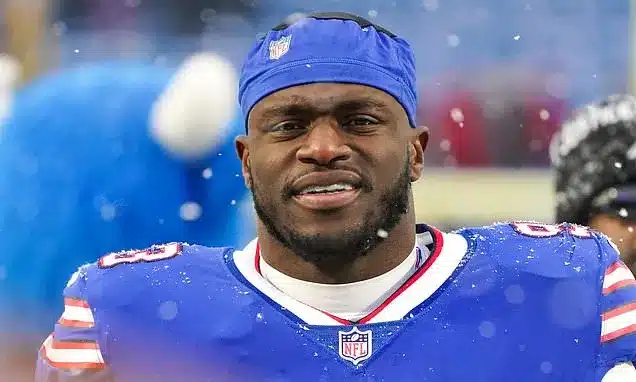
Efe Obada, the former NFL player whose journey began with a late entry into the sport and a challenging upbringing, has announced his retirement from professional football after a decade-long career. Obada, who played his first professional game at 22 for the London Warriors, is now dedicating his efforts to establishing a foundation aimed at supporting young people, particularly those who have experienced foster care.
An Unlikely Path to the NFL
Obada’s path to the NFL was far from conventional. Born in Nigeria, he was trafficked to the Netherlands to join his mother and sister before being brought to the UK by a stranger and left in East London. He and his sister subsequently entered the care of social services, who ensured they remained together and were placed with foster families in South London. These formative experiences, though difficult, have profoundly shaped his perspective and fueled his current philanthropic endeavors.
Reflecting on his time in foster care, Obada noted that while some placements were supportive, others were exploitative. He recounted instances where he and his sister were treated akin to domestic slaves by one family. Despite these hardships, Obada credits his life experiences with preparing him for the rigors of the NFL. “I feel like every experience that I’ve had has prepared me in some ways,” Obada explained. “Living in, being in foster care, living out of a suitcase, bouncing around from home to home and being uncomfortable in an environment. I had to adapt, have to people please or code switch, and that prepared me for the NFL because, you know I am in a very hostile environment.”
Transferable Skills from Foster Care to Football
The inherent instability and constant need for adaptation in foster care, Obada believes, provided him with a unique skillset transferable to the high-pressure world of professional football. The constant uncertainty of team rosters, where players can be cut or traded with little notice, mirrors the feeling of living out of a suitcase and moving between homes.
“Everybody is part of the team, but we are all independent contractors at the same time,” Obada stated. “So you’re very uncomfortable, someone’s always trying to come and get your job, sort of living in that fight or flight mode, so there’s some parallels in my upbringing in that regard. The lessons that I’ve learned from my life experience were definitely transferable when I got to the league. It helped me navigate that system and that would help me hold my own and carve out a career and a name for myself.”
Launching a Foundation as a ‘True Calling’
Obada has described the establishment of his new foundation as his “true calling,” a sentiment born from a desire to provide the support system he wished he had during his own youth. The foundation aims to create programs that resonate with and assist children in similar circumstances, particularly those in the foster care system.
“This has been like years, years in the making,” Obada shared. “I have been doing it unofficially my whole life, there is so much stuff that I do behind the scenes and, you know, I think that you shouldn’t promote your good deeds, just to keep them authentic and genuine. But this is something that holds very close to me and I want to be able to create a system and a programme that supports the kids that I resonate with, you know, being in foster care was huge, it shaped me.”
He expressed a deep commitment to helping these young individuals overcome barriers such as insecurity, low self-esteem, and a lack of identity. “I just want to support these kids, I want to show them that their life matters and that they can rewrite their lives and define their future. That they have a voice and they can fulfil their full potential and I want to be that thing that I wish I had. I want to be a system that I wish I had when I was coming out, it would have made my life easier.”
Obada highlighted the devastating consequences faced by many who lack adequate support, including drug addiction and unfulfilled potential. “You know, a lot of people get drug addictions to cope and end up dead because of the circumstances and situations, or never amount to their full potential, and I don’t want that. I don’t want that for the community I care about, don’t want that for the kids, because we all matter. We have so much potential, that is what I really believe and that’s why I want to do this.”
A New Chapter: Punditry and Role Modeling
Beyond his foundation work, Obada is also venturing into sports punditry, regularly appearing on Sky Sports’ NFL coverage. This transition marks another significant step in his remarkable life journey, from a trafficked child to an NFL player and now a media personality and philanthropist.
“Even with the TV thing, well one, I had to learn the whole game in the NFL and now I’m trying to transition to another space and learn and start all the way from the ground up,” he said. “But it is what it is, like I try to make the most of the opportunities and then develop and become the best version of the person that can survive and capitalise, I am very blessed and I am very grateful.”
Having achieved a level of success where his family’s needs are met, Obada’s focus has shifted entirely to giving back. He views his current position as an opportunity to uplift others, understanding the significant ripple effect that one person’s success can have. “It’s always about uplifting the next person because this one person who has achieved something, has been able to impact so many different people. So if I could do that for someone else, I just know that the knock-on effect is going to be huge, and then they will do that for someone else, and so on, and that is how to make real change.”
Retirement to Inspire Future Generations
Obada’s decision to retire from the NFL, while still healthy and energetic, underscores his commitment to his new mission. He aims to leverage his experiences and platform to inspire the next generation of British American football players and aspiring media professionals, demonstrating that a challenging past does not dictate a limited future.
“I think that just looking at how much I have accomplished, you know, what I’m trying to achieve and where I’m at right now in life, I just think I am ready to walk away from it,” Obada concluded. “You know and I am still healthy, and I still have a lot of energy and to be able to pour so much into that next chapter.”